
Become A Better Beekeeper
Click Here if you listened. We’d love to know what you think. There is even a spot for feedback! Read along below!
By: David Burns


Many beekeepers probably feel that raising queens is out of reach and best left for large-scale, commercial beekeepers with decades of experience. You might think that it requires a rolling hillside full of hundreds of cell builders and mating boxes to produce queens. This does exist and is how many of our queens are raised in big operations. Maybe you’ve concluded that raising queens is way beyond your reach. But don’t be intimidated. I hope this article will inspire and encourage you to raise at least one queen.
When I started beekeeping three decades ago there was no internet. Let that sink in. No internet means no YouTube, Facebook or Instagram. There was no way to send a text or a quick email to a fellow beekeeper for an answer. There were cell phones, but they had tiny screens, physical buttons, no apps, no internet, no cameras and minutes were expensive.
I wanted to learn as much as possible about beekeeping, but compared to today, educational opportunities, scientific papers, books, and classes were far less available. I poured myself into learning as much as I could and after trying hard for two or three years, looking back, I realized I had learned about forty percent of beekeeping. There was another forty percent I had never even considered. Learning to raise queens quickly doubled what I understood about beekeeping.
If you’ve never considered raising queens, be open to try it, not because I want you to start a huge queen rearing operation, but because of what the process teaches the beekeeper about beekeeping.
Some beekeepers are hesitant to try raising queens because of their eyesight or shaky hands or they feel they do not have enough hives. I’ve taught queen rearing for a long time and I assure you, you can overcome every obstacle. Even though I like using the starter/finisher Dolittle method, you can raise queens from just one hive using what is known as the Cloake board method.
When I started raising queens something big changed. I went from seeing my hives as strong or weak and started noticing timing, brood age, nutrition and populations. I started asking “why?” a lot more, which drove me to find the answers. If raising queens seems overwhelming, let me say that you have already been raising queens. Actually, your bees have and you’ve been observing it happen. You’ve witnessed swarm cells, supersedure and emergency cells. When I started raising queens, I realized that it was less about me creating queens and more about me providing a way for my bees to raise queens on my timing and in my boxes.
How Does It Benefit the Beekeeper?
Raising queens helps provide the beekeeper with queens from their best colonies. Queens raised from colonies that have already survived Winter and made you a great honey crop will give you a great advantage. Some of the traits you are most proud of will be passed down to the queens you raise. Also, you can learn to keep a few queens on hand in mating nucs available when you need them rather than waiting days, weeks or months on a new queen from an unknown or outside provider. Not to mention you will save money by raising your own queens. But what helped me the most was learning more about the colony and beekeeping overall. Raising queens made me a better beekeeper as I became more knowledgeable about the division of labor, timing and how to read frames of nutrition. I learned the importance of finding and moving bee bread, pollen, honey and nectar into my starter hive for my grafts. There is a moment when you realize you do not have to buy solutions, but you can raise your own.
Having the skill of raising queens can benefit you on a small scale when you only want a few queens on hand for your own needs. As time goes on you may be adventurous and raise your own queens for your Spring splits or Summer requeening. Or you may find it so enjoyable you raise queens to make a little extra cash to buy that extractor you’ve been wanting.
I recommend attending a queen rearing course that guides you through the entire process, from choosing which colony to graft from all the way to setting up the mating nuc.
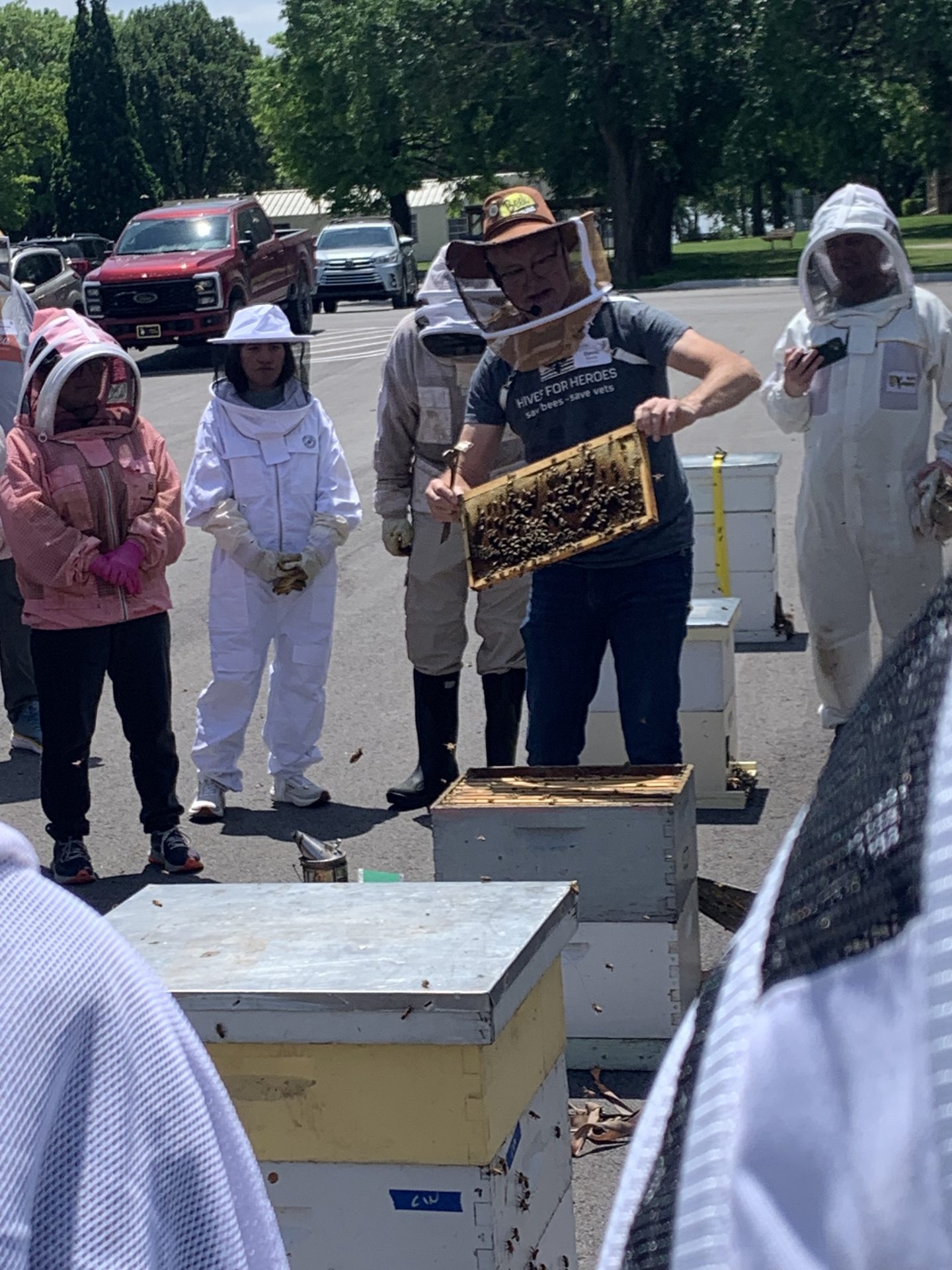
This year Dr. David Peck and I co-led a queen rearing course at the Northeastern Kansas Beekeepers Association in Lawrence, Kansas. We had forty, wonderful students mostly new to the idea of raising their own queens. Dr. Peck presented the science behind queen rearing, and I led the practical examples of grafting, setting up starter nucs (cell builders) and finishing hives in the field. We made a good team helping students to learn the biology of raising queens in the classroom and we then demonstrated the process, hands-on in the field. Students were excited to learn each step to raising their own queen. I was thrilled to see so many beekeepers excited about trying their hand at raising their own queens.
Raising your own queens is less about making queens and more about becoming the kind of beekeeper who understands how colonies reproduce, grow and thrive. I have many videos on YouTube to help walk you through the entire process of raising your own queens. Go to YouTube and search for David Burns raising queens.
If you’d like to dip your toes in the waters of queen rearing, you can download a free resource that Dr. Jon Zawislak and I have published through the University of Arkansas Division of Agriculture, Research & Extension, “Raising Quality Queens.” We’ve broken queen rearing down to simple steps and clear instructions. Follow this link: https://uaex.uada.edu/publications/pdf/mp518.pdf
Here’s a QR Code to access our queen rearing free download:

