
An Overview of Common Neophyte Beekeeper Questions and Issues
Click Here if you listened. We’d love to know what you think. There is even a spot for feedback! Read along below!
By: James E. Tew
Driving a car and keeping bees
Initiating and developing beekeeping skills is much like learning to drive a car. Few people are immediately accomplished drivers simply because they have been through a state licensing procedure. It takes years of time and innumerable instances of risks, bad weather experiences, mechanical problems, and the unpredictable actions of other erratic drivers, before a driver has “seen it all.”
Many state beekeeping groups are in the enviable situation of currently having large numbers of new beekeepers. A common concern of newer beekeepers is the sense that some seemingly obscure detail will be overlooked and their colonies will suffer because of that oversight. In essence, they are impatiently asking for all of life’s beekeeping experiences in short order. Beekeeping expertise- like automobile driving expertise – takes time and discipline. It you have recently installed packages or purchased your first hive; you should be experiencing the enjoyment of watching your new hives develop. The installation of package bees is a popular beekeeping “rite of passage” into the world of experienced beekeeping.
There are abundant sources of information that give beekeepers the correct way to perform various beekeeping tasks. In a perfect world, perfect information would be all that you should need, but alas problems do arise. Ironically, those instances when things don’t go right are more memorable that the unexciting episode when things went exactly the way they should. What follows are some examples of things not going exactly right.
One colony persists in being the runt of the litter.
It’s not uncommon for one hive to consistently be smaller than the others. Reasons are not always clear. Neither are the answers. Problems will probably be caused by drifting bee populations, defective queens, or diseases.
What are the characteristics of a runt colony?
It just does not build up as fast and its population is noticeably smaller than the population of your other colonies. The supers you added have not been used while they have in the other colonies. Upper hive parts are not propolized together allowing the hive parts to slip easily. Flight activity at the entrance is less intense than the activity at your other colonies. In general, the hive is not thriving at a time when it should be.
If bees appear to have drifted away from the weaker colony, its population should be equalized with your other stronger colonies. The weaker colony can be strengthened by adding brood or adult bees (or both) from other colonies. How much to add? It’s not a procedure that is easily quantified.
To add adult bees, select one of your colonies that is approximately 30% stronger than the weaker colony. One warm, clear day when the bees are actively flying, simply swap locations with each colony. The smaller colony gets the larger colony’s field force while the smaller field force will return to the larger colony. Giving both colonies a bit of smoke during the move would not hurt. From yet another colony take one or two frames of mostly capped brood and donate it to the weaker colony. In just a matter of minutes, the weaker colony will be dramatically stronger both in brood and adult bee populations. It would not be a bad idea to recage the weaker colony’s queen during this procedure to be certain the new foragers are not too hostile to her.
Yes, this works well and I have often used this procedure but there is a philosophy, to which I subscribe, that is your good colonies should not be pilfered to subsidize weaker colonies. It’s a classic beekeeper argument. Are you better off to manage both great colonies and weaker colonies when compared to managing all “good” colonies? Certainly, if you have more than one undersized colony, work with that subgroup to make good colonies – most likely by combining the weaker colonies to form stronger colonies. Ultimately, it’s your call.
Everything looked okay for a while but now I can’t find the queen or any eggs.
Even to experienced beekeepers, this situation can be troublesome. After natural queen replacement, (supersedure or swarming) there is a period before the new queen begins to lay when there is no sign of the queen. Additionally, there are no eggs or young larva that the bees could use to raise another queen. Much like a space capsule passing on the dark side of the moon, there is a period when there is no communication with the craft.
In a similar way, the beekeeper must wait for the new queen to mate and begin to produce eggs and begin to show her presence; therefore, coming out of the period of “queen darkness”. Occasionally, you may happen to see the elusive virgin queen, but she is difficult to find. She readily runs and is quick to hide, thus making her presence more difficult to determine. This waiting for the queen to show herself process should not go on much longer than ten days. As an insurance policy, take a frame of eggs and young larvae from another colony and place in the middle of the brood nest of the colony that is in need. Just one day later, the development of emergency queen cells will be obvious if there no queen within the colony. At that point, you must decide if you are going to order a new queen or let them produce their own. Remember that many weeks will pass before the colony-produced queen is creating worker offspring.
Shouldn’t these bees be making more honey right now?
Nectar flows are classic seasonal events. Some years the flow hits while in other years, it just never really materializes. The biggest reason that a nectar flow happens or does not happen is caused by the weather. Cold and rain does not make for a nectar flow while warm and sunny does. Now that you have these new colonies and the nectar flows are not developing, what should be done? If the colonies have no stores at all, you must feed them heavy syrup1 immediately. If the colonies ae light, but clearly have a few frames of scattered honey, you may just want to hold off for a while and continue to check them. Ironically, feeding a hungry colony inspires that colony to produce more brood – not to store the syrup as food for the future. In a way, the beekeeper has only made things worse.
The intensity of the Fall flow varies across the U.S. If you are in an area that has a good Fall flow from Goldenrod or other Fall flowers, you might just consider waiting until then to see if your colonies can put aside enough food to pass the Winter. But you will not have much time to feed your colonies if Winter comes on fast once the Fall season has begun. Give the situation your best guess.

Why won’t they take the syrup?
Now that you are finding that you need to feed, you discover that a few of the colonies just will not take the syrup or take it slowly. Yet other colonies are sucking it down faster than you can put it on. At this point, you might be wondering what else can happen.
At least two possible things are at play here. Either there is a natural flow on or the colonies in question are not learning to use the particular style feeder that you are using. You can tell the presence of a nectar flow by the presence of fresh nectar dripping on your shoes when you hold a frame sideways or by new white wax being produced throughout the colony. Most colonies will prefer to forage naturally rather than to take sugar syrup from a feeder. Not seeing those new wax features within the colony and not seeing an abundance of flowering plants in your community, you would probably then select the second common cause for not taking syrup – the bees are not using the feeder.
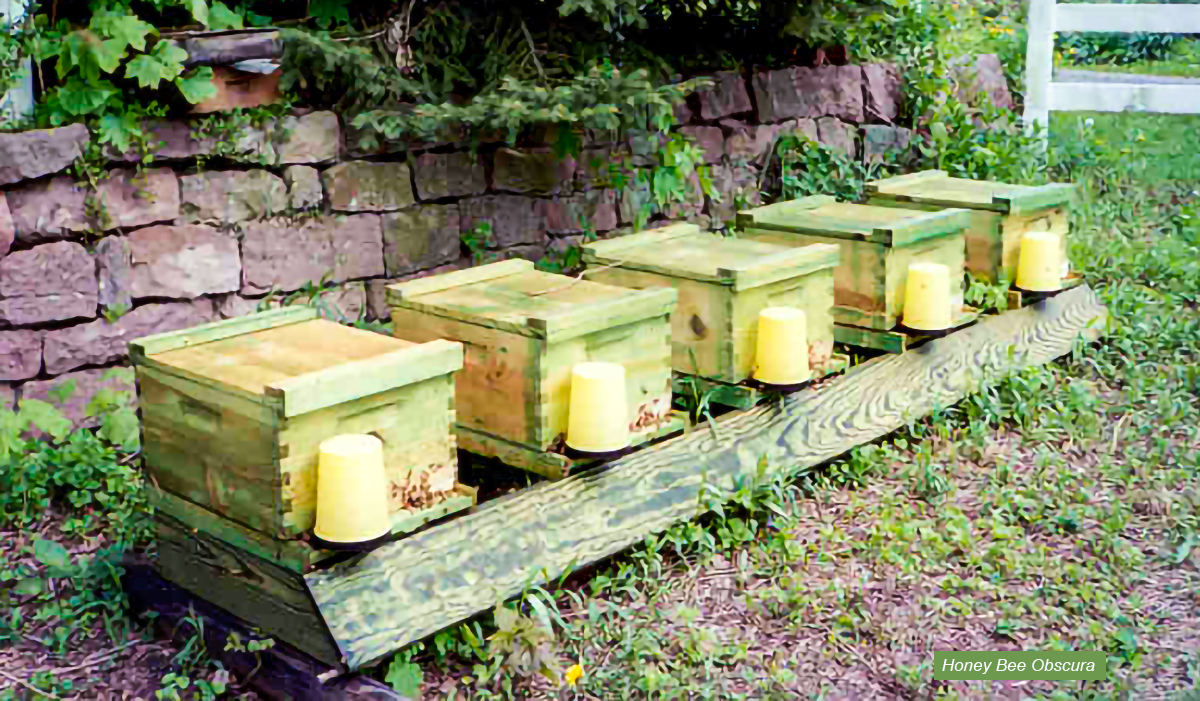
The common entrance feed (the Boardman Feeder) is frequently the feeder of choice for the new beekeeper, but it is not always readily accepted by the bees that are having to travel to the front of the colony to get the syrup. Consider removing the feed jar from the feeder at the entrance and put the jar over the inner cover hand hole. The put an empty super around the jar and close the colony. Bees tend to find and consume the syrup faster from such a feeder more quickly, but it won’t be as convenient for the beekeepers.
During times of feeding, some beekeepers drill holes in plywood board cut to the size of the brood chamber thereby improvising a flat board cover with a feeder jar-sized hole cut in it. The feed jar then just sits on top of the colony.
When do you stop feeding?
There is no clear end point. In the Spring, you might consider stopping if the colony has maybe two to five frames of processed syrup. All the sugar feed is really supposed to is get the light colony through a rainy spell. Otherwise, you must hope that they can find enough to live from day to day. (I usually stop feeding when I get tired of doing the chore.)
This yard is just not working out.
It sometimes happens that a new beekeeper feels that they have the perfect location, but it quickly works out that the location is anything but perfect. What to do? I must assume that the situation is bad enough that you feel you must move the colonies. The reasons can vary wildly. Irate neighbors, irate spouse, an angry Black Angus bull, or hives on a steep hillside. Maybe the yard is too far from the roadway or there is too much poison ivy. Obviously, these are all reasons that I have personally experienced or have heard from others. Regardless, sometimes the location simply did not work out.
Moving colony (relocating colonies) is an in-depth discussion all by itself. But the process of moving colonies is very nearly the same for one colony as it is for many colonies. For discussion, we will say that you have five colonies to move to different location that is eight miles away.
When the bees have stopped flying for the day, close the entrance with aluminum window screening. Vinyl screening does not work as well. It’s not rigid enough. Though several other procedures exist, (i.e. hive staples or wooden slats) for just five colonies, I would use ratchet straps. These common devices are now available at many locations. Using the straps, I would ratchet the colonies down. The strap must be tight or more than one strap should be used. Use occasional smoke. By now, it is nearly completely dark. Move quickly. Confined colonies can suffocate quickly. (I speak from experience.)
Also speaking from other experiences, if possible, have a human helper present. Even if the colony is in a single deep, if it has weight, a bee hive is clumsy to load. Have a good flashlight and try to maintain a good outlook on beekeeping. This is true work. Upon arriving at the new location, get the colonies off the truck quickly, and open them immediately. They could be testy at this time.
Other management procedures
Other procedures that add to the complexity of the event but make the outcome more assured should be discussed in more detail, but space limits what can be written. Upper screening would be a great idea. I would guess that if the weather is anything above 70F, top screening would be a valuable addition.
If the bees seem particularly upset, adding occasional water is certainly possible. Not too much, maybe a pint, as you feel they need it. You will not chill them, but you can certainly cause them to overheat.
A strange issue that is unusual is that in newish colonies, the bees have not had time to propolize the frames in place. During the move, these loose frames will bang against each other. I can’t say that great harm is done, but I suspect that it adds to the attitude problem that the colony has when the hive is opened. I don’t know of anything to be done about this.
Recaging the queen before the move is a great idea, but that procedure can be tricky. It takes time to find our hypothetical five queens, catch them, and then cage them. It also requires beekeeper skill. I would suspect that most of us, including me, are not planning to do this management process. For those who do this additional procedure, I would suggest leaving her caged for an additional day would not be a bad idea.


Now the hives are loaded.
Drive slowly and cringe at those times you hit a bump in the road. After you get the hives unloaded and opened, breathe sigh and head home. At this point, you can now begin to discover all the things that are wrong with this new location. Few yards are perfect. Indeed, I never had a perfect yard.
Right and wrong
Keeping bee colonies productively and enjoyably is not always about doing things right but is often about correcting things that went wrong. It’s all part of our craft. Ironically, it’s the things that go wrong that you remember the longest.
Thank you for reading and thinking. I enjoy talking about bees.
Dr. James E. Tew
Emeritus Faculty, Entomology
The Ohio State University
tewbee2@gmail.com
Host, Honey Bee
Obscura Podcast
www.honeybeeobscura.com

1 Heavy syrup is essentially hot tap water with granulated sugar mixed in (about 50/50 by volume). Even better would be water heated to nearly boiling with all the sugar the hot water can hold, but this is quite a bit of work.