
Click Here if you listened. We’d love to know what you think. There is even a spot for feedback! Read along below!
A Rare Apicultural Treat
By: Ross Conrad
Drawn comb is a valuable resource for both bees (as they will develop and expand their colony population faster) and beekeepers (resulting in larger honey harvests and more management options available). Regularly encouraging a colony to draw new comb also has the potential to reduce pathogen and pesticide residue buildup in hives when the new comb is used to replace older comb.
The regular replacement of old comb with new comb, whether built from foundation or naturally without foundation, has become a central pillar of my beekeeping management in this age of industrial chemical-based agriculture and global economics that regularly transports novel diseases to new locations around the world. Hives in my apiaries that are filled with comb less than five years old have consistently outperformed colonies housed on older combs in terms of annual survival.
In past articles, I have referred to the tendency of swarming bees that are engorged with honey prior to leaving their mother hive to be naturally primed for comb construction. When working with colonies that are not swarming, it is important to understand the resources a colony requires to build comb successfully, as well as what motivates bees to build comb in the first place.
Colony Health
Generally, a colony should be strong with a large population of bees in order to draw new comb. But even more important than a large population of workers, the colony needs to be healthy, with a fertile queen, in order to get serious about comb construction. Even if they are not exceptionally strong, healthy colonies tend to experience an increasing trajectory in their population growth. This results in a growing number of bees to attend to the work of building new comb.
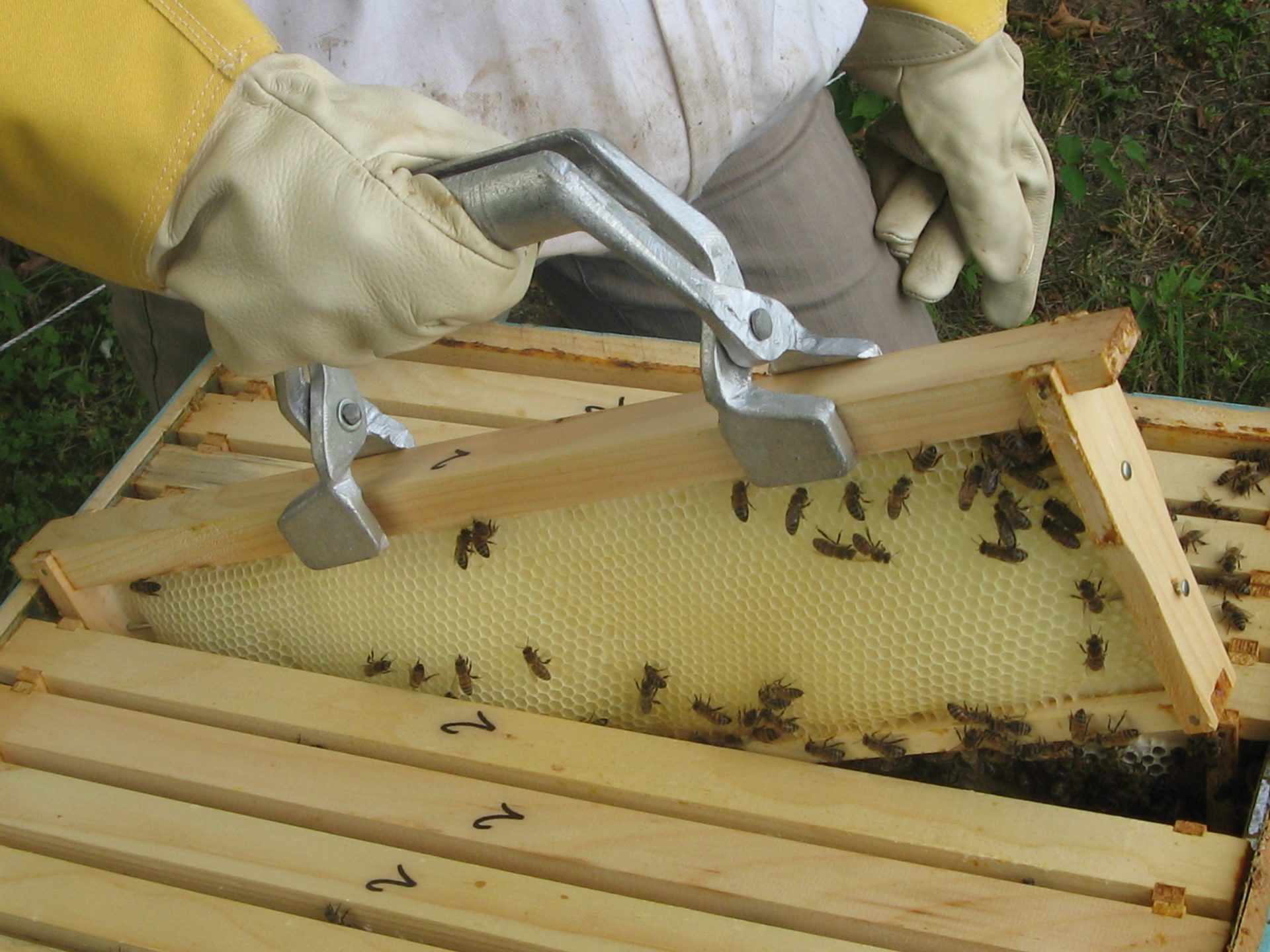
Each Spring, when I make up four-frame nucleus colonies for sale, and to replace hives I have lost over Winter, I fill the nuc box with two frames of eggs and brood, and one frame of honey from the donor colony and then add a frame of foundation. The frame of foundation is added to provide space for the nascent colony to continue to grow and expand while they raise a new queen. After 30 days, if the nuc was successful in raising a fertile queen naturally, the frame of foundation is almost always fully drawn out and filled by the bees. If the frame of foundation has not been drawn out, it usually means that that nuc failed to raise a new queen. This suggests that the small size of the nuc cavity, which allows the foundation to be positioned near the brood nest, is an important aspect of comb construction in such a situation. Honey bees time their population expansion to coincide with nectar flows. This is why when colonies are not very strong (such as in the case of a newly made nuc), the health of the colony is a critical aspect of comb construction.
Excess Carbohydrates
As mentioned previously, a large population of bees greatly aids efforts to build new comb. Lots of healthy bees translate into a large number of young wax producing bees and plenty of nectar being brought in by foragers when it’s available. Once the majority of existing comb has been filled with ripening nectar, additional nectar that is gathered is stored in the bee’s honey stomachs out of necessity. This stimulates the production of beeswax by the engorged bee’s four pairs of wax glands located on the underside of their abdomens. The wax producing bees are typically about two to three weeks of age and will gather in festoons. While newly emerged bees have not had time to develop their wax glands and the wax glands of older bees have atrophied, more mature bees can regress and return to wax production when necessary. Research also suggests that adequate protein in the form of pollen or bee bread is important for wax producing bees to do their work.
While there are numerous variables involved (such as the ambient temperature inside and outside the hive) that make it difficult to pinpoint the exact amount of honey a colony of bees will consume in order to produce one pound of beeswax, most experts estimate it to be in the neighborhood of about eight pounds.
Location, Location, Location
Colonies of bees appear to be encouraged to build comb faster when frames of foundation, or starter strips, are placed in the middle of the hive rather than next to the sides of the super. The open unused space in the middle of things created by the new foundation makes it harder for the bees to ignore compared to frames of foundation sitting on the outside edges of the hive body or super. This means that when making nucs and replacing the three frames of brood and honey I remove from a donor hive, the three replacement frames of foundation are positioned in or near the center of the brood nest.

I use the same logic when supering hives with foundation. It is generally easiest to get supers of foundation drawn out when there are no other supers on the hive. When dealing with supered hives, the best candidates for an empty super are those colonies that are already full, or almost full and have started building burr comb. In all instances, supers of foundation must be added just before, or in the early days of a major nectar flow, otherwise artificial feeding to simulate a nectar flow and stimulate comb building is required. Of course, honey supers intended for harvest should never be on a hive that is being fed sugar syrup to stimulate comb production, since the syrup will be stored in any empty or partially filled cells available in the honey supers and potentially in the new comb that is built.
Bottom-supering allows the beekeeper to place extra room for comb construction in or near the middle of the hive. When bottom-supering, a super of foundation is placed below one or more full honey supers that are sitting above the brood nest. Again, the theory is that since the additional space is in or near the middle of the hive, the colony will draw out the foundation and fill it faster than if it is placed above the full supers of honey (top-supering).
It is not that obvious that bottom-supering actually results in new comb being drawn out faster than with top-supering. There is some indication from research that this may be the case however. Jennifer Berry and Keith Delaplane of the University of Georgia published a paper (American Bee Journal May 2000, pgs. 409-410) that looked at differences in honey yield between top- and bottom-supering. Every colony in the trial was balanced in terms of frames of brood, bee population and amount of preexisting food stores. The study found about a 10 percent increase in honey stored, but concluded that due to the relatively small scale of the trial, there was no statistical difference in the amount of honey stored between the two supering techniques. The study did not look specifically at the speed with which the new comb was built, but the slight increase in bottom-supered honey production suggests that the bottom-supered hives may have built their comb faster than the top-supered hives.
What might explain this?
So what explains the potential increased comb construction speed that positioning new frames in the middle of the hive or brood nest may have over frames placed on top of the hive or on the sides of the brood nest?
As indicated previously, one possible variable is that the frames located in the middle of, or immediately above, the brood nest break up the hive organization the colony has painstakingly created and is harder for the bees to ignore. Therefore the bees are likely to attend to comb production sooner.

Another possible explanation is that new foundation placed in or near the brood nest may benefit from the warmer hive temperatures in that part of the hive. This has the potential to help the bees build new foundation a bit faster especially during periods of cool weather that force the bees to cluster in the brood area. In order to easily shape the wax and get the cells of the comb to take on their familiar hexagon shape, the wax producing bees need to work in an environment with elevated temperatures. As any beekeeper that has worked with beeswax knows, wax is much easier to work with when it’s warm. In this case, extra heat from the brood nest has the potential to translate into faster comb construction.

Space Requirements
When all the existing combs in a hive are full of honey, pollen, bee bread and brood, new comb will be built as long as there is space available for comb construction in the hive cavity. A lack of available space for new comb will result in the brood nest becoming honey bound and lots of burr comb being constructed between the bottom bars and top bars in the hive.
Size Matters
Comb honey producers have long used the technique of reducing the size of the hive cavity in order to create the congestion (lack of space) required in the hive to stimulate comb construction. This is typically accomplished by removing all of the supers and forcing the colony into a single deep box separated from a comb honey super by a queen excluder just as a major nectar flow is starting.
Additional supers of comb honey foundation are typically added by bottom–supering so that the workers do not have to walk across the cappings of the already filled supers in order to work on the new foundation. This helps to keep the existing cappings on the completed comb honey pristine and white. It’s amazing how stained cappings can get when hundreds of thousands of little feet travel up and down them as they unload their cargo in top-supered colonies.
Go with the Flow
During a strong nectar flow, if a colony runs out of space within the hive and becomes honey bound, the bees will prepare to swarm. As a result, swarm prevention has long been one of the primary challenges comb producers face when producing comb honey.
Along with placing supers of foundation on the hive too late and experiencing a swarm, problems may also arise if supers of foundation are placed on hives too soon. Supering too far ahead of a nectar flow with foundation may result in colonies chewing up the edges of the foundation.
No matter how you slice it, getting new comb drawn out is not an easy proposition. From the extra work and expense of preparing new frames of foundation each year, to sacrificing some honey production in order to stimulate comb production, getting new comb built is a lot of effort and work on the part of both the beekeeper and the bees. The benefit however is that the beekeeper, ends up with a lot of extra beeswax to harvest from the old combs and healthier hives that are more likely to survive Winter.
