
Click Here if you listened. We’d love to know what you think. There is even a spot for feedback! Read along below!
It is enjoyable and easy
By: James E. Tew
A handy colony
inspection procedure
Through the years, as I have increasingly become an older beekeeper, I have grown in my support of the concept of “leaving the bees alone as much as possible.” That is actually probably good advice but it just so happens that I am not always eager to remove deeps of honey to see how the brood nest looks. But I love the bees, so almost every day, I go to my apiary and have a look to see what’s going on at the hive entrance.
But I need to write that opening a colony is appropriate if you are a new beekeeper who is still learning or if there are specific reasons. While I enjoy the detective work required to predict the colony’s state, I will readily open the hive if I sense there is a need.
What should I be looking for?
Right now, for me, it’s June. For most of us, the Spring crop season is fading, but our colonies are at full strength. What should my hive front look like? I would suggest looking for the following characteristics.
The typical activities at
the hive front
- Intensive, busy flight at the entrance, but not frantic flight.
- A clean landing board and, for the most part, a clean ground in front of the hive.
- As a part of #2, certainly, no mound of dead bees indicating insecticide exposure.
- No indication of robbing or fighting with other insects such as yellowjackets.
- No indication of skunk or raccoon predation or attacks by any other animal.
- No crawling bees with deformed wings, chalkbrood mummies or other indications of disease.
- A few healthy drones may be on the landing board.
- During the nectar flow, there will be a delicate floral odor in the air, but during goldenrod bloom time, the apiary will take on a weedy odor that I have grown to like.

Limited flight at the hive entrance. Not good.
Clearly, weak flight at the hive entrance on a warm day is not a good sign. This time of the year, bees should be everywhere. This observation will require opening the hive to determine what has gone wrong. Queen loss, laying workers, pesticide exposure, or diseases are the most common reason for a hive to fail. There is no outward indication of pesticide damage so I will have to open this hive up to determine what screwed up. This is an easy call. This hive needs help or it will not survive the upcoming Winter.
Swarm-like activity at the entrance of the colony
Through the years and several times this year, I have observed significant amounts of flight at the colony entrances. Just today – a warm day with late morning thundershowers – ALL of my hives had bees pouring from them. I could have thought that I had swarms issuing from every colony. These bees are gentle and many are scenting. Drones are in the mix. This looks like swarming, but it is not. In an hour or so, all returns to normal. I don’t know what the bees are doing, but I no longer go right to swarming or orientation flights.

Chalkbrood mummies in front of the hive.
Chalkbrood mummies on the landing board is a clear indicator of this disease. There is no reason to drop everything and panic, but colonies with this malady will probably not thrive. Without question, requeening, at some time, should be considered, but again, no real hurry. There is no chemical control for this disease that I should administer. It has rained a lot this season. Chalkbrood is a fungal disease. Did that help this disease thrive? Maybe once the afflicted colony dries a bit, things will recover in this afflicted hive – or not. I don’t know. But at this moment, I do know that the bees within colonies like this are susceptible to Chalkbrood while the remaining hives are not. Either way, these colonies need a new queen before Winter.

Generally, good features but hive garbage on the ground.
“Let the bees clean it out” is a common comment from beekeepers when putting on equipment that needs cleaning. Actually, I too have given colonies cruddy equipment at times. Sometimes it’s all that I had. They really can do a better job than me at cleaning things up.
So, if all else seems proper, good flight, no robbing, clean landing board, I suspect the hive detritus on the ground is probably okay. Bees are just refurbishing equipment for use that had some messiness about it. This refuse is primarily a mix of old comb cappings, wax moth litter and dead bees. Strangely, some colonies will make a great effort to move hive garbage farther away from the hive and keep everything much neater. Other bees dump it at the hive front and call it done.
Cappings removal – a healthy mess.
When compared to the dark, contaminated clutter described previously, the hive front mess looks better, in a manner of speaking, when bees are cleaning supers for reuse.
As beekeepers uncap, comb and cells are damaged and broken. Plus, wax fragments are abound within the extracted super. When this equipment is given back to bees, they go over it and restore it to appropriate bee standards. I suspect this remodeling happens in two phases.
At first, before bees need space, they are simply inspecting the newly added supers to garner any remaining honey fragments. No doubt, this activity results in some hive front litter. Later, as space is needed, serious reconstruction occurs as cells are reformed and combs strengthened. At this point, even more hive front litter is accumulated. Either way, I count this type of hive front detritus as a good sign. Bees are cleaning things and getting ready to store honey.
Robbing behavior
In my “Hive Front Features” list, do you remember that I said the bee flight activity should be energetic but not frantic? Frenzied flight combined with aggressive fighting would indicate a robbing situation. Once the defenses of the hive being attacked are overcome, robber bees will loot the hive’s honey resulting in a significant pile of cappings at the hive entrance.
If you have recently put on supers of drawn comb, you can expect some capping piled out front. If you have not recently put on equipment and there are piles of cappings out front, you should suspect robbing.
Bee color at the hive entrance.
Essentially, the color of bees milling about the entrance means very little, but it is an obvious feature of the hive front. If you historically had one color and notice that bees on the landing board are not the color they should be, I suppose you could suspect that your queen has been replaced, but not much more could be surmised without opening the hive. I notice the mix of individual bee colors, but I don’t make much of it.
Pollen Collectors
While I am not always sure if a returning bee is a nectar collector or just a returning bee, I can clearly pick out the pollen collectors. In this case, color is useful. Over the passing years, you will most likely determine the ability to tell what floral sources are producing pollen. I always enjoy watching the pollen collectors return. They are heavily loaded and are generally “all business” and rushing to get back to the source.

The number of returning pollen collectors varies greatly. Naturally, this collection behavior is seasonally influenced. I particularly enjoy those days when the pollen flow is heavy. Each pollen load represents a new future baby bee.
Ventilating bees on the landing board.
During this time of the year, a few bees will commonly ventilate at the hive entrance. Ventilating bees will put their rear ends in the air and furiously fan their wings. Look closely – in fact – very closely. If you can see a membranous area right at the sting end of the bee, that particular bee is scenting to other bees using her Nasanov gland. If the bee is not exposing her membranous area, she is an air-conditioning bee and is simply circulating air. I suppose one bee could be doing both, but most times she will be doing one job or the other.
A hot hive.
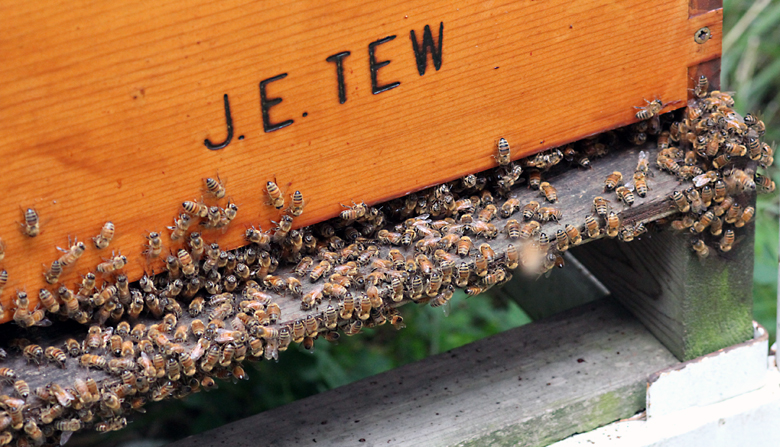
Before you even switch off your truck in the beeyard, you can tell this kind of colony needs more space. Bees matting out front are a clear indicator that things are either too hot or too crowded – or both – within the hive. In some instances, there is no great harm in the bees clustering out front. If your nectar flow has already passed, I suppose you could still put on some supers to give the bees a place to cluster, but you have already missed some of the crop. But if the ambient temperature is high, the bees may still choose to cluster out front as a way to control internal temperature whether or not you give them space.
I am uncomfortable with categorically leaving bees clustered out front – even though I have told you that no great harm comes to pass. However, if my colonies are in a crowded neighborhood (two of mine are), I don’t want the spectacle of thousands of bees hanging on the hive front to unnerve my tolerant neighbors. Plus, I don’t like for the occasional thunderstorm downpour to drench my bees hanging on out front. So, while no great harm is done if the nectar flow has passed, some assistance administered would be helpful to a crowded hive.

Wash boarding behavior
From mid-Summer on through Fall, bees will occasionally gather outside the colony and rhythmically move back and forth. The behavior is puzzling. Many beekeepers feel that propolis is being applied, but I do not see propolis-bearing bees in the vicinity. Generally, a wash boarding hive is healthy and productive. Last season, a particular hive was really pumped up about this labor.
Landscaping bees
I have described these bees in past BC articles. Generally, there are only about six to eight of these bees that seemingly have been assigned a tough task. They seem committed to clearing grass and litter from the hive front – but these are not the bees that remove dead bees from the colony and drop to the ground. These housecleaning bees work tirelessly at the colony entrance, struggling to get airborne with a load of trash or to clip grass.
Propolis workers
Commonly, workers can be seen manipulating propolis as though they were working wet cement. Sometimes they will be working in groups in a general area while at other times; they work alone on some self-assigned project. This group seems to be a particularly hard-working squad.
Apiary odors
Obviously, there is no way to provide a photo or video that distributes apiary odors. A healthy beehive has an odor that can be detected throughout the apiary. That seems odd at first glance. One use of propolis is to disguise the colony entrance yet the entire area is permeated with essence of beehive. Many mammals – including humans – would eagerly use that clue to rob the colony’s storage larder. But on the other hand, the blossoms are frequently perfumed to help the bees find the nectar reward. I suppose it carries over that pounds and pounds of concentrated flower nectar would have also had the odor of the floral source. For whatever reason, a healthy beehive with a honey reserve normally has a very pleasant odor.

Sooner or later.
You can only put it off so long. Sooner or later, you will need to actually open your hives. But on those afternoons when all is right with the world, just having a look at the entrance activity can give you a dependable appraisal of the colony’s condition – without having to fire up the smoker and suit up, plus I don’t have to work so hard.
Dr. James E. Tew
Emeritus Faculty, Entomology
The Ohio State University
tewbee2@gmail.com
Co-Host, Honey Bee Obscura Podcast
www.honeybeeobscura.com
