
Click Here if you listened. We’d love to know what you think. There is even a spot for feedback! Read along below!
By: Stephen Bishop

My dad is not a beekeeper, but that has never precluded him from odd behavior. One of my earliest memories is of my dad trapping a honey bee under a mason jar while it worked a clover flower. I was probably four or five. I’m not sure why he did this. Perhaps he was trying to impress his offspring with an act of bravery. Perhaps he was just strange. I must have had some understanding that bees could inflict pain and shouldn’t be trifled with because I remember the acute sense of fear I had that the annoyed bee, ricocheting around walls of the jar, might target me once freed from captivity.
Many decades later, I am still well acquainted with that acute sense of fear. It still hits me occasionally whenever I lift the top of a hive, especially when the bees are riled up and I am not armored in adequate personal protective equipment. And over the years, I’ve also had a couple of demonic hives that were so mean I felt an acute sense of fear even when armored up.
It always amazes me to watch beekeepers work bees with absolutely no protective gear. There are several beekeepers on YouTube who do this. With millions of views of her videos, perhaps the most famous is Erika Thompson who does cut outs without any protective gear. Usually, when I do cut outs, the greater area surrounding the cut out resembles a war zone, with ruin and rubble, with bees repeatedly strafing me.
I remember the first cut out I ever did. I was so naive I did it for free—no need for payment, I thought, since I would get some economic value from saving the bees. About three hours into the cut-out, it felt like somebody needed to save me. The bees were in a dormer above a second story window, and the only way to get to the bees was from the inside. Best I could tell, the bees did not want to be saved. Most were suicidal. Many hours later, when I finally finished liberating the bees from the dormer wall, the homeowner felt so bad for me that she actually wrote a $100 check for my services in pity. Of course, she probably wouldn’t have done that had she seen the aftermath, but I did give her the name of a good carpenter and quickly packed up my gear and skedaddled. I think if I made a YouTube video of that occasion it would probably have a lot of views too, but for entirely different reasons.
Randy Oliver takes it a step further and has a video in which he works bees without protective gear, in shorts and no shirt. What I believe both Randy and Erika share is a monkish equanimity while working bees—that, or a desire to be reincarnated as a pin cushion. If I ever worked up the courage to work hives sans a veil, in my shorts and with no shirt on, I would be trembling more than a congealed salad on a Baptist Homecoming Sunday.
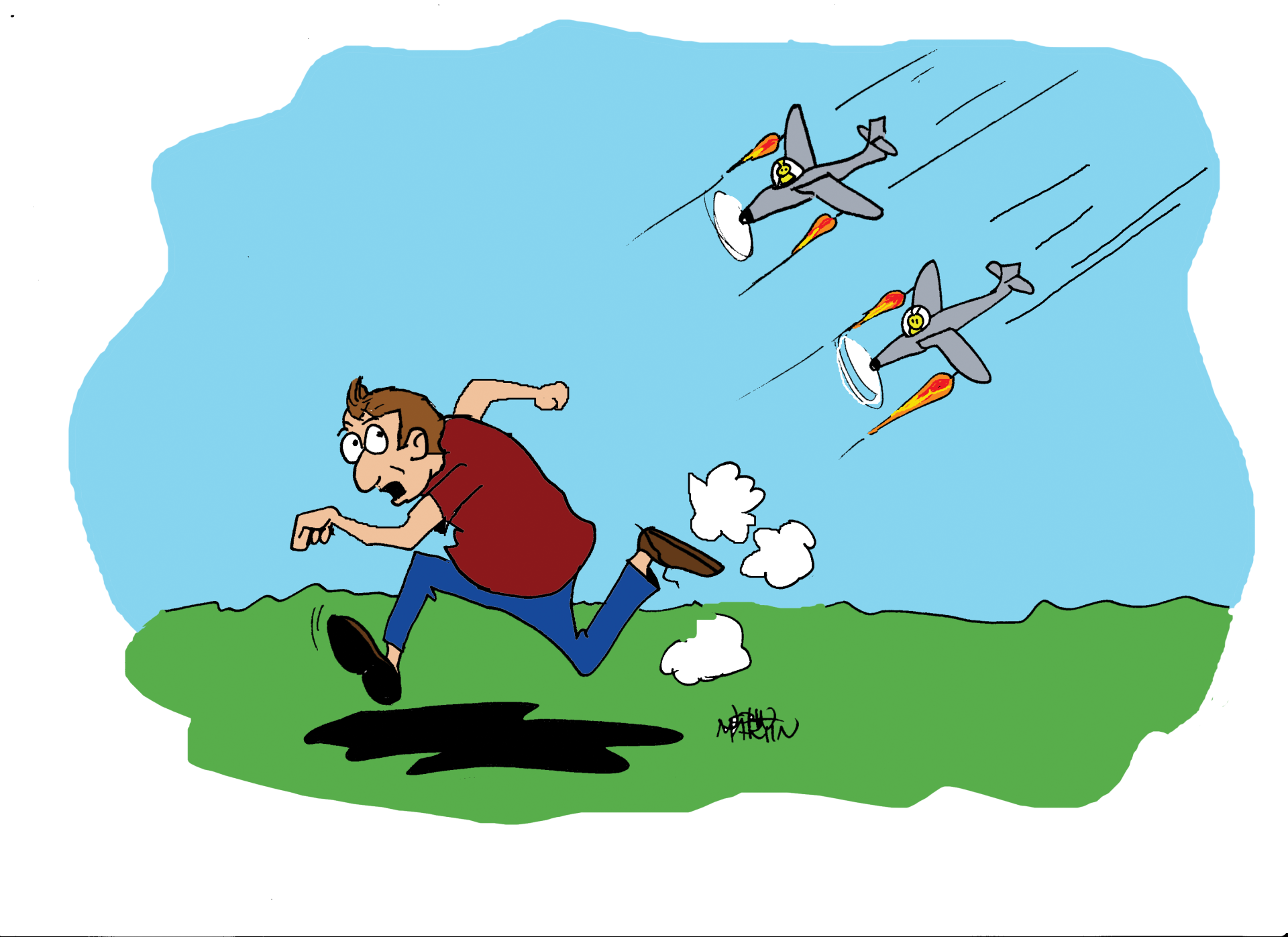
The problem, as far I can tell, is that I am not brave. The closest I get to bravery is during the Spring, when the bees are happy and honey is flowing, when sometimes the only protective gear I wear is a veil, a t-shirt and jeans. That said, one time while beekeeping I got down to my skimpies because a task force of bees from a demon hive infiltrated a hole in my jeans. Granted, by that time, I had set the land-speed record and was a half-mile from the hives. Of course, the problem with running with bees inside your clothing is that the bees run with you—hence, the trail of clothing marking the route of my successful land-speed record.
Just remember, in beekeeping, it is sometimes advisable to live to fight another day bravely running away. Likely no one will ever know about it unless you write an article about it or stream it on YouTube.
