
Click Here if you listened. We’d love to know what you think. There is even a spot for feedback! Read along below!
Choosing the Best Colony Spacing
By: Ross Conrad


Feral honey bee research conducted by Cornell’s Tom Seeley on bees living in the Arnot Forest near Ithaca, New York suggests that wild colonies prefer to space themselves out. Seeley’s observations found Arnot Forest hives coexist at a density of about 2.5 colonies per square mile (or roughly 1 kilometer apart). The average distance between colonies was found to be about 875 yards (about the length of 9 football fields). Seeley’s work built upon previous research he conducted that suggested bees preferred nesting sites that were more than 985 feet (300 meters) from the parent colony (Seeley & Morse, 1978).
Today some beekeepers refer to this research to support claims that bees do best when spread out. Naturally-minded beekeepers often promote the importance of spacing colonies widely in order to mimic the natural dispersal that has been found in the wild.
Naturally spaced colonies
There are many explanations why the honey bee’s natural instinct, or genetic determination, might lead to widely dispersed colonies.
Spacing out hives reduces competition with other colonies for nectar and pollen. Also, the greater the distance between colonies the less competition for the tree resins required for propolis production as well as water needs.
Generally, optimal conditions for colony survival are said to be associated with greater distances between nesting sites since widely dispersed colonies are less likely to spread pathogens and parasites between hives. Increased hive distances are associated with decreased robbing pressure from competing colonies and less drifting of bees between hives, both of which reduces the risk of disease and mite transmission (Seeley & Smith, 2015).
Studies such as those mentioned above suggest that swarming bees prefer nesting site’s far from their original hive location and other existing colonies. However, whether swarms of honey bees purposely seek out new nesting sites that are far from their parent hive and other colonies in the area is difficult to establish. Not only is the science on this subject limited, bees themselves are highly variable. Thus, the spacing of honey bee hives such as those found in the Arnot forest could simply be a result of the natural spacing of tree cavities favorable to honey bee colonization, rather than any intentional action on the part of swarming bees.
Additionally, there have been numerous reports from beekeepers discovering swarms that move into empty bee equipment located within a dozen feet of other occupied bee hives in an apiary. Would this observation be so common if the honey bee was genetically, or instinctually predisposed to establish nests far from other hives?
A 2023 review of wild honey bee densities from around the globe indicates colony spacing is variable, depending on the number and quality of available nesting cavities, the mean annual temperature range and the net primary productivity of the region. (Visick & Ratnieks, 2023) Meanwhile, indirect measures of wild colony density are reported to be lower in agricultural areas compared to natural habitats (Hinson et al., 2015; Jaffé et al., 2010). This is potentially due to fewer available nesting sites in agricultural areas. Thus, after accounting for the carrying capacity of an area, there does not appear to be any natural inclination for colonies to space themselves a specific distance from one another. Bees seemingly occupy a region to whatever level the area is able to support.
How close is too close?
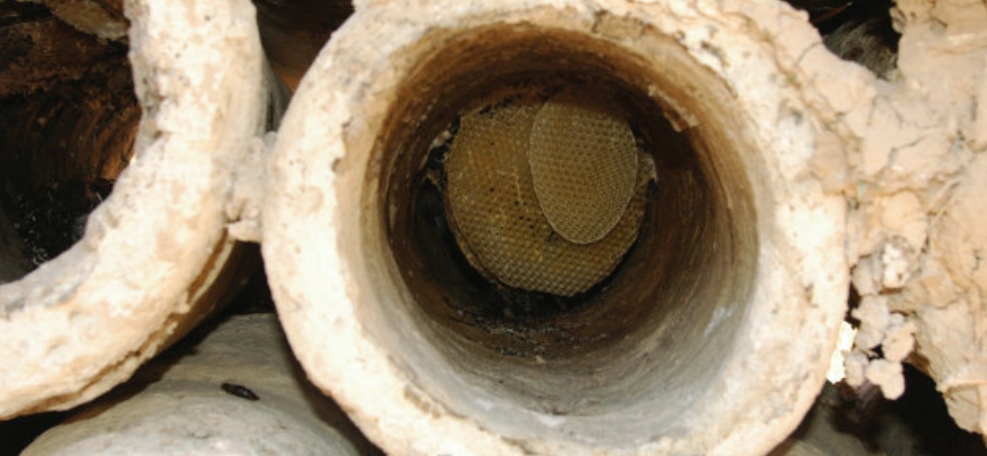
Ancient archeological excavations have revealed what appear to be commercial scale apiaries established some four-to-five thousand years ago. Like cells of the honey comb that are designed to maximize the amount of honey stored within the minimum amount of space, these apiaries were found to be composed of dozens, if not hundreds, of long cylindrical clay hives stacked next to and on top of each other. A removable cover on the end of the cylinder opposite the hive entrance used by the bees, allowed beekeepers easy access to the inside of the hive. While modern commercial beekeepers typically don’t maintain hives that are quite so close together, we do keep bees in fairly densely stocked bee yards.
Ultimately the bees don’t seem to really care if their hive is next to, or distant from neighboring colonies. Any adequately sized cavity with a small entrance that is surrounded by plenty of forage, water and tree resin sources seems to fit the bill. Beekeepers can help reduce incidences of bees drifting between hives by painting the hives a variety of colors, painting unique designs by the entrances of each hive, and/or by varying the orientation of hives so entrances are not all facing the same way.
The bees needs
A primary consideration on the part of the beekeeper is the amount of forage in the form of food (pollen and nectar) that is available in the area surrounding a hive. The greater the number of established hives in an area, the larger the amount of forage needed to adequately feed and maintain the colonies, especially if the bees are in managed hives that are expected to produce harvestable honey for the beekeeper in addition to sustaining themselves throughout the season.
When not artificially propped up by beekeepers, nature will limit the number of hives in regions that have reduced forage availability. Colonies that are unable to store enough food to see them through the annual dearth of the locality, will die out reducing the area’s density of honey bee colonies. In this way a natural balance of colony numbers and available forage can be expected to establish and maintain itself over time.
This natural regulation of colony density that occurs within feral populations appears to apply to colonies even when they are under pressure from parasites. Three surveys over the course of more than 30 years in the Arnot Forest of western New York State (1978, 2002, and 2011) indicate that despite the introduction of the varroa mite in the 1990s, feral colony densities in the area remained substantially unchanged. (Visscher & Seeley, 1982; Seeley, 2007; Seeley et al., 2015)
Similarly, in two surveys conducted between 1991-to-2001 and after 2013 following the invasion of Africanized bees in the Welder Wildlife Refuge in Texas, found that feral colony densities remained high more than a decade after the invasion. (Rangel et al., 2016) By showing that wild populations of honey bees can remain stable over long periods, despite significant changes in the bees themselves, these studies appear to support the theory that the carrying capacity of the land is the primary determinator of the density of honey bee colonies in a given area.
Beekeeper concerns
The distance between colonies in areas with managed hives appears to have more to do with the preferences of beekeepers than of the bees themselves. A major consideration for today’s commercially oriented beekeeper is the amount of time and energy spent inspecting, manipulating and maintaining hives. Apiaries with many colonies in close proximity to one another are simply more convenient and efficient for beekeepers to manage.
Unlike ancient Egyptian hives that featured a relatively small cover that had to be removed, modern hives with their various lids and frames of one kind or another, require more room for the beekeeper to work. As a result, colonies are typically kept with a minimum of 3-to-4 feet of open space on at least two sides of the hive to provide the necessary room to efficiently work colonies, move equipment around and keep vegetation trimmed and mowed around the hives. Maintaining a few feet between hives can also help to reduce the risk of agitating adjacent colonies during inspections.
The pest and disease issue
Another colony spacing concern that beekeepers are wise to consider are the impacts of pests and diseases. Parasites and pathogens have the potential to be more of an issue among managed colonies that are maintained in large apiaries where hives are crowded together in much higher densities than normally found in the wild.
When colonies live side by side in managed apiaries, parasites and diseases are more likely to be transmitted horizontally through drifting and robbing behaviors. Widely dispersed colonies are more likely to transmit pests and pathogens vertically through swarming from parent colony to offspring. (Pfeiffer and Crailsheim, 1998)
It is theorized that colonies living under dispersed conditions are more likely to develop less deadly pests and diseases. This is because the vertical mode of parasite and pathogen transmission (swarming) only occurs in hives that are healthy enough to reproduce. The theory predicts that over time this generally should select for host-parasite relationships that are more benign. Therefore, when honey bee colonies live under natural conditions, it is possible that their parasites and pathogens will be selected to be less virulent, enabling the bees to stay healthy enough to produce swarms necessary to transmit the parasites and pathogens to new colonies. (Fries and Camazine, 2001) On the other hand, the only way for beekeepers to breed bees that are disease and pest resistant is through intensive management and not under what is considered more natural conditions.
Despite the additional pressure from pests and diseases spreading through robbing and drifting, healthy managed colony densities can be maintained through timely and conscientious beekeeper management. When pests and diseases are kept in check, the beekeeper benefits in many ways from the close spacing of hives. At the same time beekeepers will also use widely spaced colonies as part of their management plan, such as when they establish isolated mating yards or quarantine yards for sick hives.
So how close is too close when it comes to honey bees? There can be good reasons for both high and low-density operations. This is why in practice we can find beekeepers using all types of colony densities, close and distant. No single practice is clearly preferable in all situations. Each has its own pluses and minuses. It appears that in the end, the best distance to maintain between colonies is a personal decision on the part of the beekeeper.
References:
Fries, I., Camazine, S. (2001) Implications of horizontal and vertical pathogen transmission for honey bee epidemiology, Apidologie, 32 (3): 199-214
DOI: https://doi.org/10.1051/apido:2001122
Hinson, E. M., Duncan, M., Lim, J., Arundel, J., & Oldroyd, B. P. (2015). The density of feral honey bee (Apis mellifera) colonies in South East Australia is greater in undisturbed than in disturbed habitats. Apidologie, 46(3), 403–413. https://doi.org/10.1007/s13592-014-0334-x
Jaffé, R., Dietemann, V., Allsopp, M.H., Costa, C., Crewe, R.M., Dall’Olio, R., De La Rúa, P., El-Niweiri, M. A. A., Fries, I., Kezic, N., Meusel, M. S., Paxton, R. J., Shaibi, T., Stolle, E., Moritz, R. F. A. (2010), Estimating the Density of Honeybee Colonies across Their Natural Range to Fill the Gap in Pollinator Decline Censuses. Conservation Biology, 24: 583-593. https://doi.org/10.1111/j.1523-1739.2009.01331.x
Pfeiffer, K., Crailsheim, K. (1998) Drifting of honeybees. Insectes soc. (45) 151–167 https://doi.org/10.1007/s000400050076
Rangel, J., Giresi, M., Pinto, M.A., Baum, K.A., Rubink, W.L., Coulson, R.N., Johnston, J.S. (2016) Africanization of a feral honey bee (Apis mellifera) population in South Texas: does a decade make a difference?, Ecology and Evolution, 6(7): DOI: 10.1002/ece3.1974
Seeley, T.D., Morse, R.A. (1978) Nest site selection by the honey bee, Apis meliffera, Insectes Sociaux, 25.4: 323-337
Seeley, T.D. (2007) Honey bees of the Arnot Forest: a population of feral colonies persisting with Varroa destructor in the northeastern United States, Apidologie 38(1): 19-29
Seeley, T.D., Smith, M.L. (2015) Crowding honeybee colonies in apiaries can increase their vulnerability to the deadly ectoparasite Varroa destructor, Apidologie 46, 716-727
Seeley, T.D., Tarpy, D.R., Griffin, S.R., Carcione, A., Delaney, D.A. (2015) A survivor population of wild colonies of European honeybees in the northeastern United States: investigating its genetic structure. Apidologie 46, 654–666. https://doi.org/10.1007/s13592-015-0355-0
Visick, O.D., Ratnieks, F.L.W. (2023) Density of wild honey bee, Apis mellifera, colonies worldwide: A Review, Ecology and Evolution, 13:10 https://doi.org/10.1002/ece3.10609
Visscher, P.K. & Seeley, T.D. (1982) Foraging strategy of honey bee colonies in a temperate deciduous forest, Ecology: 63(6):1790-1801 https://doi.org/10.2307/1940121
