
By: Becky Masterman
Click Here if you listened. We’d love to know what you think. There is even a spot for feedback! Read along below!
Honey Production
Behind every bumper honey crop is a nectar flow. Some call it a honey flow. Frank Pellett, author of American Honey Plants, summarized honey production as being “dependent upon a few species which yield nectar abundantly and which are sufficiently common to enable the bees to secure honey in large quantity.” When these key species flower, it is time to add honey supers to your colonies.
When a healthy colony with access to great habitat makes honey, yields can be dazzling.
Colonies need a strong population of foraging age workers to take advantage of a major nectar flow. An experienced beekeeper boosts brood production in wintered colonies by providing supplemental nutrition. They time their splits and new queen introductions to ensure colonies are ready for honey production. They encourage a large foraging force to take advantage of the copious amounts of nectar available during the flow. And swarm prevention counts. If your colony swarms, the population and honey stores are reduced. You also lose valuable foragers who know the landscape and could have contributed to your honey crop.
Honey Production Highs
The current state-reported honey yield per colony numbers dazzle a bit less than in the past. Historical U.S. honey records document some U.S. states reporting average honey crop yields of over 100 lb. One 1967 report listed the top average state yields per colony of 105 lb (Wisconsin), 104 lb (Iowa), and 112 lb (South Dakota) lb (Harper and Calkins, 1967). Almost 60 years later in 2024, USDA National Agricultural Statistics Service data show the average yields for these three states were reported to be 44 lb (WI), 67 lb (IA), and 63 lb (SD).
Although honey crop yields per colony averages have dropped dramatically, a well-positioned apiary in the US can still average well over 100 lb of honey per colony in a season. Declining yields would suggest that honey production isn’t what it used to be, but beekeepers are well served by knowing what the historic and current average crop yields are in their region. If your average honey yields are below average, explore the reasons why. It might be management related or location. Enhancing habitat if you have enough land or moving an apiary just a few miles can make a difference in honey production.

Nectar Flow Knowledge
More importantly than how much honey production is possible, beekeepers need to know just when to expect the major nectar flows in their region. If you aren’t aware of when to expect colony honey production, it is difficult to ensure that your colonies are ready for the flowers. Timing colony population growth and ensuring that your colony has space to store and process incoming nectar (helps with swarm prevention!) is critical. It is also important to time needed varroa control so that your treatment does not interfere with honey production.
Gathering nectar flow knowledge is not necessarily easy. While there are excellent online resources (listed below) and seasoned local beekeepers are always generous with sharing their honey plant knowledge, the best education is experience. Taste the incoming nectar, watch the supers fill, and note the timing. Consider using a hive scale to monitor weight and measure the incoming food resources. Nectar flow timing and strength will change with each season’s weather conditions but your knowledge will build and your timing predictions will get better.
Weather Matters
Weather impacts honey production. A recent review of research that investigated the impact of short-term weather on both the plants and the honey bees was published (Vincze et al., 2025). The review is worthy of an in-depth look and here are a few interesting highlights from their summary:
– Honey bee foraging flights generally occur between the temperatures of 50-104 degrees F with one study suggesting that optimal flight temperatures were between 68-77 degrees F.
– Increasing rainfall, humidity, and wind speed have negative impacts on foraging behavior.
– High wind speeds have negative impacts on foraging flights and honey production. Wind speed can decrease flower visits and limit visitations to the lower parts of trees.
– While one study estimates that weather accounts for 80% of the variability of honey production, another suggests that June rainfall amounts explain 42% of the honey production variability. Moderate rainfall was reported to lower colony average daily weight gain by 60% in another study. Light rainfall did not impact foraging.
– Temperature and humidity impact nectar production of flowers. Flower species also have differing peak nectar production times during the day.
– Air pollution, impacted by weather, can influence foraging behavior. Pollution can result in longer foraging trips and interfere with the detection of floral scents.
Understanding honey production dynamics can help your bees and improve your operation. How does your honey production compare to other beekeepers in your area? Aim for an above average honey crop. Surplus honey production is sign of a healthy colony living in a healthy habitat (and suitable weather for the bees and flowers!). Know your nectar sources, the timing and what weather conditions impact them. Prepare your colonies for the nectar flow and your reward will be sweet.

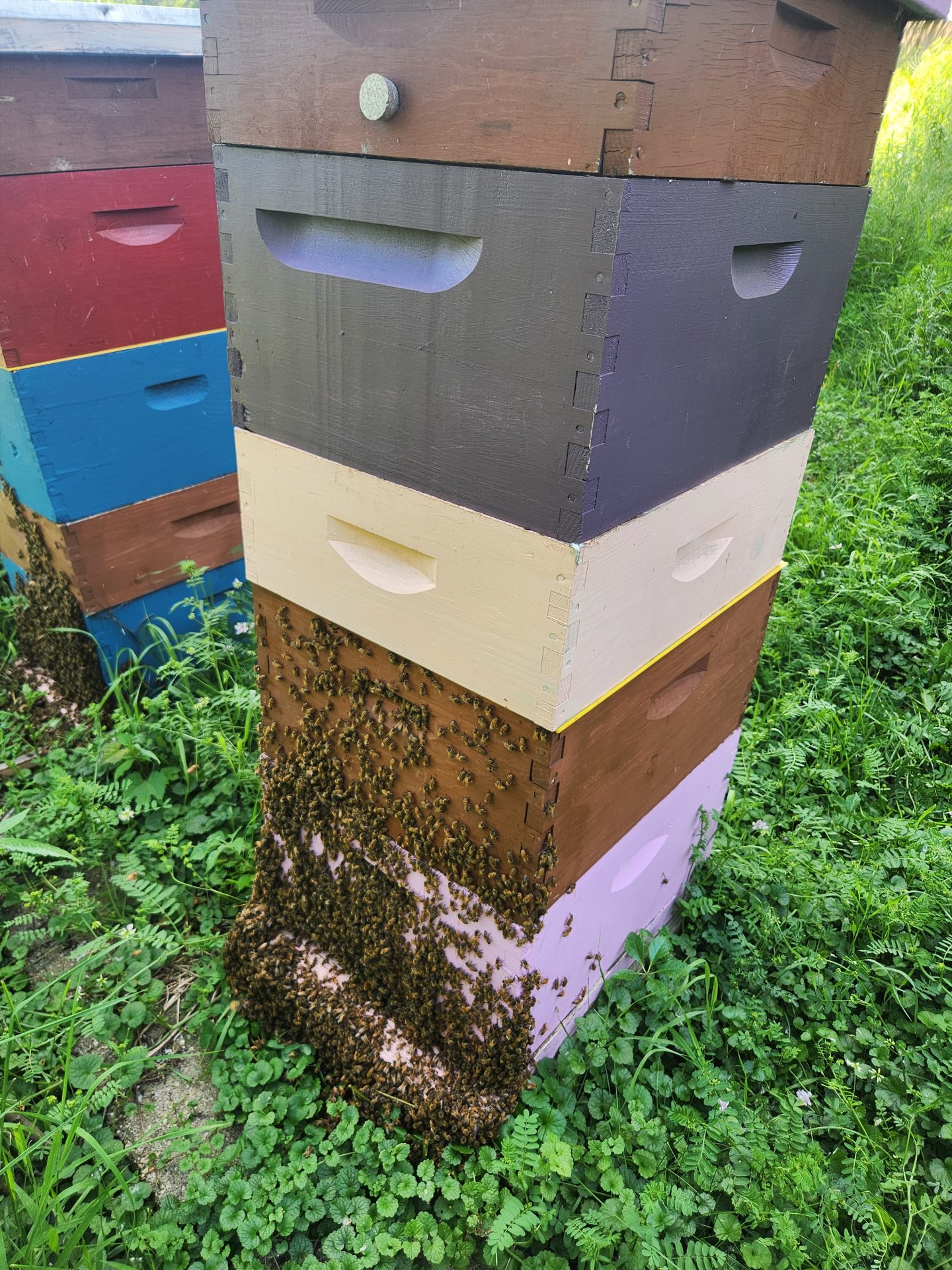
age workers to take advantage of a nectar flow. Photo credit: Rebecca Masterman
References and Resources
Honey Bee Forage Map Information https://honeybeenet.gsfc.nasa.gov/Honeybees/Forage_info.htm
Beescape https://pollinators.psu.edu/bee-health/beescape
Harper, C. W., & Calkins, C. F. (1967). Some Aspects of Apiculture in Minnesota. Journal of the Minnesota Academy of Science, Vol. 34 No.2, 122-126.
Pellett, F. C., & Dadant & Sons. (1976). American honey plants, together with those which are of special value to the beekeeper as sources of pollen (5th ed. /edited by Dadant & Sons.). Dadant.
Vincze, C., Leelőssy, Á., Zajácz, E., & Mészáros, R. (2025). A review of short-term weather impacts on honey production. International Journal of Biometeorology, 69(2), 303–317. https://doi.org/10.1007/s00484-024-02824-0
