
Click Here if you listened. We’d love to know what you think. There is even a spot for feedback! Read along below!
By: Stephen Bishop

The flap and yap should not be confused with the flail and wail or, for that matter, the flailing whale. The first is a simple self-defense combo. In that regard, the flail and wail is quite similar to the flap and yap — however, the flaps extend into gesticulations, and the yaps build to a pronounced wail, which adds somberness to the hoopla. The flailing whale is the most advanced apicultural flailing technique. It should only be attempted by master beekeepers who have spent years practicing and mimicking the vocalizations — the cadence, the timbre, the deep resonance — of a mother humpback whale giving birth. Some beekeepers struggle mightily with wailing, but truly excel at the flailing part, mimicking a beached whale with much aplomb. There is no right or wrong way to display emotion after getting stung. As you progress deeper into your beekeeping journey, you will likely develop your own personal style.
Hands are the most commonly stung body part, so it is important to develop a firm swat before moving on to flapping. Simple as it may sound, it is not always easy to muster a vigorous swat. Some beekeepers (especially self-conscious individuals) may struggle mightily with your basic swat, due to societal inhibitions regarding proper behavior. They will try to regulate their response and a wishy-washy swat will result. It’s better to disregard all inhibition and fling the bee as far as you possibly can.
Then you should run. Some people run faster than others and some people run funnier than others. It doesn’t matter much how you run, but you should. Bees are a lot like tyrannosauruses. You can try standing still in hopes that they won’t see you, but that only works in the movies. You should run. Running while flapping will not produce flight, but ducks can still be used to model good form. Your natural tendency will be to run in a mobile fetal position, but you should lean forward and keep your head up because if you don’t you’re liable to run into a tree or other impediment which defeats the point of running.
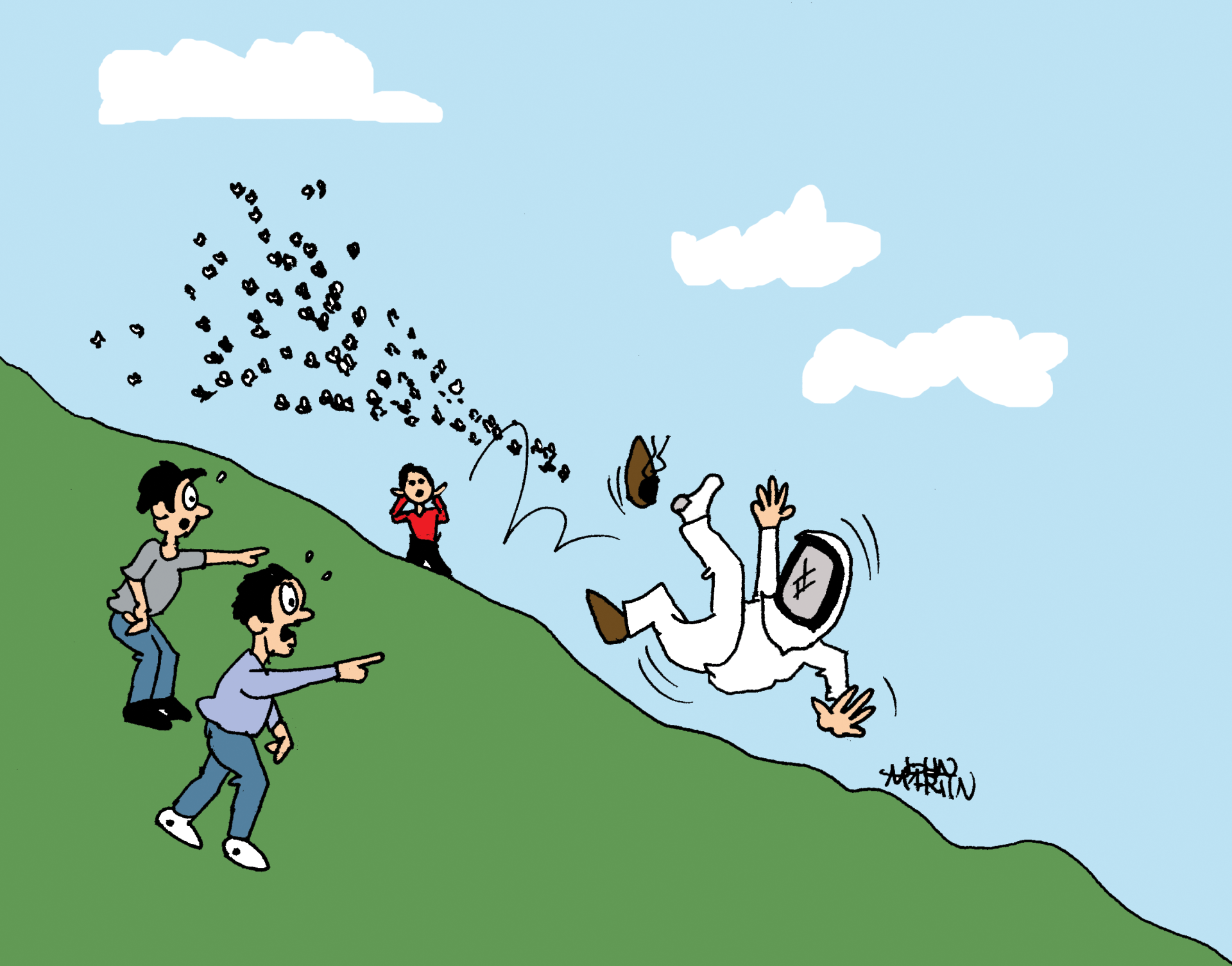
Sometimes bees will chase you and bystanders may not be able to see the bees from a distance so it could look like you’re running and swatting for no apparent reason, especially if you are a male who doesn’t wear personal protective equipment. Bee gear is vital for context clues. Without it, people will most likely be confused.
Bystander 1: “What’s he doing?”
Bystander 2: “He appears to be hitting himself —
while running.”
Bystander 3: “What’s he running from?”
Bystander 2: “I don’t know.”
Bystander 1: “Uh oh…”
Bystander 2: “Ouch, that looked like it hurt — he
never even saw that limb.”
It will be your natural instinct after running into a tree to look around and see if anyone witnessed the impact. Play it cool. Dust yourself off and get back to swatting. If you tripped on a root instead of clotheslining a limb, it doesn’t hurt to hop around on one foot while clutching the other foot with one hand and swatting with the other. Like patting your head and rubbing your stomach, the hop and swat requires concentration or else it can be misconstrued.
Bystander 1: “What’s he doing now?”
Bystander 2: “Looks like he’s playing hokey-pokey.”
Bystander 3: “Ow, he just fell over again.”
Bystander 1: “I think he’s given up.”
Bystander 2: “No, he’s doing the stop, drop, roll.”
Remember: the stop, drop, and roll should only be used when you’re uphill. Never give up. Swat, flap, flail, run, hop, drop, or roll, but never give up.
