
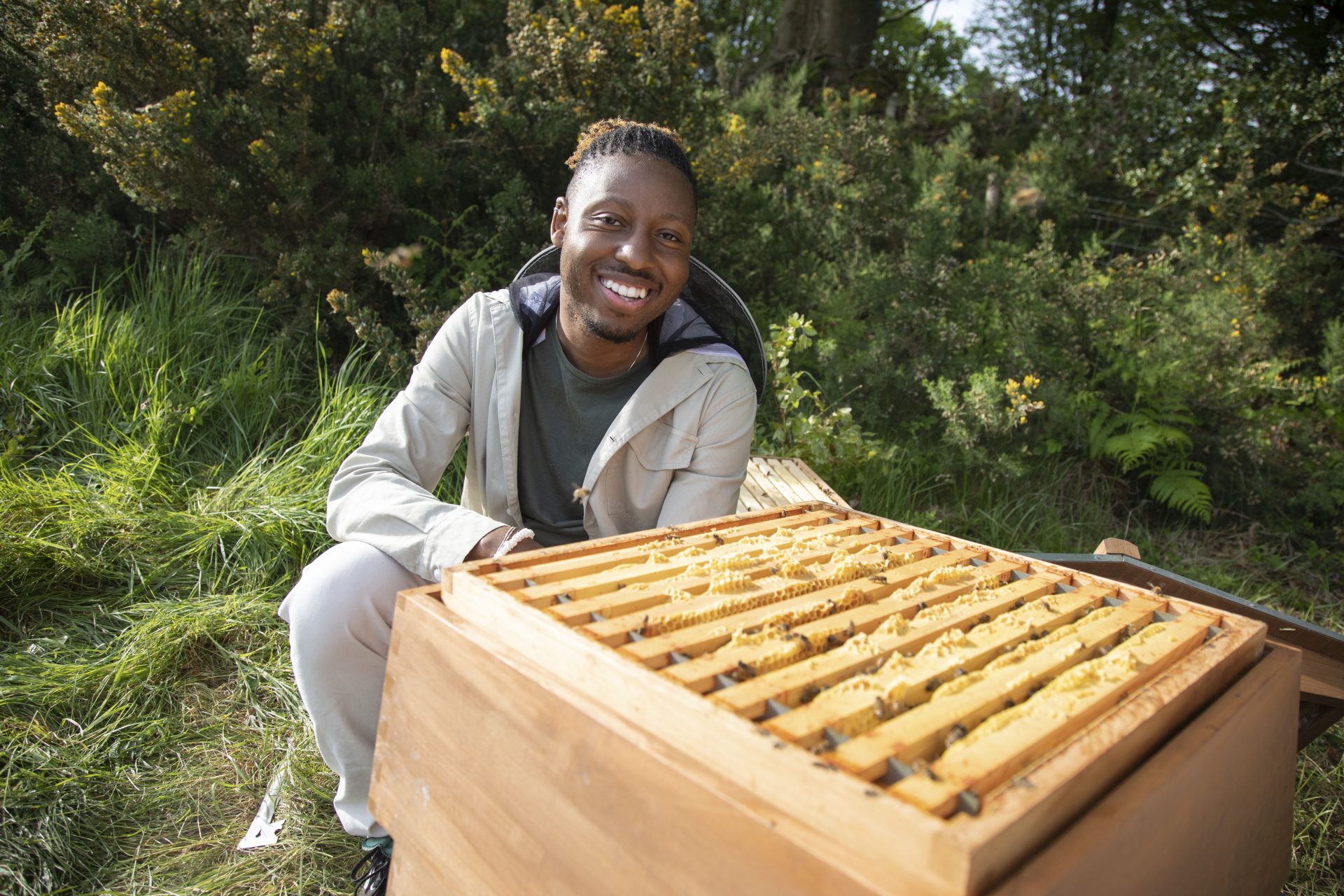
On National Geographic’s Secrets of the Bees
Jerry Hayes & Dr. Samuel Ramsey

National Geographic’s Secrets of the Bees will be available to stream on Disney+ and Hulu beginning April 1.
Dr. Sammy
All right.
Jerry
All right. What do you want us to talk about? Well, how are you doing, Sammy?
Dr. Sammy
I’m doing really well, Jerry. How are you doing?
Jerry
I’m doing fine, but you know, we haven’t hugged each other in quite a while as you’ve been busy.
Dr. Sammy
It’s been a minute.
Jerry
Yeah, you’ve been all over the world.
Dr. Sammy
All over the world and starting up a lab that I’m hoping will be a world-class research juggernaut, so it’s a lot of all at once.
Jerry
Right, it is all at once, but by the same token, I think you’ve been prepared and and we’re prepared for this opportunity.
Dr. Sammy
Thank you.
Jerry
So how many students do you have, you said?
Dr. Sammy
Right, right now I have six graduate students, I’m probably going to be moving up to seven, and I think seven is the absolute max that I can do.
Jerry
Wow. All right, so what are your research goals for them or what are their research goals?
Dr. Sammy
So my students have been focusing on figuring out different aspects of honey bee pathologies, and then pathologies in other groups of bees as well. So it’s kind of a disease diagnostic system while also really looking heavily into how parasites have been able to gain supremacy over host immune system capacity. So it’s been kind of fun looking at that side of things. It’s taking me down much more of a biochemistry spiral than I ever thought I would be in.
Jerry
That’s the fun and interesting and scary part about this journey in mortality is that, you don’t know. You you might have a vision, you might have expectations, but that’s not how it always turns out 100%.
Dr. Sammy
That is true. That is true. But it’s been really exciting. I think starting off as someone who gave so many outreach presentations to beekeeping groups, I learned a ton about what beekeepers really want and need in their operations, while also learning so much about the biology of the bees for my coursework as a graduate student. And bringing all of that together, I think I’ve got some great ideas to help the beekeepers, to help the bees. I think at this point, it’s just getting everything launched in such a way that it’s sustainable. Working with students, they can be fairly transient, so making sure I’ve got solid postdocs and a lab manager and that my nonprofit is ready for dissemination of all this stuff. It’s has been a lot of infrastructure building in place setting, but it’s all coming together.
Jerry
Good, and so that’s a great question, what made you decide to go to Colorado?
Dr. Sammy
When I say they made me an offer I could not refuse, sir, I mean it. CU Boulder, they made it very, very, very clear from the start that they were going to support me and this entire I would say nontraditional set of initiatives, that I brought to bear as a researcher. So when I first became a candidate for this position here, when they first started recruiting me and everything, it was the same month I found out that I was being inducted into the National Geographic Society, and I was planning all of these projects running around different parts of the world now that I had Nat Geo support. And so when I started talking to CU Boulder about what it was that I wanted to do and how frequently I would be gone running around the world, I thought that they would immediately give me the, “That’s not quite what we’re looking for.” Instead they put all of their muscle behind it. They are doing everything they can to help me establish a research station so that research can continue year round in Southeast Asia. My teaching schedule is structured around the migration of honey bees in Southeast Asia so that I don’t have to teach January and February of each year, so that I can run around in the Philippines and Thailand and Singapore. They engineered science communication into my job offer. So, instead of my promotions being simply based on service, teaching, and research as they are with most researchers, mine is research, teaching, and science communication, and I think that that is amazing that they were willing to put their money where their mouths are. And just another aspect, the fact that they were determined to make sure that I found reasonable living space in this area, given how expensive everything is. They just have been great.
Jerry
Wow. And I find that interesting too because they must have had a vision of what they want to do, what they want you to do, and I hate to say this. This is sounds very corporate, but you being there brings positive advertising to the university.

Dr. Sammy
It is. I understand the corporate dynamic that comes along with imagining how each person you bring in impacts the bottom line, impacts advertising, and everything else. If I felt like I was being used, I would have a lot of, of push back, to go with there, but it has always been my goal to ensure that the doors are wide open to people who are, who want to do research, but who are nontraditional in one way or another, who think differently. And so to find a university that was aligned with that same goal set, I was so ready to jump in feet first.
Jerry
Right. It sounds like it’s it’s a super opportunity. So what made you decide to, focus on Asia and bees and beekeepers and stuff?
Dr. Sammy
So there is only one region of the world where every single bee species is present, and that is Southeast Asia. Tiny little window, but the amount of biodiversity there in bees means that it is an invaluable resource for understanding bee health. If you think that you’re going to understand the health and wellness of bees, their their disease networks, and so on, and not go to Southeast Asia, you’re sorely mistaken. We in the West have one honey bee species. One. And we think that we’ve got all the details. The vast majority of bee research comes out of the Western world. More than 70% of the bee papers that come out, come out on our side of the world where we have just one bee and the minimum, the bare minimum of of research on bees, I think it was about 2% of bee research actually comes out of Southeast Asia, which is unfortunate. And so I’m trying to shift things more in two ways. I’m trying to make sure that more people are aware of what we are missing by not focusing more heavily on Southeast Asia. And then I also want to build up the research capacity of our Southeast Asian collaborators. The vestiges of colonialism, unfortunately, have left things in such a way where there’s not a lot of that kind of infrastructure in Southeast Asia to get this sort of research done. There are not a lot of trained researchers in these areas, and so taking the time to try to invest in this area, to work with researchers, to help build up the research capacity, it’s something that I really see as an important goal set. It’s a big goal set of the Ramsey Research Foundation, and it’s another reason why I was so happy to work with CU Boulder because they’re allowing the Ramsey Research Foundation and my lab at CU Boulder, the Boulder Bee Lab to collaborate, so that the Ramsey Research Foundation can move forward a number of the philanthropic goals and our desires to build up these research entities, while the Boulder Bee Lab can focus on making sure that the research is analyzed and effectively disseminated to the world.
Jerry
So, are you going to have any students come over from there and be in your program?
Dr. Sammy
That is most certainly the goal. I can’t wait until we have that as a consistent back and forth. My first postdoc who I actually had signed up with the lab was from a lab that I was working with in Thailand. Unfortunately there were some difficulties with making all of that work so quickly with the startup of the lab, and so that didn’t quite come together, but it is it has been our goal from the very start to make sure that that is a consistent theme.
Jerry
Okay. And so, how much time are you spending over there?
Dr. Sammy
So when I first got started, it was three to four months out of the year. That has been let’s say unsustainable with a full teaching load and full research load and managing all of these students. So now I’m going maybe four to five weeks each year and then my students and postdocs and everything, they’re really helping to manage the remainder of the details along with our partnership with Nat Geo. And the Explorers Club.
Jerry
Sure. So, being on the ground in person and being there in real time and having that visual is great. But can you do anything from a distance? Can you do Zooms or anything?
Dr. Sammy
Yep. Yep. That’s the goal. We’ve consistently, about once a month, are having these meetings back and forth with our teams over in Southeast Asia, getting an idea for what it is that we’ll need to do as soon as we hit the ground to make sure that our trips are as efficient as possible when we get there, discussing what they’re seeing on the ground in the day to day while we’re not present. There’s a lot that I would like to do in the future with better understanding how bees in Southeast Asia function as disease reservoirs. We’ve done some amazing work through the CDC and the World Health Organization looking at how we can determine based on what’s circulating in one part of the world, what version of the flu or other viruses will circulate in another part of the world. And there is a pollinator model for that, that we are developing in the Boulder Bee Lab so that we will be better able to anticipate the sorts of diseases that start pollinator pandemics that are already circulating in one part of the world, but we haven’t been paying attention to those disease reservoirs. And so taking that kind of information and translating it is what I’m really excited about. And I’m hoping that the documentary that we’ve been working on, that Secrets of the Bees will also show people how important that is because we’ve got some incredible footage from Asia, and Secrets of the Bees that I’m super excited to share with the world. And they’ve also focused on the work that we’re doing here at the Boulder Bee Lab, so that people can better understand how these strange experiments that we’re up to are able to really help the world in a number of different capacities.
Jerry
I’m going to jump over to a question here. What do you think their pests, predators, and diseases will teach you about what we have now and what happens if some of those come over here? We have concerns with airplanes and ships and people’s suitcases bringing pests, parasites and diseases.
Dr. Sammy
There was a time where we could talk about our world as discrete ecosystems. We could talk about the Asian ecosystem. We could talk about the African ecosystem. We could talk about the North American or South American ecosystems. But now we exist in a world that is a unified ecosystem in a number of ways. There’s a consistent circulation of organisms around the world through planes, trains, automobiles, boats, all of that. And so we have to shift our thinking in that way. It would be naive and unprofitable for us to continue thinking about the world as those discrete ecosystems when that model no longer serves us. And so, as my lab focuses on understanding the symbioses involved in bee populations, the predators, the parasites, the the pathogens, all of those things that are interwoven into the colony dynamic, better understanding those dynamics helps us better predict disease, helps us better mitigate and fight off disease. And so that’s the reason why I started this incredibly ambitious project. As soon as I partnered with Nat Geo, I told them, I’m going to start something called the Honey Bee Genome Project. And, of course, it hearkens back to one of my favorite scientists of all time, Francis Collins, who I recently met at the Aspen Ideas Festival. The Honey Bee Genome Project, the goal of it is to understand all of the genetic underpinnings throughout the entire apis genus. So the giant honey bees, the dwarf honey bees, and the cavity nesting bees as a unit, understanding all of the genetic underpinnings for why some of them are resistant to disease, why others are extremely vulnerable, what things allow them to determine when there are pathogens present, what’s underpinning their systems of social immunity? All of those things are encoded for and embedded in their DNA, and we’ve not put the work into applying the incredible tools and resources we have now to understanding it. We have the gold standard systems of long read sequencing now, where we can sequence the entire genome of an organism extremely quickly, but also without doing it by short reads, which we used to take these tiny little snippets and then try to assemble them together. It would be like doing Mad Libs with a sentence. Instead we can take entire snippets that are full sentences and try to restructure what everything says, rather than trying to piece it together word by word. So now that we have this technology, we’re sequencing the genome of every single honey bee species, all of their pathogens, all of their parasites, all of their viruses. It is an incredibly tall order. But with the partnership from Nat Geo and also the Explorers Club, we have made incredible headway, and we just have three more species of bees to tackle, we will have completed the first of the projects that have started here at the Boulder Bee Lab, and I’m super excited about it.

at University of Colorado. (credit: National Geographic/Ryan Tidman)
Jerry
Wow. Okay. So, that’s incredible. You have to share this with your colleagues. So, where will these appear? Where will this data, where these papers will it be?
Dr. Sammy
So the first of this set of data was just published last month in the journal of Genes, Genomes, and Genomics. So that’s G3, the journal G3. And this is the dwarf honey bee genome, the Apis and Apis florea. We were hoping to publish the giant honey bee genome first, but we have had a difficult time getting the permits necessary to access Apis laboriosa in the Himalayan region. We just got the permit that we need from Bhutan, and so we should be heading over there this Summer, which is really exciting, because then we’ll have the giant honey bee genome fully established as well. I’m, hoping to put that out by the end of this year, and then we’ll be really focusing on the cavity nesting bees. There’s one in Borneo where we can only, the only place it’s ever been found is on Mount Kinabalu um in Borneo, and so we’ll have to go to exactly that area to find those bees. But it’s this is what I’ve dreamed about doing since I was a little kid. I used to read Nat Geos, I had so many that I built a fort out of them until it became structurally unsound. I would watch researchers, look at the cool things that they were doing, flipping through those pages and think, “Man, it would be incredible to have a job like that.” And it is amazing to me that I get to be a part of the National Geographic Society, that I get to do this incredible work in partnership with the University of Colorado Boulder, and that I as a science communicator get to detail this to people in documentary format, I get to detail it to people in presentations, and this is the life that I’ve always wanted to live.
Jerry
Oh, terrific. The good Lord has blessed you for real.
Dr. Sammy
Oh, yeah.
Jerry
Yeah, you really have. So, if you find viruses or you find other pests, you know, that are going to show up here, how do you stay ahead of the curve so that we know, we beekeepers here in North America, know how to control these? You know, with the huge losses we’ve had last couple of years and I’m hearing we’ve got similar losses maybe coming up now, what do we do, Sammy?
Dr. Sammy
So I’ve been very nervous about the ways that we have been backing away from greater investment in honey bee research, with the awareness that bees are so important to our food systems, with the awareness that bees are important to the environment around us and establishing consistent systems of pollination, but also the awareness that they are having a very tough time. And I know that there’s been a lot of misinformation and disinformation about bees and how well they’re doing all throughout social media. People are kind of confused as to what’s going on, and I think that’s made it easier to pull back from funding this kind of work. And so I get nervous when I hear about things like the National Honey Bee Disease Research Laboratory at the USDA being, you know, broken up and dispersed and in some way shut down, because there’s so much more that we need to understand about these contexts. I’m taking a lot on myself as someone who did my postdoc research at that laboratory. A lot of what they have taught me, I am applying to our systems here. But the most important thing for me is making sure that I don’t lose that connection that I have to the beekeeping community, that I don’t stop giving presentations just because I have a lot more on my plate now, that I continue to disseminate information um in all the different formats that I can because there’s going to be new stuff on the horizon. As the Tropilaelaps mite barrels down on us, people are going to need to know how to treat for these organisms before they arrive. And so I maintain a connection with our biosecurity agents at the USDA, consistently interacting with them back and forth to make sure that they are aware of the findings that that we are consistently coming to and ways that they might be able to employ this for emergency response plans. And then I’m constantly, constantly connecting with beekeepers either through my outreach on Instagram, through the documentary formats that we’ve discussed, but often just through presentations, whether that’s on Zoom or going to these different locations. My foundation subsidizes a couple of small beekeeping groups per year for me to go to them and give a presentation when they wouldn’t otherwise have the capacity to bring me as a speaker to those locations. And so that helps with making sure that I’m connected even to the groups that aren’t one of the larger ones out there, and then just explaining as clearly as I can what we’re doing, why we’re doing it, and the impact that it’ll have on beekeepers. I think is really useful.
Jerry
Oh, you you have to do it. It’s more than useful, you have to do it. And and not to sound selfish, but I know the editor of Bee Culture Magazine and I think his subscribers need to be connected somehow, Sammy, and I don’t know if it’s articles or if it’s QR codes with your presentations or what or something, but we we’re too small an industry and too close of a family to not do this kind of stuff.
Dr. Sammy
Correct. I fully agree with every word of that.
Jerry
We have to do, we have to do better. So, how do you keep your head from exploding every night, Sammy?
Dr. Sammy
That’s a really good question. I think grounding myself and reminding myself that, one, I have the type of personality where I really want to be involved in fixing problems that I see, and I can’t fix all of the problems. And so trying to remind myself that I need to focus my attention on the problems that I am best structured to meet head-on, and then reminding myself, and this is my favorite part of all of it, reminding myself that there is this force-multiplying capacity that I have as a professor because of the fact that I’m mentoring the next generation of researchers. I don’t have to be able to do everything. I don’t have to be able to understand all of the different principles and all of these different systems. I can train and mentor these incredible students who have been coming my way, who I don’t even seem to have to advertise that I’m looking for for students. They just find me and they’re incredible. And so training them to tackle these huge problems, taking them with me on trips all over the world so that they understand that there is a global outlook to problem-solving. And then making sure that they understand that their peculiarities, their ways of thinking about the world differently, those are assets, not liabilities, despite what anyone else has told them and bringing them into the fold of scientists. That has just been that’s one of the things that excites me most about the space that we’re in, and it takes me out of that space where it feels like my head is exploding to the space of calm where I realize, “You know what? I’m doing what I can do to make sure that the world is going to be better by making sure that every person that I come across who I can mentor and help in this capacity, I’ve given them the best I can.”

illuminated bee frame which showcases honey bees interacting with varroa mites at University
of Colorado. (credit: National Geographic/Ryan Tidman)
Jerry
You’re absolutely right. And to go back in time, you had a great professor by the name of Dennis van Engelsdorp.
Dr. Sammy
Good old Dennis.
Jerry
What did he teach you?
Dr. Sammy
So, when I was a student in Dennis’s lab, I was a refugee from another lab. I had just left a context that wasn’t the best fit for me as a researcher. And one thing that Dennis was able to do so effectively was that he could tell that what I needed was somebody to encourage me, to allow for me to try the the crazy ideas that I had because while they were unorthodox and not the direction that other researchers had taken with things, that didn’t mean that they were bad ideas. And in some of my prior mentoring experiences, I was constantly pushed away from doing things that were too outside of the the ordinary spectrum, because those individuals had a harder time believing that those things that were more innovative were things that I could actually follow through with. Dennis had this understated way of just saying, “Huh, is that what you think you should do? All right. I mean, you’ve got a great track record at this. Let’s see what happens.” And I love that vibe because it allowed me to just jump into all of these these cool ways of of navigating things, and now with my own students, I take that to them. They’ll start talking about this idea that they have and in the middle of it, they’ll start talking themselves out of it and explaining why they couldn’t possibly be the person to figure this out or if if this were really true, somebody would have noticed it by now. And then I work them around to reminding them that they are unique human beings. Each one of them is somebody totally different from anybody else. So there’s every reason in the world to believe that you will see something that no one else has seen, because no one else has been you.
Dr. Sammy
Well, thanks so much, Jerry. I loved talking about this and we’re going to see a write-up about it?
Jerry
Well, of course in, Bee Culture. We need to engage, I think, our readership in these things, and then we’re strong and we’re going to be focused, but we really need the general population because more people are better than less people to support what you’re doing and how you’re doing it, and so we just need to start someplace and make it happen.
Dr. Sammy
Amen to that.
Jerry
You’re doing great, and but we’re here to help.
Dr. Sammy
Thank you so much. I really appreciate it.
Jerry
Thank you, sir.
Dr. Samuel Ramsey, Producer, Entomologist, Biologist, National Geographic Explorer

(credit: National Geographic/Nadege Laici)
Dr. Samuel Ramsey received his bachelor’s in entomology from Cornell University and his Ph.D. in entomology from the University of Maryland, College Park. He completed his post-doctoral training with Dr. Jay Evans, Steve Cook and Daniel Sonenshine at the USDA Agricultural Research Service’s Bee Research Laboratory and now serves as an endowed professor of entomology at the University of Colorado, Boulder, BioFrontiers Institute and the Ecology and Evolutionary Biology department.
He has been featured on Hulu’s docuseries “Your Attention Please,” as well as in the Washington Post, The New York Times, NPR, CNN, Wired, CBS’ “This Morning,” Khan Academy, Seeker, NBC’s “The Today Show” and several local news segments.
Dr. Ramsey is celebrated as an engaging science communicator, and he uses this talent to make science more accessible to a broad audience. His nonprofit, The Ramsey Research Foundation, works to develop novel pathways for scientific funding by removing the paywalls that keep the public from engaging with published scientific work.