
Click Here if you listened. We’d love to know what you think. There is even a spot for feedback! Read along below!
By: David Burns


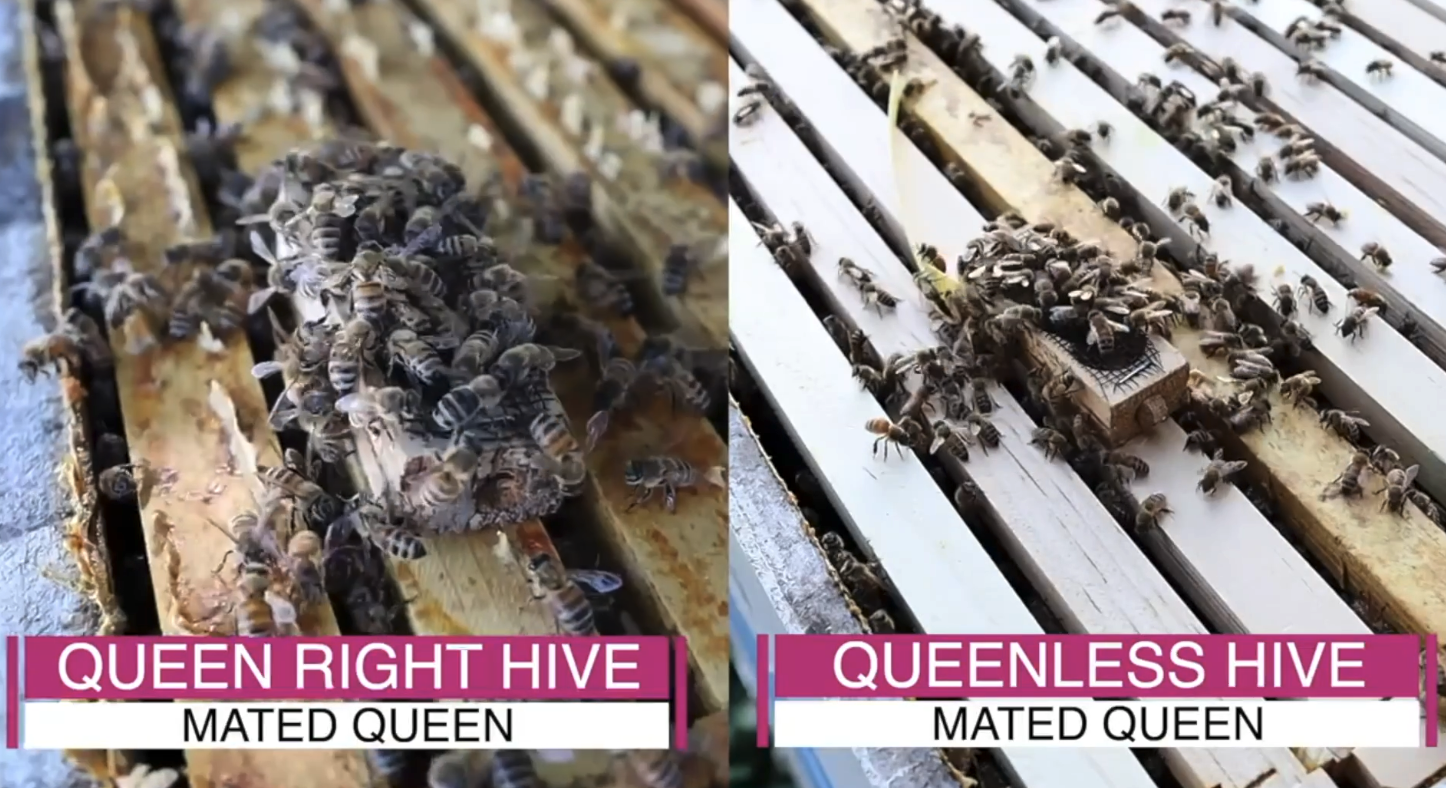
We all know the feeling of spending forty dollars for a new queen and another forty dollars for overnight shipping only to have her not be accepted in our queenless hive. Sometimes a colony seems to reject every attempt to establish a new queen. In part one of this article, I’ll be addressing the reasons why new queens are rejected. Then, next month, in part two I’ll share several approaches to overcome these challenges when your bees keep rejecting a new queen.
Usually when a colony refuses to accept a new queen it is because the beekeeper is unaware that something else is going on. Even though the colony appears to the beekeeper as queenless, they may have started to raise their own queen. A newly started, small queen cup, covered by bees can be easily missed on a hot day with sweat in your eyes, looking through a veil on a cloudy day.
A newly purchased queen will always be subpar to what your bees have already started. They’ve invested significant energy into starting to raise a new queen. Even though you’ve searched every frame carefully and may not have seen queen cells nor a queen, they can still be in the process of establishing a new queen. How? There have been many times I have found this to be the case, so I’ve learned a trick to solve this challenge. In these scenarios I perform my inspections just after sunrise or just before sunset when there is still enough light to inspect. Why? Because what’s happening is the colony may have a virgin queen. It only takes 16 days to raise a queen from an egg. She may have been out on a mating flight when you did your mid-day inspection. These virgin queens can take more than one mating flight. I have also observed, and documented on video, virgin queens outside the hive, flying around for an extended amount of time, likely performing an orientation flight. If you look for her on the frames when she’s performing an orientation flight or is outside the hive, you’ll assume your hive is queenless, purchase a new queen, introduce her only to have the new queen killed because your hive is not queenless like you thought.
Another challenge in getting your new queen to be accepted is when your hive has laying workers. Laying workers are just what their name implies, workers which are laying eggs. However, workers cannot be fertilized by drones so their eggs will develop into smaller sized drones as they are laid in worker size cells restricting the drone’s full-size development. What makes it possible for workers to be able to lay eggs? Workers cannot produce eggs when a mated, laying queen and brood is present. Pheromones from the brood and the queen suppress the workers from being able to produce eggs. However, when these pheromones are absent from the hive for several weeks, from the loss of a queen, workers will lay eggs.
For many years we believed that only one laying worker functioned like a pseudo-queen. However, studies have found that when this happens there are many laying workers laying these eggs. In fact, these laying workers are foragers who can forage, come back to the hive and lay unfertilized eggs in the absence of the queen and brood. We used to believe we could shake all the bees out of the hive several yards away and the laying workers could not return because they were too heavy to fly back being full of eggs. However, now we have found that laying workers are quite capable of easily flying back to the hive.
Since there are many laying workers in the absence of these pheromones, and no sign of a queen, the hive appears queenless other than eggs being laid in the cells, and I do mean eggs (plural). Often there are 5-10 eggs in the back or bottom of a single cell. This is a giveaway that laying workers are present. Always be on the lookout for multiple eggs in a cell if your colony is queenless. Keep in mind, a new queen who is just starting to lay usually may lay a couple of eggs in a cell for the first few days, but that will clear up once she gets her rhythm established. When we introduce a new queen into a hive with laying workers, the new queen is often rejected. A new queen can also be rejected if the hive is going through some type of agitation such as a skunk at night, mite or beetle infestation.
Another common reason a new queen can be rejected is timing. If we introduce her too soon after a queen loss, the queen mandibular pheromone, QMP, is still strong throughout the hive. Not all the bees have received the message about losing their queen, so the new queen is viewed as a foreign invader. On the other hand, if a queen is introduced too late following a queen loss, the colony likely has started raising their own queen from a fertilized egg/young larva from the old queen.
Your bees need time to realize their queen is gone and to lose their loyalty to their old queen. This is why it is important to make sure your bees really do need a new queen. Search carefully for queen cells and a virgin queen. See if there are signs of laying workers. Wait 10 days to check again.
In part two, next month, I share several special techniques I have found highly effective for introducing a queen into a colony determined to reject her.
If you’d like to watch my video where I explore this topic more visit: https://www.honeybeesonline.com/davids-youtube-channel/
