
Click Here if you listened. We’d love to know what you think. There is even a spot for feedback! Read along below!
By: Stephen Bishop

After years of working at the agriculture office, I have come to realize that agriculture is ground zero for jargon and its fallout on effective communication. Jargon is everywhere. Once, for instance, I was talking to an up-and-coming young farmer when I realized I couldn’t understand him. It wasn’t that he was mumbling. It wasn’t that he spoke a dialect different from my own. It was just his words—words full of sound and agribusiness lingo, signifying nothing. The young man was fond of utterances like the following:
“What the public doesn’t understand is that modern agricultural producers are utilizing the latest technologies and materials—we’re deploying the safest chemistries and best genetics to maximize revenue and increase productivity, just to feed the world.”
Of course, I didn’t have the heart to suggest to the young farmer that what the public doesn’t understand are his verbs and nouns. And it’s likely only a matter of time before his last bastion of understandable lingo, “to feed the world,” is transformed into some monstrosity like, “to replenish the planet’s gastric capacity.” The oddity is that when the young farmer talked of other topics, not related to agriculture, his sentences were both clear and intelligible, but the moment agriculture was broached in conversation, a switch flipped and he spoke in riddles.
The government is partly to blame for this. For decades, the USDA has referred to farmers as “producers” or “operators.” I think the intention is to make farming seem more modern and business-like, to leave behind the pitchfork and overalls stereotype. So highfalutin farm words are, in a sense, an innocent way to puff out one’s chest, to say “I’m important.” But, in my opinion, concocted words like producer and operator have done more harm than good and have only exacerbated the separation and increased the distance between non-farmers and farmers. A child will never comprehend an “animal unit” if it can’t comprehend a heifer or steer.
And not all separation is so innocent. Words are purposefully manipulated to soften and hide meaning. Thus, killing becomes depopulate; slaughterhouse becomes processing plant; pesticides become chemistries. My favorite metamorphosis is the transformation of the word lagoon from a waterbody in a tropical paradise to a manure pond at the end of a loafing shed.
To be fair, alternative agriculture is not without offenses. Words and phrases like biodynamic, regenerative and beyond sustainable are bandied about with such frequency and carelessness that one never knows exactly what they mean. The problem is everybody is trying to one-up everybody for sales—mostly, these words are just feel-good marketing terms. Often they’re used vaguely and all-inclusively, for anything from moon crystals to cover crops—just more words meaning everything and thus meaning nothing.
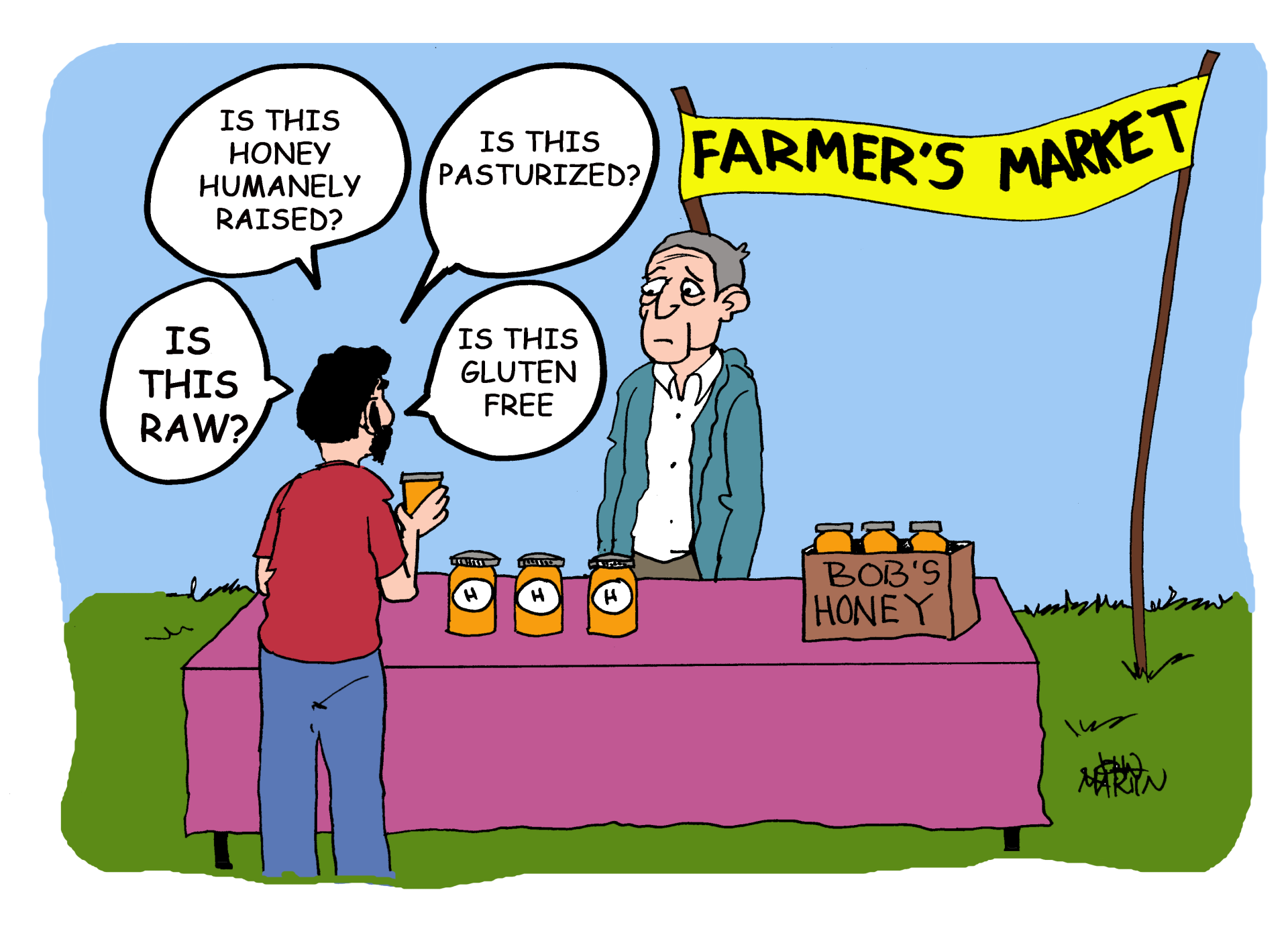
Certainly, this trend has crept into beekeeping. Just to sell a bottle of honey nowadays, it seems like it has to be organic, raw, unfiltered, unpasteurized, humanely raised and gluten free. I refuse to play this game. My label just says “pure local honey.” My philosophy is if my customers can’t taste the difference, then they’d be better off just buying diluted Vietnamese honey in the grocery store.
But my point here is that farm talk didn’t used to be this way. If you listen to any old-timer talk about farming, you’ll immediately notice a difference. For one thing, farmers are farmers, not producers. You’ll hear nothing of “animal units” but plenty about cows, and more specifically the twenty brood cows grazing the back pasture. You’ll hear idioms that are both illustrative and clear, like “meaner than a Jersey bull” or “madder than a wet hen.” I once heard an old beekeeper say a “hive had the devil in it.” I knew immediately what he meant. And forget about feeding the world—if you talk to an old farmer, you’ll hear about the struggle to feed the family when the boll weevil came through in 1949. You’ll not only hear words, but know meaning.
