
Click Here if you listened. We’d love to know what you think. There is even a spot for feedback! Read along below!
Mowing And Moving
Some equipment that makes these beeyard tasks easier
By: James E. Tew
It’s no secret
In previous articles, I have written that most of beekeeping has nothing to do with keeping bees. There is a long list of required non-beekeeping tasks that make my apiculture project possible. At the risk of boring you, I would like to write about two of those tasks and list some of the equipment that makes beekeeping both easier and possible.
Common grass control procedures
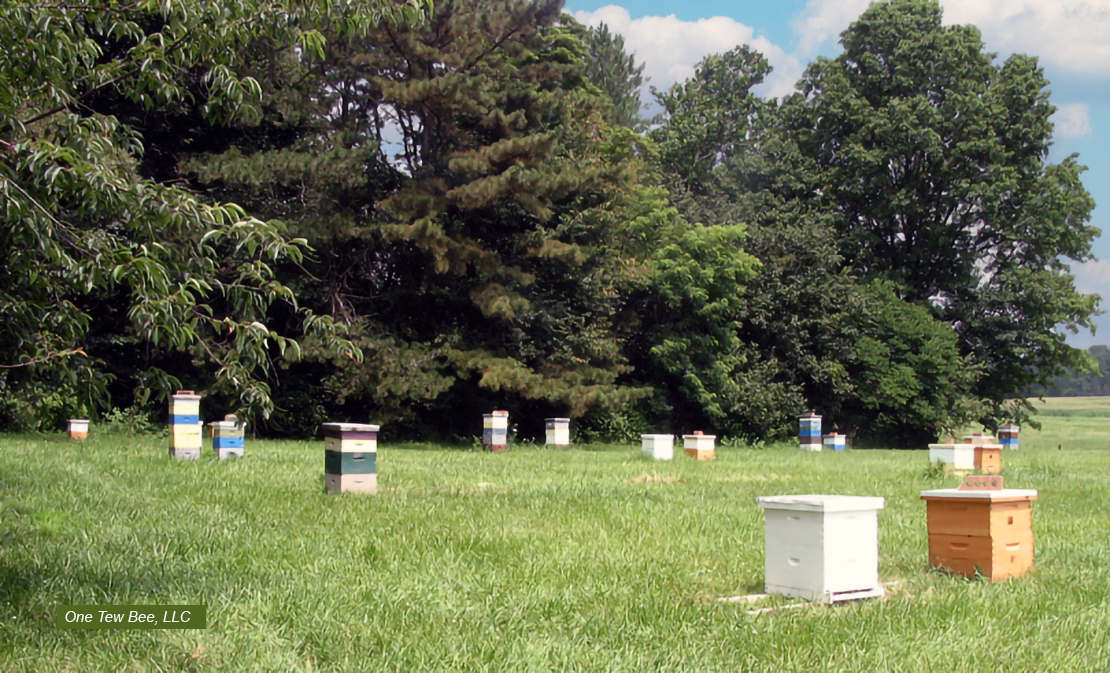
Grass in the bee yard cannot be ignored indefinitely in most parts of the U.S. I know this fact, because I have tried to work bees rather than working the bee yard. A better word would be vegetation rather than grass for much of what I must cut is not grass at all. It is shrubs and bushes.
Matting or landscape quilts.
In years and yards past, I have tried landscape matting or plastic quilts that go down on a bed of chemically killed grass. On that foundation goes the hive stand and all is covered by mulch or pine straw (or whatever). That should be the beginning and end of the grass problem in yards prepared like that – right? Well, yes, for a while, but not indefinitely.
It has been my observation that with anything other than professional landscape matting, which has a lifespan of about eight to ten years, I get at most a year and possibly less from the labor-intensive procedures. So, things look good in early Spring and slowly degrade as the weeks pass and seed germinate beneath the covering. Then what? More herbicides?
Herbicides
I have no idea if it’s true, but I have read that the average homeowner uses ten times the amount of chemicals than the average commercial farmer. Many beekeepers use herbicides to keep grass down in the bee yard. For many years, I did, too, and to some extent, still do. But for the past two years, I have used less herbicide and cut grass and weeds more often.
Herbicides are expensive. They have a fairly short duration requiring frequent re-application. They require application sprayers and they are not complete. Said another way, some plants are resistant and can hang on even after being sprayed. So, I keep this procedure as an option, but not my primary one.

Mowers
Give me just a minute to get this off my chest. In this country, we seem to be in the golden era of yard maintenance. Most homeowners seems to want (and will pay for) a green, weed-free lawn. Dandelions, which are edible, and clover, which fixes nitrogen, are examples of colorful and bee-friendly “weeds” that are despised by most grass-loving lawn owners.
Several seasons ago, I stopped cutting white clover swatches that were in bloom. I was killing too many of my own bees as they foraged in my lawn. Not wishing to sound as though I have had an epiphany, it is easy to see that the tall, flowering clover also attracted butterflies as well as other bee species. I found that rabbits also liked the taller forage as did Japanese beetles. Out of respect for my neighbors, I do mow my front yard, but my back yard is where I and my bees live. I generally just let it grow. In early fall, I mow that down too.
Mowers in the beeyard are of limited value depending on the layout of the yard. In one of my former yards, I had wide aisles that were conducive to riding mowers, but in most of the yards, the layout was wrong and hauling the mower to the yard was a hassle. As expected, riding mowers are helpful in some instances but limited in others. For me – especially now – a riding mower has not been the universal solution.
But in large beeyards, push mowers are essentially useless, unless you regularly keep the grass regularly mowed. I have never used small mowers in bee yards very much. Brush mowers do a much better job, but these mowers are heavier and more costly to buy and operate. I have a hard time justifying the investment of such a specialized mower.
String trimmers
String trimmers – no bee operation should be without one (or two). I use this device a lot. I bought a commercial unit that could stand the abuse of heavy grass and inexperienced labor. Since I hate pulling a cord on an engine that will now start, I get mine professionally serviced and store it correctly during Winter months. I really want it to dependably start and run when I am in the yard.
In past years, I experimented with different cutter heads. The plastic knife head whacked the hives so hard that bees came roaring out to find out just how stupid I really was. The brush cutting blades were no better – scaring and damaging the hive boxes. I simply reverted to the original string cutter head. I have the following personal suggestions and observations.
1. Trim fast and be gone. The bees don’t care for these devices and will finally find something to sting. Suit up, make the cuts and get away. If all is not perfectly neat, get it the next time. A smoker helps.
2. Equipment damage. If I really try to get close to hives, the whirling string will mar the hive boxes. After a few cuttings, the equipment can begin to show damage. Use common sense. Some weeds just survive. Don’t try to get them all.
3. Carry a knife. You will need a knife or cutter pliers to snip the twine when you reload the device in the field. Bees are flying and stinging. You’re hot and in the middle of the job and you really want to finish. Don’t forget to put the knife away (as I have obviously done in the past).
4. Don’t buy a trimmer with a large protective hood over the cutter head. It’s too clumsy when working between close hives.
5. Top off with gas before you start. Fill the trimmer tank or take extra gas, but DO NOT forget that that gas is around when you light or use your smoker. I have never heard of a single person getting into trouble with trimmer gas and smokers, but I have been shocked when I would get distracted by daytime heat and flying bees and find that I was dangerously close to my gas container as I manipulated my smoker.
Last October (2023) in Bee Culture, I wrote about the walk-behind trimmer that I bought for my weedy apiary. I have now used it for nearly two years and I can tell you that I like it very well. It is still laborsome to use it, but I don’t have to shoulder a string trimmer and it does not require 2-cycle gasoline mix. But you should know that the traditional sting trimmer still gets plenty of use.

Where I am now
Okay, I have accepted the compromise. There will always be grass and weeds somewhere in my yards. I try to keep the hives accessible and allow free flight for the forager bees, but I no longer try to kill every last weed in the yard. I haven’t used one drop of herbicide this year, rather relying on what I could get with my mower and my weed trimmer. The yards are not perfectly manicured but my labor input has been lowered. I would say that it’s a stand-off.

Ratchet straps
Ratchet straps have nothing to do with mowing, but they are one of the improvements (like converting from the old metal five-gallon cans to the modern plastic five-gallon buckets) that have made my bee life considerably easier. Depending on the number of colonies you maintain, buy a bunch. Ratchet straps are probably restricted to beekeepers with smaller numbers of hives. These devices would be impractical when moving large numbers of hives.
In years past, beekeepers used hive staples that are still available from bee supply outlets. Years ago, I commonly gave detailed instructions on how to correctly staple hives together for moving. As you would expect, the bees took a dim view of all the banging that went on as the staples were driven into the hive bodies. After using these a few times, your equipment acquired staples holes along the staple sites. Rot began there. Finally, I also gave instructions on how to get those same staples out of your tire after you dropped them in the yard. I don’t use staples anymore and I don’t miss them.

An alternative was for beekeepers to use wooden slats nailed along the sides of the hive to hold them in place for moving. Obviously, you had to cut the slats, get the proper nails and then remove the entire hive to the new location. In the dark, it was easy to step on the nails in the up-turned slats. At times, I used screws rather than nails. I don’t miss slats either. Then, for a short while, beekeepers used metal banding. Banding could only be used once and gloves had to be worn to prevent cuts on the hands of the beekeeper. Banding worked well but was one-time use and purchase prices were significant.

The first ratchet straps I used required a wrench to tighten them. The present–day ratchet strap has incorporated a handle eliminating the need for tools for tightening. I still have a few of these old models, but I never use them.
Are these gadgets perfect for beekeeping? Absolutely not! If I am moving twenty-five hives, I will need at least fifty straps. For me, that’s prohibitive. But for smaller moves, they are such an improvement over anything else that I have a bucket full of them. Therein is one of the problems. Try to untangle them at night – even better with bee gloves on. Neatly arranging them during the day before the move is one of those good ideas that never gets done. Also, the ends of the straps will fray with use, becoming increasingly difficult to push into the ratchet device. Most of the time, this is not a problem as the strap halves are never pulled apart, but many times tangles require separating the halves and then reassembling them.

Getting the straps underneath the hive can be a challenge. (Remember the weeds against the hive that I recommended you ignore? Now they are in the way as I try to work the strap underneath and around the hive.) When doing this procedure in the southern US, I wore gloves to protect me from snakes and poisonous spider bites.
Once the strap is around the hive, hook the ends together, pull all the slack out and tighten the ratchet. Be sure that all the slack is pulled out and ratchet tight. Common straps will withstand about 300#. I have never had one break. If a longer strap is needed, hook two together. The tension is released by opening the ratchet handle and pressing the release device with your thumb.
Combined with propolis seals, the straps do a good, but not perfect job of holding the equipment together; however, it is not unusual for the hive bodies to slip a bit allowing bees to escape during the move. For those of you moving colonies that are open, the slippage is inconsequential.
Your truck or trailer bed should be smooth. Truck bed liners prevent the hive from smoothly sliding into the truck. One of my old bee trucks had a welded floor. The welds had to be smoothly finished to prevent tearing the strap as I pushed the hive onto the truck bed. The standard floor in the bed of my personal pickup – the bed with raised ribs – works nicely.
Thank you.
As always, thank you for reading. Grass cutting and weed control will not go away and I am not claiming that I have presented anything new here. I’m just trying to get by and get the job done as quickly and as easily as possible. I wish you good luck with your bee yard grass.
Dr. James E. Tew
Emeritus Faculty, Entomology
The Ohio State University
tewbee2@gmail.com
Co-Host, Honey Bee
Obscura Podcast
www.honeybeeobscura.com
