
Click Here if you listened. We’d love to know what you think. There is even a spot for feedback! Read along below!
By: Theresa J. Martin


In this series, we are focusing on practical ways to make solo beekeeping safer, more efficient, and more enjoyable. In past articles, we covered topics such as safety, tools, record keeping, weight management, and swarm catching. This month, we wrap up with locating the queen, pulling honey, and finally moving a hive.
Tip #9: Locating the Queen
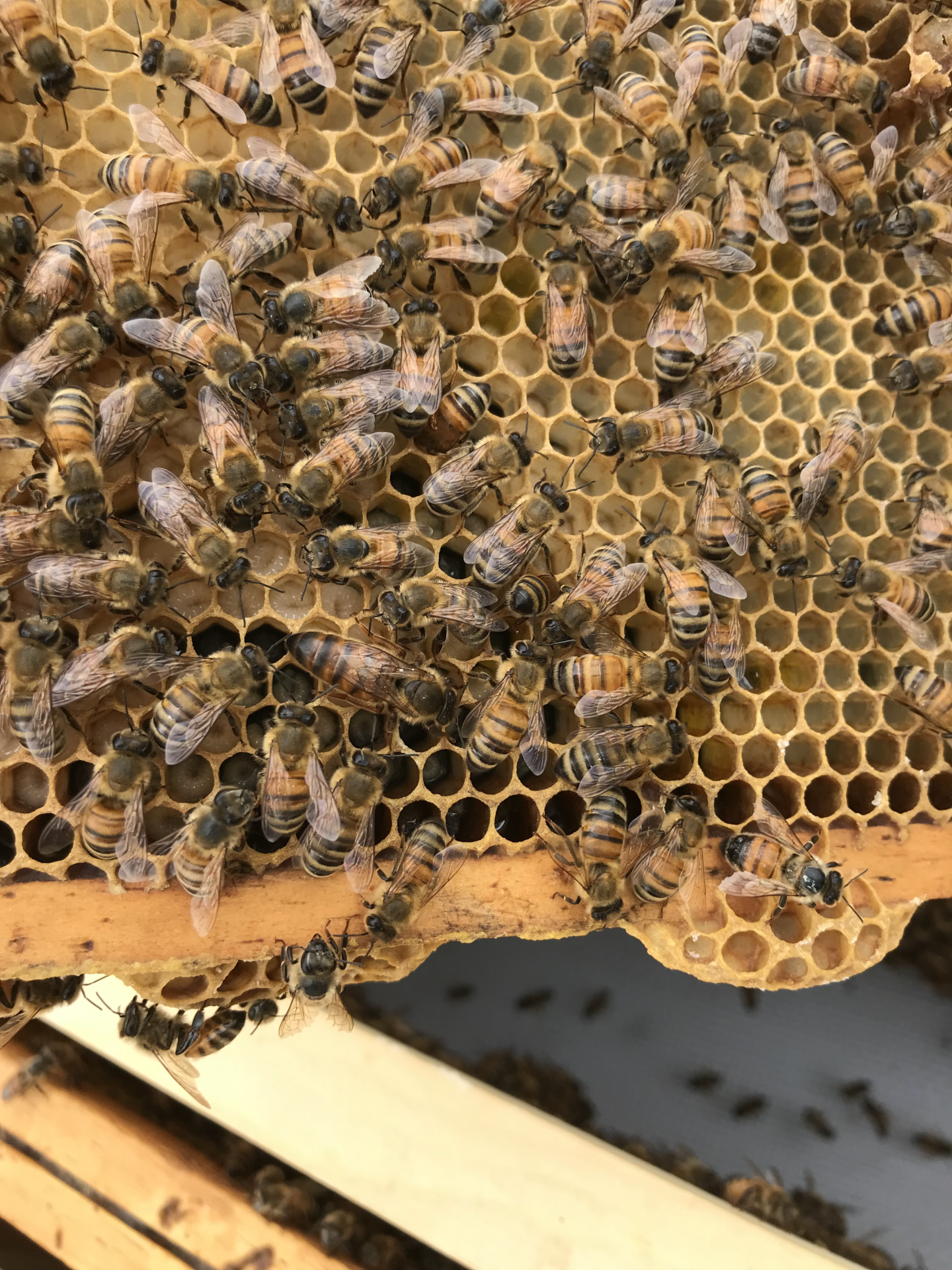
It is not necessary to find the queen to verify she is laying. Seeing eggs, young larvae, and ample capped worker brood indicates she is present and well-mated (Figure 1 and 2) However, there are occasions when a beekeeper must locate the queen, usually to replace her. As a solo beekeeper, I use a combination of the “immediately look in the location the queen is most likely to be” and the “split box” method.
For example, in August 2021, one of my hives called Tadpole had clinical signs of chronic bee paralysis virus (CBPV) that persisted for several months. CBPV is not known to be vectored by Varroa but can be more severe in a colony with high Varroa loads, so I verified via multiple mite samples that Varroa was well below threshold. One recommendation to remedy CBPV is to requeen, so I had to locate her to remove her.1
Tadpole was in a deep and 2 mediums. From a prior inspection, I had noted in my bee journal the presence of brood in all stages on frames 2 through 4 (counting left to right from the back) in the deep.
Using very little smoke which can induce the queen to run, I removed the top two mediums and set them into their own flipped over telescoping cover, covering each with a pillowcase because August is robbing season in Kentucky. Splitting the boxes up prevents the queen from running between boxes.
I then started pulling frames from the deep. I pulled the left outermost frame, frame 1, methodically scanned it for the queen from left to right, top to bottom. Not finding her, I hung it on my frame holder outside the box. I pulled frame 2, scanned it, and placed it on the frame holder as well. I pulled frame 3, scanned it, and placed it in the ample space vacated by frames 1 and 2, making it harder for the queen to walk to a frame I already scanned. I pulled frame 4 and found the queen on the right side.
As is often the case, the queen was where previous inspections indicated she was most likely to be. Had I not found her on the first pass in the deep, I would have placed a pillowcase over it and moved to the medium that was above it, repeating the process until I located her.
Tip #10: Pulling Honey
There are several ways to pull honey and remove the bees, such as a fume board, bee escape, or leaf blower.2 A medium box of honey weighs about 50 pounds, so carrying it any distance can be difficult.
When pulling honey, I prefer the frame-by-frame shake, brush, and walk method (Figure 3). In the back of my car, I place a hive body inside a flipped-over sturdy telescoping cover, covered with a second lightweight telescoping cover. I pull a single honey frame from the hive, give it a shake into the box, another shake in front of the hive, then walk and brush with my bee brush, as I carry the frame towards my car. After I’ve brushed and shook all the bees from the frame, I place the frame into the box and close the lid to keep it bee-free. Walking and brushing keeps the bees from congregating around me and encourages them to fly back to the hive.
When I get to my house, I must lift the full box of honey out of my car and carry it a short distance inside. The sturdy bottom telescoping cover is essential, as it bears the full weight of the box of honey (Figure 4).
Tip #11: Moving a Hive
Moving a full-sized hive is one time the solo beekeeper should ask for help. However, there are rare occasions when a hive must be moved urgently, and the solo beekeeper may be compelled to attempt the move alone.
One method is to separate the hive bodies, placing each box on its own bottom board with its own cover, secured with ratchet straps. Once the hive is at the new location, the hive is re-assembled. If moving the hive any distance or in warm weather, ensure there is ample ventilation, so the bees do not suffocate.
If the original and new hive locations are where a vehicle can back up to them, there is a second option. The beekeeper can carefully jack up the hive until it is the height of the bed of the vehicle, then slide the hive into the vehicle bed.
One late afternoon in August 2024, I was made aware of a bear in the area where I keep two colonies. I strongly suspected my colonies would not survive through the night. Disassembling the hives to move them was undesirable for several reasons and friends were unavailable to help me on short notice. My choice was to leave the hives in their current location and risk them being destroyed by the bear or attempt the move alone.
Figure 5 shows the process I used to move the two colonies in this emergency. Luna hive was an 8-frame deep with two mediums, and weighed 140 pounds. First, I removed the top medium and cleared the bees from it. There were too many bees to fit into a single deep, so I could not remove the second medium. Instead, I removed the telescoping cover and attached two ratchet straps flush with the sides and top to secure the bottom board, deep, medium, and inner cover. These actions reduced the total hive weight to 96 pounds. Yet, weighing 110 pounds myself, it was still too heavy for me to dead lift it up and into the higher bed of my vehicle.
At dusk after the bees were all in, I closed up the entrance, then carefully tilted the hive to the left and inserted a 4-inch-tall cinder block under the right side. Then, I tilted the hive to the right and inserted a second cinder block under the left side. I repeated this process with cinder blocks 3 and 4, which raised the whole hive to the desired height. I backed up my side-by-side, then slid the hive into it. After securing the hive in the back, I drove to the new location and reversed the process.
You Got This
Beekeeping is filled with opportunities to solve problems, innovate, and demonstrate tenacity. For solo beekeepers, our triumphs, our struggles, and our failures are all our own. If you are a solo beekeeper, write to me and share your innovations. I’d love to learn what works for you.
REFERENCES
1Dittes et al. (2020) provide a comprehensive study of the transmission routes and relationship of chronic bee paralysis virus and Varroa.
Dittes, J., Schäfer, M. O., Aupperle-Lellbach, H., Mülling, C. K. W., Emmerich, I. U. (2020). Overt infection with chronic bee paralysis virus (CBPV) in two honey bee colonies. Veterinary Sciences, 7(3),142. https://doi.org/10.3390/vetsci7030142
2Caron and Connor (2013) provide an excellent review of the methods for removing a super of honey on pages 245-247.
Caron, D. M., Connor L. J. (2013). Honey Bee Biology and Beekeeping, Revised Edition. Wicwas Press, Kalamazoo, MI.
