
Part 1
By: Vanessa Corby-Harris and Milagra Weiss
1 Carl Hayden Bee Research Center, USDA-ARS, Tucson, Arizona, USA


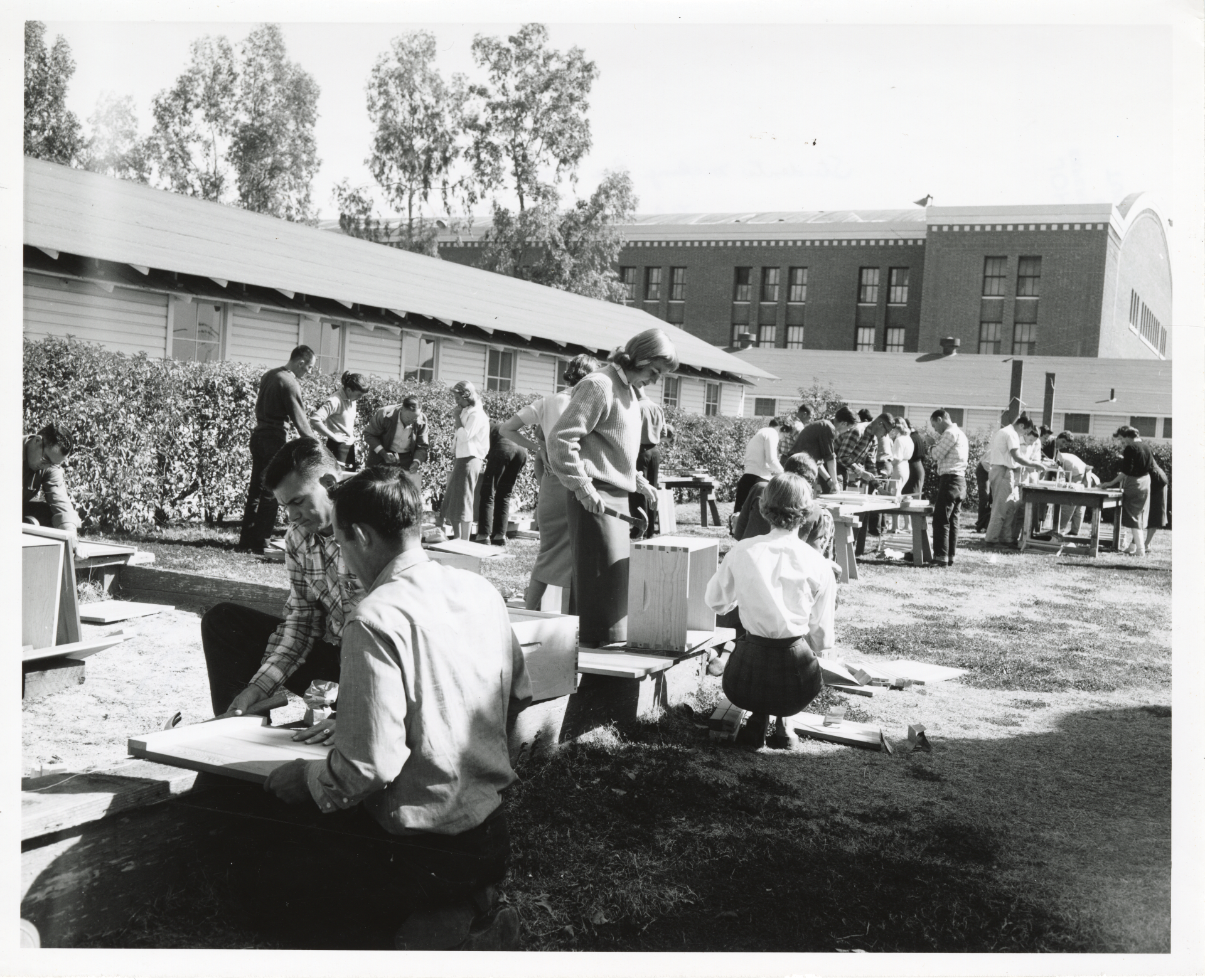
Credit: Special Collections, The University of Arizona Libraries.

Credit: Special Collections, The University of Arizona Libraries.
Hello and best wishes from the Carl Hayden Bee Research Center! This is the first of four articles to highlight the history of our Center, our work and mission, our experiences beekeeping in the desert Southwest, and more. We are grateful to Bee Culture for this opportunity to tell these stories to the wider beekeeping community. We are also happy to reintroduce ourselves after the departure of our long-time Research Leader, Dr. Gloria DeGrandi-Hoffman. Gloria is still active in the research community, but now as a collaborator and cooperator. We also recently and reluctantly celebrated another milestone with the retirement of Dr. William Meikle. Both Gloria and William left indelible marks on our Center through their leadership, friendship, and service to a generation of researchers and the beekeeping community.
The Carl Hayden Bee Research Center (CHBRC) is located in the middle of Tucson, Arizona, 3 ½ miles north of the University of Arizona. The lab started in a small stucco building at the University of Arizona in 1949 before moving to its current location north of campus in 1966. When our Center was established in 1949, the Tucson metro area had 141,216 residents. Today, metro Tucson has 1.04 million residents! Housing also increased tenfold between 1950 and 2020. What started at the University is now part of a research campus in the center of busy midtown Tucson.
Let’s first look back at the history of the Carl Hayden Bee Research Center – our beginnings and the people who shaped the Center.
In the 1930s and 40s Arizona beekeepers suffered high colony losses due to arsenic insecticide application in cotton. Arizona beekeeper, Clarence Benson, voiced his concerns about pesticide effects on honey bees to Congress and convinced the USDA to assign Dr. Samuel E. McGregor to study pesticide and pollinators in Arizona between 1945-47. Dr. McGregor’s research led to recommendations for safer insecticide use in the presence of honey bees. As the development and use of new types of pesticides rapidly expanded, there was increased need for new research on the effects of agricultural pest management on honey bee health. Mr. Benson continued to call for investment in bee research in Arizona and found an important ally in Senator Carl T. Hayden. Hayden pursued and successfully passed appropriations for the establishment of a federally funded bee research laboratory in Arizona, with cooperation from the University of Arizona in 1949. USDA scientists Dr. Frank E. Todd and Dr. McGregor were transferred to Tucson to formally start the Southwestern Bee Culture Laboratory on the University of Arizona campus. Dr. Todd, who had been performing entomological research in Logan, Utah and Yuma, AZ investigating alfalfa pollination, was appointed as the lab’s first Research Leader. The focal points of research at the Southwestern Bee Culture Lab throughout the 1950s were honey bee-pesticide interactions and cotton, melon, and alfalfa pollination.
The 1960s were a time of growth for bee research in Tucson. The USDA lab moved from the University of Arizona campus to 3 buildings on 5.3 acres on Allen Road in 1963. Through continued advocacy by Mr. Clarence Benson and Senator Carl Hayden, funds were appropriated in the early 1960s for a new USDA research facility on Allen Road. Construction of the new 16,000 square foot building was completed in 1966.
The 1960s were also a time of several leadership changes in Tucson and to the national bee research programs. In 1962, Dr. Todd was transferred to Beltsville to head the national honey bee research program, and Dr. McGregor became the new Research Leader in Tucson. Dr. McGregor left Tucson in 1965 to replace Dr. Todd as chief in Beltsville and Dr. Marshall D. Levin (formerly of the Logan, UT lab) became the new Research Leader in Tucson. Dr. Levin oversaw the completion of the new USDA Bee Research Laboratory in 1966 and then transferred to Beltsville in 1969 as the new Chief of Apiculture Research for ARS, while Dr. McGregor returned to Tucson. Throughout all these shifts, Drs. Todd, McGregor, and Levin continued to contribute critical research on safflower, cucumber, melon, alfalfa, and cotton pollination.
Dr. Lonnie N. Standifer took over the Research Leader role in 1970. The new laboratory space enabled a staff expansion to include 9 research scientists and 4 collaborating scientists. The lab’s research program also expanded in scope. New topics of interest included basic honey bee biology and nutrition, bee behavior, microorganisms, and improvements in colony management and artificial bee diets. Major advances in these areas were made by Drs. Standifer, Martha Gilliam, Gerry Loper, Joseph O. Moffett, N. M. Kauffeld, Roy J. Barker, Brenda Lorenz, Dorothy Prest, Yolanda Lehner, Michael R. Kunzmann, and Steven Taber. Dr. McGregor published the seminal pollination handbook, Insect Pollination of Cultivated Crop Plants in 1976. The Tucson lab was officially renamed in honor of Senator Carl Hayden on October 10, 1978.
When Dr. Standifer retired in 1982, Dr. Levin returned to Tucson as Research Leader until 1986. Upon closure of the USDA bee lab in Madison, Wisconsin, Dr. Eric H. Erickson was transferred to Tucson as the new Research Leader. Throughout the 1980s and 90s, the research scope in Tucson again expanded to include work on the newly introduced Africanized honey bees, while Drs. Stephen L. Buchmann, Martha Gilliam, Justin Schmidt, Hayward Spangler, James R. Hagler, and Steven C. Thoenes continued important research on swarming, chalkbrood, tracheal mites, pollination, microbiology, and nutrition.
Varroa mites were pushed to the forefront of honey bee research in the 2000s. Dr. Gloria DeGrandi-Hoffman became Research Leader in 2002. Together with Dr. Diana Sammataro, the lab shifted its focus to mite population dynamics and novel control tactics. Traditions of crop pollination and nutrition studies continued. Key cooperative research agreements with industry partners enabled initial versions of supplemental diets and miticides.
Drs. Kirk Anderson, Mark J. Carroll, Vanessa Corby-Harris and William Meikle joined the lab in the 2010s to expand research on the bee microbiome, nutrition, and pesticides. They also introduced new research on queen behavior and continuous hive monitoring. Key partnerships and collaborations with commercial beekeepers enabled the study of colony-level issues in migratory beekeeping contexts. Today, we work toward the mission “… to conduct research to optimize the health of honey bee colonies, through improved nutrition and control of Varroa mites in order to maximize production of honey bee pollinated crops.” Details on how we address that mission statement will follow in subsequent articles.
In addition to re-introducing our Center, research, and people, we also want to create open lines of communication with our stakeholders. Do you recognize any of the names we mentioned? Do you have a story about the CHBRC to share? What are your most pressing beekeeping challenges? Scan the QR code to access a short form where you can share your thoughts with our team.

Top 10 Most Cited Papers With CHBRC Authors
Cox-Foster, Diana L., et al. “A metagenomic survey of microbes in honey bee colony collapse disorder.” Science, vol. 318, no. 5848, 2007, pp. 283–287. https://doi.org/10.1126/science.1146498.
DeGrandi-Hoffman, Gloria, et al. “The effect of diet on protein concentration, hypopharyngeal gland development and virus load in worker honey bees (Apis mellifera L.).” Journal of Insect Physiology, vol. 56, no. 9, 2010, pp. 1184–1191. https://doi.org/10.1016/j.jinsphys.2010.03.017.
Gilliam, Martha. “Identification and roles of non-pathogenic microflora associated with honey bees.” FEMS Microbiology Letters, vol. 155, no. 1, 1997, pp. 1–10. https://doi.org/10.1111/j.1574-6968.1997.tb12678.x.
Engel, Philipp, et al. “The bee microbiome: impact on bee health and model for evolution and ecology of host-microbe interactions.” mBio, vol. 7, no. 2, 2016. https://doi.org/10.1128/mBio.02164-15.
Corby-Harris, Vanessa, Patrick Maes, and Kirk E. Anderson. “The bacterial Communities associated with honey bee (Apis mellifera) foragers.” PLOS ONE, vol. 9, no. 4, 2014, e95056. https://doi.org/10.1371/journal.pone.0095056.
Alaux, Cédric, et al. “Honey bee aggression supports a link between gene regulation and behavioral evolution.” Proceedings of the National Academy of Sciences of the United States of America, vol. 106, no. 36, 2009, pp. 15400–15405. https://doi.org/10.1073/pnas.0907043106.
Schneider, Stanley Scott, Gloria DeGrandi-Hoffman, and Deborah Roan Smith. “The African honey bee: factors contributing to a successful biological invasion.” Annual Review of Entomology, vol. 49, 2004, pp. 351–376. https://doi.org/10.1146/annurev.ento.49.061802.123359.
DeGrandi-Hoffman, Gloria, and Yanping Chen. “Nutrition, immunity and viral infections in honey bees.” Current Opinion in Insect Science, vol. 10, 2015, pp. 170–176. https://doi.org/10.1016/j.cois.2015.05.007.
Schmidt, Justin O., Steven C. Thoenes, and M. D. Levin. “Survival of honey bees, Apis mellifera (Hymenoptera: Apidae), fed various pollen sources.” Annals of the Entomological Society of America, vol. 80, no. 2, 1987, pp. 176–183. https://doi.org/10.1093/aesa/80.2.176.
Dietemann, Vincent, et al. “Varroa destructor: research avenues towards sustainable control.” Journal of Apicultural Research, vol. 51, no. 1, 2012, pp. 125–132. https://doi.org/10.3896/IBRA.1.51.1.15.

References
Benson, C.L. (1987). Letter to the Editor of Modern Maturity: Bee Lab History
Carruth, L.A. (1950). The Southwestern Bee Culture Laboratory. Progressive Agriculture in Arizona.
DeGrandi-Hoffman, G. (2016). A visit with Tucson Bee Lab leader Gloria DeGrandi-Hoffman (interview with J. Hayes). Bee Culture.
Hotchkiss, A.S. (1962). Todd the bee man goes To Beltsville. Progressive Agriculture in Arizona.
McGregor, S.E. (1976). Insect pollination of cultivated crop plants. Washington, D.C.: US Department of Agriculture, Agricultural Research Service.
Rice, V.H. (2024). Tucson then and now: what has changed over 75 years. https://www.azeconomy.org/2024/11/demographics-census/tucson-then-and-now-what-has-changed-over-75-years/ (Accessed September 2026)
Standifer, L.N. (1978). Research In The USDA-SEA Bee Research Laboratory at Tucson Arizona. American Bee Journal, pp. 544-547: Dadant and Sons.
Unknown author (1968). New federal honey bee laboratory opened in Tucson. Progressive Agriculture in Arizona.
Weaver, R.S. (1968). New USDA Bee Lab. American Bee Journal.