
Selling Honey Through Season, Story and Trust
By: Fiach O’Broin -Malloy


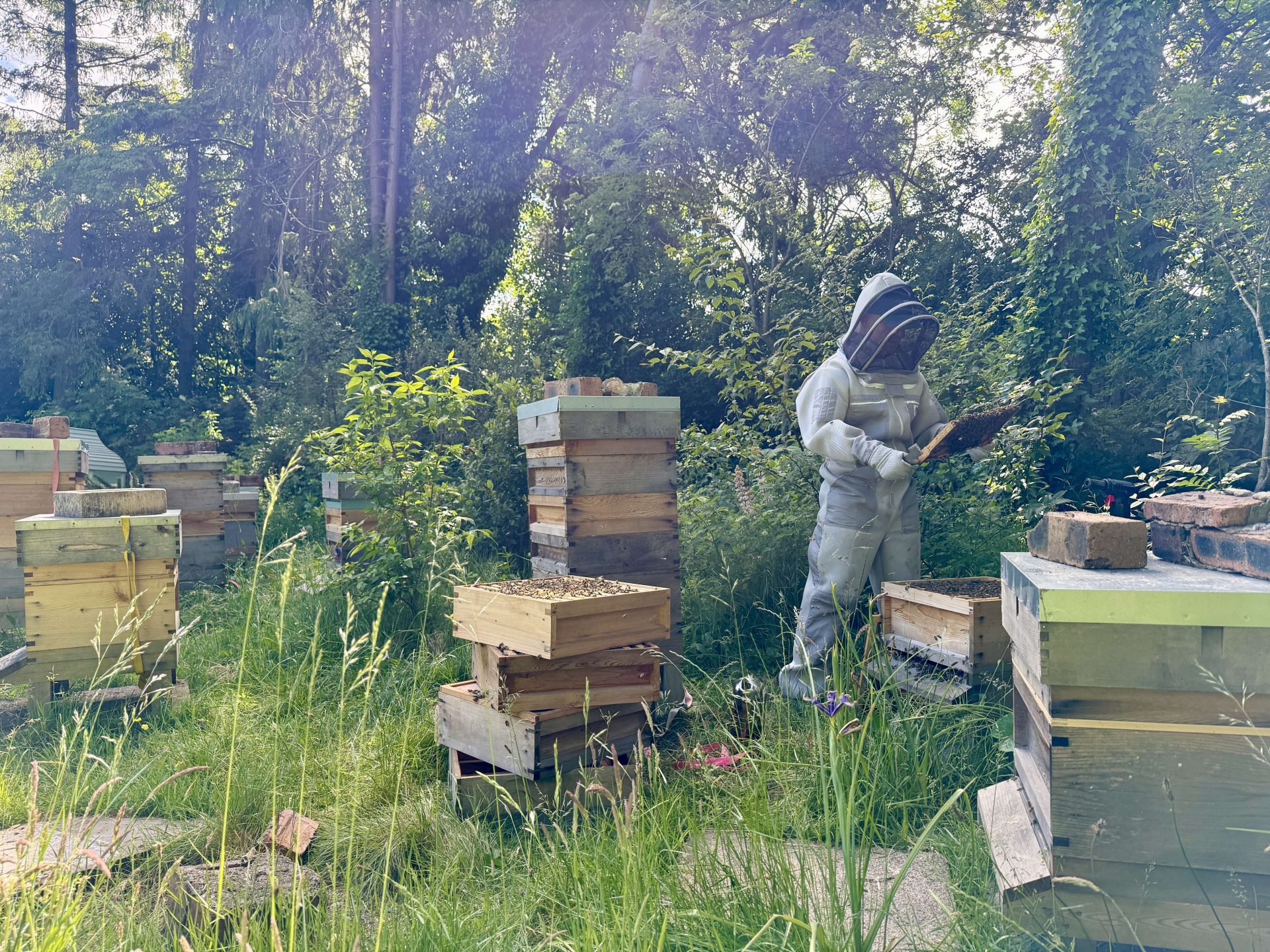
a Summer inspection at the Paisley Honey apiary.

The Atlantic does not sit beyond our apiary merely as scenery. It enters every harvest decision as rain, wind, temperature and a narrowing number of days in which bees can fly. By mid-to-late August, Autumn is already beginning to make itself felt in the west of Scotland. The question is not simply how much honey is present, but how much is ripe, what the colonies can safely spare, whether another useful flow may come, and how much time remains for feeding, treatment and winter preparation.
At Paisley Honey we take one modest harvest each year. This is not a rule for Scottish beekeeping, nor a method that I would prescribe everywhere. It is the model that has grown from our particular conditions. The western season is cool, wet and frequently interrupted. Flowers can be plentiful while wind or rain keeps the bees at home. The Spring flow falls away into the familiar June gap, and we do not have the broad, predictable acreage of oilseed rape (canola to American readers) found in more arable districts. Abundance comes, but often in brief openings.
Taking one harvest concentrates a season of judgement into a single decision. I am watching colony strength, the weight of stores, the proportion of capped honey, its moisture, the forecast and the forage still available. I must also leave enough time after removing the supers to assess stores, feed where necessary, treat for Varroa and help the colonies prepare for Winter. The aim is not to remove everything that can be extracted. It is to recognise what the bees can responsibly spare.
This year has sharpened that perspective. The moisture and relative coolness of our Atlantic position, so often experienced as constraints, have also felt like a form of shelter while other parts of Europe have endured extreme heat, drought and fire. Here, damp weather before the lime flowered was followed by sunshine at the right moment, and the colonies made good use of it. There is no triumph in being spared what others have suffered, only gratitude and a renewed awareness that the same weather can be limitation one year and mercy in another.
Living with that uncertainty requires a particular quality of attention. There is an old custom, found in Ireland, Britain and elsewhere, of “telling the bees”: informing the colonies of births, marriages, deaths and other changes in the household. We speak to our bees more ordinarily while working among them, telling them why we are opening a hive, what we are seeing, or what we need to do. I make no claim that they understand the words. The practice changes the beekeeper. It slows my hands, sharpens my attention and reminds me that harvesting is an intervention in a living community, not simply the removal of a crop. Perhaps this is reverence, but it is practical reverence. It appears in steadier handling, closer observation and a willingness to accept a smaller crop than hoped.
That obligation to speak honestly travels outward. Long before there is honey to sell, customers follow the colonies through seasonal updates. The story develops in the same order as the season itself: Spring growth, the June gap, changing forage, interrupted weather and, eventually, the approach of harvest. I share the progress, but also the delays and setbacks. Customers therefore understand that the crop cannot be guaranteed and will not be identical from year to year. By the time honey becomes available, its scarcity requires very little explanation. Anticipation has grown from witnessing a real process rather than from an artificial countdown or a manufactured shortage. The eventual sale is not the beginning of the relationship, but the culmination of a season the customer has already followed.
Frame sponsorship offers a simple form of participation. A customer chooses a name or short dedication to be engraved on a wooden hive frame. It is photographed as it enters an active colony and remains there as part of the working hive. At installation, the sponsor receives an online folder of social-media-ready images, plus a card containing selected photographs of the frame in situ. These shareable images have increased the apiary’s social-media reach. Alongside Paisley Honey’s handmade work, sponsorship provides income when no honey is available, reducing pressure to enlarge the apiary or ask every commercial expectation to be carried by the bees.
The result is straightforward: our modest annual harvest sells out each year while the apiary remains at a scale I can manage responsibly. The transferable lesson may not be to adopt one harvest specifically. It is to begin communicating before there is anything to sell, to make genuine limitations understandable, and to build other forms of participation around the apiary. Scarcity becomes trustworthy when customers have already seen where it came from.
One harvest works for us because the marketing follows the bees and the weather, not the other way around. We tell the bees what we are doing. We tell our customers what the season has allowed. Between those two conversations, the honey finds its place.
