

Part 1
Click Here if you listened. We’d love to know what you think. There is even a spot for feedback! Read along below!
By: Ross Conrad

While yellow-legged hornets and reduced oversight and regulation of pesticides and pollution at the EPA are a couple of the latest concerns that have potential to be a major threat to the U.S. beekeeping industry, tropilaelaps mites are a major concern for many. As a result, researchers have been working furiously to learn more and some results have become available in papers published during the first half of 2026.
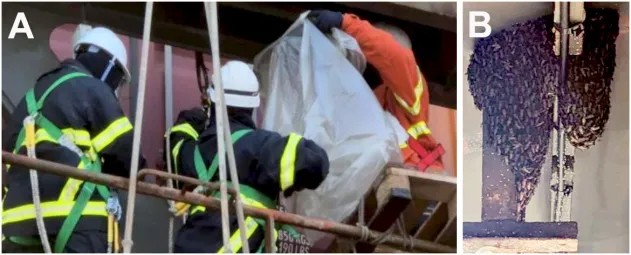
A report titled, “Interception of an Apis dorsata swarm with Tropilaelaps mercedesae and Kuzinia morsei mites on a cargo vessel inbound to the United States” was published in May in the journal Frontiers in Insect Science. (Ramirez et al., 2026) It documents last year’s event when a swarm of giant honey bees (Apis dorsata) that was carrying Tropilealaps mercedesae and Kuzinia morsei mites was prevented from making landfall on U.S. soil. (see figure 1)
Previous studies indicate that tropilealaps is unable to survive on European honey bees (Apis mellifera) without access to uncapped honey bee larvae for more than 2-3 days. The mite has adapted however to survive on adult giant honey bees (their natural host) for many weeks when necessary. This is because A. dorsata are known to not just swarm, but to regularly abscond. Most populations abandon their comb during seasonal migrations and travel to new nesting sites when local nectar and pollen quality and abundance deteriorates.
Previous research indicates that migrating giant honey bees may take a month, or more to reach their final destination. (Koeniger and Koeniger, 1980) Study the map of Tropilaelaps’ current known distribution on both its natural hosts and European honey bees, and you see that the swarm probably originated either in India (Mundra) or Pakistan (Karachi).
There were a total of 78 different days where the swarm of Giant honey bees could have landed on the cargo vessel (70 days before the ship originally left Mundra Port, and another 8 days while the ship traveled along the coast and was docked in Karachi.) Depending on when the swarm landed on the ship, the Tropilealaps mites migrating with the swarm survived a minimum of 17 days, and a maximum of 82 days without access to brood.


A new mite of concern?
Not given much notice in the original press on the swarm intercepted on its way to a U.S. port was the presence of another mite, K. morsei, migrating with the swarm of Giant honey bees.
The papers authors noted, “While little is known about Kuzinia morsei, several Kuzinia species are known to be associated with bumble bees (Bombus spp.) and distributed across the Neartic, Paleartic, Neotropical and Oriental biogeographic realms. These species are known to feed on pollen, honey, bumble bee cocoon material, nematodes, and fungi, but the effect on bees living with these mites is currently unknown. The immature Kuzinia deutonymphs are known to disperse on adult bumble bees. The co-occurrence of multiple mite species on A. dorsata dorsata raises important questions about potential mite-mite interactions, their impact on colony health, and whether different mites have evolved similar host-specific survival adaptations.” (Ramirez et al., 2026)
The question of T-mite survival
The ability for mites to migrate by hitching a ride on foraging, robbing, swarming and drifting European honey bees (Apis mellifera) is well documented. This is especially true for A. mellifera drones that are known to regularly drift widely and be accepted into most any colony that they attempt to enter. It is this fact that raises questions about the accuracy of the results of another 2026 article that claims to have documented Tropilaelaps surviving swarming events in European honey bees (Uzunov et al., 2026).
The cargo vessel interception report refers to this recently published study by Uzunov, et al., “…their study revealed limited survival capacity, with mites surviving only 4–6 days in the absence of brood when associated with A. mellifera, a non-native host species. This short survival duration contrasts with the extended broodless periods experienced by T. mercedesae’ natural host, the giant honey bee (Apis dorsata), which spends several weeks in migratory cycles with no brood production. This apparent mismatch between T. mercedesae survival capacity on non-native hosts and the bio-ecological requirements of the natural host migration patterns suggests that T. mercedesae may possess host-specific adaptations that allow its survival during extended broodless periods on native hosts. Understanding these survival mechanisms is critical for predicting T. mercedesae dispersal and developing effective management strategies.” (Ramirez et al., 2026)
Observations of a natural swarm
Since previous published reports all document that Tropilaelaps die within 2-3 days without access to uncapped brood, the reference to a 4-6 day survival time caught my attention. In this referenced study, researchers followed a natural A. mellifera swarm from a Tropilaelaps infested colony that was caught in the former Russian empire country of Georgia. When the first worker brood raised by the swarm was inspected, four T. mercedesae mites were discovered. The study’s authors state that the findings “demonstrate a mechanism for T. mercedesae to achieve extended dispersal into new territories.”
During the study, researchers only opened the entrance to the hive for 5 hours a day to allow the colony to forage in order to limit the potential for drifting drones from other infested colonies in the area from entering the hive. Unfortunately, this precaution does not guarantee that absolutely no drones from other colonies that may be carrying a Tropilaelaps mite entered the study hive during the trial. This makes their conclusion that the mite is normally capable of surviving a natural swarming event less than conclusive.
Observations of artificially created swarms
The researchers in this reference study also looked at the survival of phoretic mites in artificially created, broodless, queenright colonies to test whether T. mercedesae could survive a swarming event. Two colonies infested with Tropilaelaps “were moved 10 m (meters) away from their original positions. Two hive boxes, each with 4 frames of drawn combs, which contained honey and pollen, were placed on the original sites of the source colonies. These drawn combs were sourced in advance from T. mercedesae free colonies, which for the past 5 yrs. had only received organic acid based miticide treatments, thus minimizing the risk of the presence of acaricide residues in the wax. Prior to use, the combs were visually inspected for the presence of mites using a magnifying glass and stored for 7 days at minus 20 °C (-4˚F). The original queens were transferred to the two hives, and their respective foragers were allowed to return to create two artificial (age-biased) swarms…The entrances were closed to prevent bees from exiting the hive, and custom-made ventilation openings were included in the bottom board to ensure air flow.” (Uzunov et al., 2026)
Contradictory results
Over a dozen mites were found reproducing in the brood comb of the newly hived natural swarm, but not the artificial swarms the team created: “…following their successful movement to the new hive, mite survival differed between the natural and artificial swarms. The T. mercedesae mites, which successfully transferred from source colonies to artificial swarms 1 and 2, all died within 6 and 4 d (days), respectively. No mites were found in the sealed brood at day 12, no mites were able to reproduce, and all the mites which were found on the bottom boards (natural mortality) seemed shrunken (non-gravid). T. mercedesae are known to bite 2nd and 3rd instar larvae, but in a study on T. clarae (Woyke 1994) it was found that mites feeding on larvae younger than 3.5 d old survival was 2 d (days) at the most.” (Ed. Note: the mites referenced in the Woyke study were Tropilaelaps clareae and not Tropilaelaps mercedesae so the T. clareae data may, or may not apply to T. mercedesae.)
So, in this trial, the Tropilaelaps mites were able to survive in the natural swarm, but were unable to survive in the split given drawn comb so the queen could start laying eggs immediately and the workers did not have to build comb from scratch like most swarms. This inconsistency further raises questions about the researcher’s initial conclusion that mites can survive migrating with a swarm and strengthens the idea that drifting bees may have compromised the results where the mite survived a natural swarming process.
It is interesting to note however, that in a study published last year, “Mites survived for over 96 hours (4 days) on live adult A. mellifera, over 144 hours (6 days) on decomposing pupae, and up to 168 hours (7 days) on decomposing adults. These findings demonstrate the mite’s ability to survive for extended periods without access to live brood, challenging existing assumptions about its biology and survival limits.” (Gill, M.C. et al., 2025)
So how long can the Tropilaelaps survive in a European honey bee colony without access to its primary food source, uncapped brood? It is 2-3 days as previously reported in past research or 4-6 days? How does this apply to swarm and splits made from A. mellifera? The answers to such questions are critical if we are to fully comprehend the true risk of mite transmission between localities and the potential success of proposed management strategies for Tropilaelaps control.
Unfortunately, there’s a lot we just do not know about Tropilaelaps mercedesae. As a result, none of us really understands how great their impact will be should they ever successfully make their way to the United States.
Despite these ongoing questions, some relatively useful news was also reported in the scientific literature and next month in Part 2, we will continue looking at some of the latest research on Tropilaelaps monitoring methods and potential treatment options.
Ross Conrad is the Author of Natural Beekeeping: Organic approaches to modern apiculture, Revised and Expanded 2nd Edition, and The Land of Milk and Honey: A history of beekeeping in Vermont.

References:
Gill, M. C., Chuttong, B., Davies, P., Earl, A., Tonge, G., Etheridge, D. (2025). In vitro assessment of Tropilaelaps mercedesae survival across different substrates. Apis, 2(2), 24-29. https://doi.org/10.62949/02634299.0581119
Koeniger, N., and G. Koeniger, (1980) Observations and experiments on migration and dance communication of Apis dorsata in Sri Lanka, Journal of Apicultural Research, 19: 21–34.
Ramirez, J.L., Tembrock, L.R., Zink, F.A., Fife, A., Gilligan, T.M., Chen, Y., Evans, J.D., Mottern, J., Smith-Pardo, A.H., Ochoa, R. (2026) Interception of an Apis dorsata swarm with Tropilaelaps mercedesae and Kuzinia morsei mites on a cargo vessel inbound to the United States, Frontiers in Insect Science, Volume 6. https://doi.org/10.3389/finsc.2026.1829350
Tokach, R., Seshadri, A., Rogers, S.R., Chuttong, B., Jung, C., Williams, G.R. (2026A) Global range of Tropilaelaps mercedesae, Journal of Apicultural Research, 1-5 https://doi.org/10.1080/00218839.2026.2645867
Uzunov, U, Janashia, I, Chen, C, Costa, C, Kovačić, M, Gill, M.C., (2026) Swarming promotes Tropilaelaps mercedesae (Mesostigmata: Laelapidae) dispersal in Apis mellifera (Hymenoptera: Apidae), Journal of Economic Entomology, 119(2): 1473–1477, https://doi.org/10.1093/jee/toag027
Woyke J. (1994) Tropilaelaps clareae females can survive for four weeks when given open bee brood of Apis mellifera, Journal of Apicultural Research, (33)21-25 10.1080/00218839.1994.11100845