
A Comparison of Different Methods to Estimate Varroa Mite Infestation
Kim Guillemette (NSCU) & David Tarpy (NSCU)
Background
Whether one is an experienced beekeeper or a novice, navigating the management of Varroa mites can be confusing. Control measures can be complex, including temperature restrictions, whether or not honey supers can be on hives during application, and variations in delivery. Many integrated pest management (IPM) strategies and best management practices (BMPs) seem to conflict or even compete with one another. The most important underlying necessity when implementing any Varroa control strategy is regular monitoring to understand the levels of mites within each colony. Even with monitoring, however, there are several options to quantify the level of infestation of Varroa mites.
One such approach uses powdered sugar to coat adult bees and dislodge mites (powdered sugar shakes or rolls). In the early 2000s, researchers at the University of Nebraska-Lincoln investigated dusts as a way to detect Varroa mites in honey bee colonies (Macedo et al., 2002). Of the dusts tested, powdered sugar proved to be an effective, low risk option. Researchers suggest three plausible reasons why powdered sugar dislodges mites. First, dust may interfere with the ability of Varroa’s ambulacra (or foot-like structure) to adhere to their host. Indeed, anatomical investigations suggest several potential mechanisms, where powdered sugar disrupts the claw-like structures enabling them to grasp, sticky pads enabling them to adhere, and possibly setae or specialized hairs on the leg that reinforces their grip (Hatjina et al., 2002). Second, dust may stimulate the honey bee to dislodge mites by self-grooming. Micholson and Currie (2024) suggest that grooming may be an important pest management strategy, as some honey bees respond to Varroa mites with more vigorous grooming than others. Third, dust might also stimulate the mite to groom and dislodge itself.
While the exact mechanism for how powdered sugar dislodges Varroa mites is still debated, the ‘sugar shake’ or ‘sugar roll’ as a diagnostic tool has been widely accepted by hobbyist and sideliner beekeepers alike. Reasons for using powdered sugar include its low cost, widespread availability, non-toxicity, ease of storage, and being environmentally friendly. The powdered sugar roll is usually proclaimed as non-destructive to the honey bees being tested, which can be re-introduced back to their hive. However, powdered sugar may not be the most reliable method to estimate mite infestations in a honey bee colony, thus the powdered sugar roll may represent a tradeoff between accuracy and convenience.
To further complicate matters, there are several different recommendations of how to properly conduct a powdered sugar shake. A search of the internet and literature for instructions yielded four unique sets of instructions (full instructions in Appendix B): (1) USDA Agricultural Research Service (USDA); (2) Honey Bee Health Coalition (HBHC); (3) Betterbee Beekeeping Suppliers (BB); and (4) Dewey Caron’s textbook Honey Bee Biology and Beekeeping (3rd edition) (Caron). Instructions vary in the amount of powdered sugar to be applied, time spent shaking and rolling, and whether to rest the jar in sunshine or shade. Some instructions are of short duration while others take longer or involve more manipulation. With such respected sources, how does one decide which set of instructions to follow? And does one method work better than others? Are the bees equally unharmed in each of these techniques?
The goal of this study was to determine if the powdered sugar roll is as reliable as an alcohol wash when determining the infestation of Varroa mites, as well as to compare the results of these four different methods.
Approach
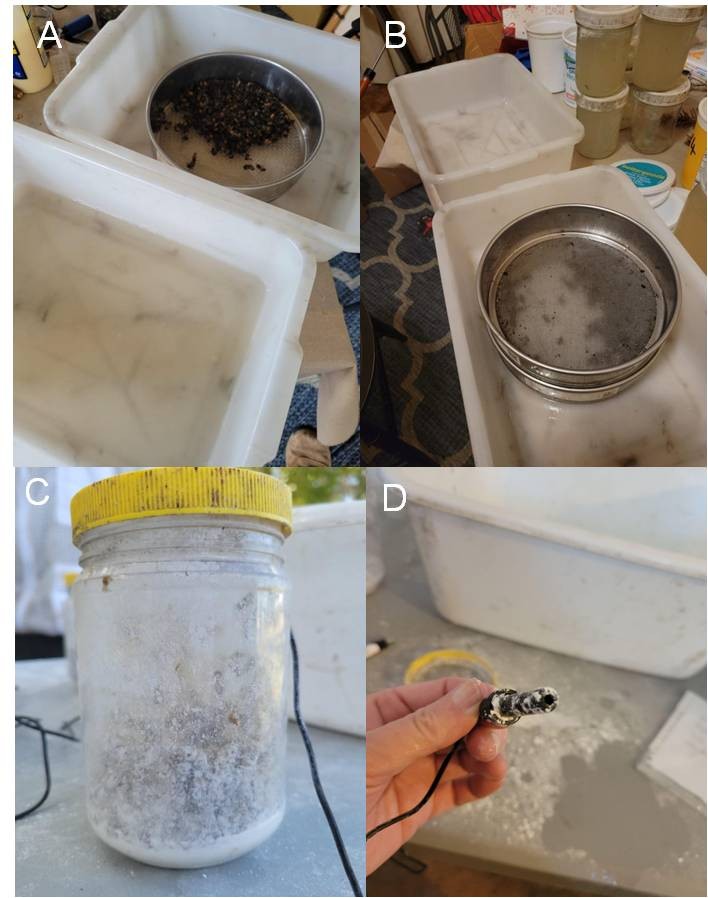
Before doing any testing, we needed to resolve two important issues. First, to calculate efficacy, we needed to define and test a reliable method of recovering all mites so that we can determine the number of mites left behind from a powdered sugar roll. We therefore employed an alcohol wash using the double strainer/double tub method, as this was the protocol used by the Bee Informed Partnership’s Technical Transfer Team and was favorably compared to alcohol washes completed in the USDA Bee Research Laboratory in Beltsville, Maryland. This method employs a soil strainer with a coarse screen capable of catching bees but allowing mites to wash through (Figure 1A) followed by a fine screen allowing the alcohol to pass through but catching the mites (Figure 1B). The alcohol is alternately poured through the soil strainers between two tubs to accumulate the mites. This process is repeated until two consecutive washes fail to yield any new mites in the tub. To validate this method for the study, samples of bees were added to a jar with 91% isopropyl alcohol solution and agitated for no less than one minute. The samples were then poured through the strainer system until no new mites were measured. Next, the bees were visually inspected for attached mites, and then were vigorously washed with copious water to dislodge any mites still in the bodies of the bees. In all, we tested 10,952 bees and yielded no attached mites and four detached mites (0.04% error). This makes this alcohol wash method very reliable and sufficient to quantify all mites in a sample.
The second major issue that we had to address was standardizing each set of instructions for the sugar shake to ensure consistency. This was necessary to make each test repeatable over time and among different testers. Any and all vague language was strictly defined, including the timeframes for completing steps and amounts of powdered sugar. Where a range was given, the midpoint was chosen. Where times were not defined for a repeated step, the same amount of time as defined in the first occurrence of the step was used. The standardized instructions are found in Table 1.
With our total mite quantification method and sugar shake protocols determined, the study began in earnest. We tested thirty-one colonies over the course of 3 months and simultaneously quantified mite levels following each set of instructions. We repurposed peanut butter jars with lids altered to fasten #8 hardware cloth to conduct the powdered sugar rolls (Figure 1C). We taped a temperature and humidity probe inside each jar to monitoring any changes during the sugar shake (Figure 1D). Following standard methods, we then shook frames of mixed open and capped brood from a large, robust colony into a tub. The top edge of the tub was sprayed with cooking oil to inhibit bees from crawling out. Each of the four jars were filled with a ½ cup scoop of bees from the tub and randomly assigned to one of the testing conditions. Temperature and humidity were monitored for each sample during the sugar roll process and recorded in 60 second intervals. At the end of shaking the mites into a shallow pan of water, each sample of bees was transferred into a quart jar filled approximately two thirds full with 91% isopropyl alcohol solution. The alcohol wash was completed using the validated double-tub method to get the true number of mites.


Outcomes
We found that, despite variation among the four sets of instructions, there was not much of an appreciable difference among the techniques. All four methods yielded statistically equivalent Varroa load estimates (Figure 2A), although they did vary in the proportion of recovered mite compared to the total number of mites in the colony (Figure 2B). Indeed, all methods showed an underestimate of mite levels as mite load increased, suggesting that sugar shakes are conservative in their estimates especially at high mite levels. Nonetheless, none of the techniques drastically underestimated the economic threshold (Figure 2C), where only six of the 124 sugar shakes (4.5%) yielded an erroneous economic threshold. When looking at the “harvesting rates” of mites (how many mites are collected per minute of effort), the USDA technique was more efficient than the others (Figure 2D); that is, it provided the best estimate of mite load for the time taken to conduct the sugar shake.
For the most part, the powdered sugar shake is almost as good as an alcohol wash. Therefore, the powdered sugar roll is a “good enough” diagnostic tool for estimating Varroa mite infestations. This means that most of the time, irrespective of which set of instructions one follows, the results accurately reflect Varroa mite infestation and are a reasonable quantification of the economic threshold. More specifically, this study suggests that more is not always better. For example, we found that exposing the sample to sunlight for a short period of time does not significantly increase the temperature inside the jar, and thus the recommendation of placing the sample in the sun lacks empirical support (indeed, a 2025 review by Xu et al. of hyperthermia treatment for Varroa mites finds hyperthermia “remains inadequately researched”). In the end, it did not matter if we included more powdered sugar, more rolling, more shaking, more heat, more time, or more manipulation — the simple fact is that dust dislodges Varroa mites reliably and effectively.
Limitations of using powdered sugar should be mentioned and include mites adhering to the walls of the container in caked-on powdered sugar (see Figure 1C). Mites shaken into water readily climb the sides of the basin and each, other making the mite count more challenging. Mites are often in the water but covered by powdered sugar, making them hard to see without agitating the water. Powdered sugar works better when it is fresh and is difficult to keep from clumping in hot, humid weather (this can be avoided by making your own powdered sugar without corn starch! Just take normal table sugar and pulverize in a food processor, it will be very fine but less prone to clumping). To reduce clumping, it is important to close the bag tightly when not in use otherwise it can become a solid block after only a short period of time. For this study, the walls of the peanut butter jars were not rinsed or washed to remove hidden mites due to the temperature and humidity probe attached to the side wall of the container (see Figure 1D).
One should not underestimate the importance that for sugar shakes, practice makes perfect. After 31 hives, 124 sugar rolls, 1,107 mites, and 36,754 bees, the proficiency of assessing mite levels went up over time. Indeed, the volunteer beekeepers participating in the current study strongly believed that their reliability in their sugar shake increased with the number of hives completed. Owen et al. (2022) wrote that “a well-performed sugar shake may perform as well as a well-performed alcohol wash” and “that differences are probably caused by technique.” The main finding of this study is that the powdered sugar roll, despite variations in instructions, can be an effective diagnostic tool for reliably determining if the mite level in a given honey bee colony is above economic threshold. Keep in mind, a recently published study (Bruckner et al., 2025) debunks the non-lethality claim, suggesting that bees released back into the hive after a powdered sugar roll die prematurely. Future research needs to investigate if simple exposure to powdered sugar condemns the bee to a slow death. For if this is the case, the alcohol wash is the better choice for determining mite counts.

References
Bruckner, S., Williams, G., Tsuruda, J., and Underwood, R. (2025). Let’s not sugar coat it: the powdered sugar shake is not harmless for honey bee workers. Journal of Apicultural Research, DOI: 10.1080/00218839.2025.2550855.
Hatjina, F., Zacharioudakis, S., Gregorc, A., Pappas,N., and Theophilidis,G. (2002). Adhesion Mechanism of Varroa Destructor onto Apis (Mellifera Macedonica). Hellenic Institute of Apiculture (N.AG.RE.F.), 63.
Macedo, P. A.; Wu, J.; and Ellis, Marion D., (2002). “Using inert dusts to detect and assess varroa infestations in honey bee colonies”. Faculty Publications: Department of Entomology. 174. https://digitalcommons.unl.edu/entomologyfacpub/174.
Micholson, D. and Currie, R., (2024). Heightened sensitivity in high-grooming honey bees (Hymenoptera: Apidae). Journal of Insect Science, (2024) 24(3): 21; ieae057 https://doi.org/10.1093/jisesa/ieae057.
Owen, R., Stevenson, M., and Scheerlinck, J. (2022). Comparing Sugar Shake to Alcohol Wash: Is Alcohol Wash the Gold Standard?, Bee World, 99:2, 66-67, DOI:10.1080/0005772X.2022.2046367.
William B. Ramirez and Jollyanna G. Malavasi (1991). Conformation of the ambulacrum of Varroa Jacobsoni oudemans (Mesostigmata: Varroidae): A grasping structure, International, Journal of Acarology, 17:3, 169-173, DOI: 10.1080/01647959108683903.
Xu, X., Zhou, S., Huang, J., Geng, F., Zhu, X., Abou-Shaara, H.F. (2025). Influence of hyperthermia treatment on varroa infestation, viral infections, and honey bee health in beehives. Insects 2025, 16, 168. https://doi.org/10.3390/insects16020168.

in the sun lacks empirical support.

Appendix: Pictorial Steps

- There are multiple versions of the powdered sugar shake.
- Four unique sets of instructions were chosen from respected sources and standardized.
- Temperature probes were secured in jars. Each lid’s center was replaced with #8 hardware cloth.
- Frames of bees with mixed open and capped brood from a large colony were shaken into a tub. The tub was prepared with cooking spray on the top edge to keep bees from escaping.
- A 1/2 cup scoop of bees was added to each jar. Samples were processed with a timer and temperature recorded every 60 seconds.
- Honey Bee Biology and Beekeeping (3 Ed.) called for bees to sit in the sun.
- Once processed, bees were transferred into a jar with 91% alcohol to recover missed mites.
- The alcohol wash was completed with a coarse and fine soil sifter and two tubs.
- Cages were made for the next phase of the project, complete with jungle gyms.
- The last two colonies saw samples caged with an addition of two controls and placed in an incubator. Bees were assessed at 96 hours followed by an alcohol wash for missed mites.
USDA Varroa Sugar Shake Instructions
Honey Bee Health Coalition: A Guide to Effective Varroa Sampling & Control
Betterbee Instructions and Resources
Honey Bee Biology & Beekeeping 3rd Ed.