
Click Here if you listened. We’d love to know what you think. There is even a spot for feedback! Read along below!
New(ish) Beekeeper Column
Vertical Splits, The Demaree Method
By: Richard Wahl
Intro
When I began working with bees as a result of a swarm catch in 2010 I never imagined that I would be assisting new beekeepers in the near future. I hesitate to use the term beekeeper in that first year as I was reading and absorbing as much as I possibly could to stay ahead of the management of my one hive, far from having any beekeeper proficiency at the time. Since my hive survived its first Winter in my sporadic care, I ordered two packages of bees to increase my hive count going into my second year.
During that first year, a high school student on a robotics team that I coached learned I had a beehive and he peppered me with questions about bees at any opportune time. Since I had already ordered two packages for my second year to augment my first hive, I told him that if he could convince his parents to get the needed woodenware to house some bees, I would give him a package of bees. To my surprise he got the needed hive equipment and I gave him one of my two packages. Suddenly I was not just learning, I was assisting someone beginning their own new “beekeeper” journey.
By my third year I also joined a club and found myself answering questions from other new beekeepers as we continued to learn the art of beekeeping together. My background as a high school college-prep math teacher made explaining beekeeping management techniques seem natural. That eventually led to becoming a co-instructor for twenty to twenty-five new beekeeping students each of the past five years. One thing I frequently hear from these new “beekeepers” is their desire to keep only one or two hives for garden pollination or personal honey production purposes with no plans to expand or go commercial. That is where the conversation about splits often creates a dilemma. Splits can mitigate swarming, but also mean the need for more hives to house those bees and more equipment costs.
The Demaree vertical split method offers a clever workaround. Developed around 1892 by George Demaree, this technique helps control swarming pressure without increasing hive numbers. It’s essentially an expanded version of the classic Spring recommendation to reverse the two brood deeps when the cluster is mostly in the top box, upon that first Spring frame by frame inspection. By placing the queen, a frame of brood and some bees in the bottom deep, the queen has room to expand into freshly made or open drawn comb. This keeps the colony productive while relieving the congestion that triggers swarming.
Origins of the Demaree Vertical Split
Research indicates that George Demaree first introduced his non-destructive, labor efficient swarm prevention method in the American Bee Journal in 1884. A refined version appeared in 1892 where he described separating the queen and the use of a queen excluder. This method became a main management component of the commercial beekeeping industry in the early twentieth century. I do not have access to those particular journal editions but the Demaree method has been documented, used and explained in many other sources. Demaree’s idea essentially tricks the bees into believing they have already swarmed without the beekeeper losing the queen, brood, or the workforce needed for honey production. The urge of a strong colony’s Spring desire to swarm is driven by overcrowding in the brood area and the natural impulse toward colony reproduction. The Demaree maneuver interrupts that urge by separating brood and adult bees vertically while keeping them all in one hive. The result is reduced congestion in the brood nest, the queen kept busy laying while a strong foraging force is maintained, and a significantly lowered chance of losing half the bees to a swarm.


Steps in the Demaree Split
The Demaree vertical split works best in early Spring when strong colonies begin to feel crowded or when you spot the first queen cups. You will need two deep brood boxes, one extra brood box with empty or drawn frames, a queen excluder, and an optional honey super or two containing drawn comb and nectar or capped honey. The key step is locating the queen. Once the queen is found the rearrangement begins. The bottom deep must contain the queen, should have mostly empty or drawn comb, at least one frame of brood, and a frame or two of honey and pollen. This gives the queen fresh laying space and immediately relieves congestion. The frame or two of honey/nectar and pollen sustain the bees working in this bottom super.

Next a queen excluder is placed over this bottom deep. In the original Demaree method, the beekeeper simply swapped the two brood boxes and modified frame positions. Later adaptations introduced the idea of placing one or two partially filled honey supers between the two deeps. If your hive already has honey supers with drawn comb and some nectar or capped honey, place them above the excluder. These honey super(s) give the bees in both deeps a place to store nectar and helps maintain unity between the separated brood areas. If your honey super(s) are empty foundation, don’t use them here. The bees in the upper deep won’t draw them out and may instead decide to raise a new queen. Regardless of whether you choose to place honey super(s) between the deeps, the top deep should receive the majority of the capped brood along with most of the bees shaken into it. The bottom deep remains lightly populated with just enough brood and resources to keep the queen laying steadily.

As the queen ramps up egg laying in the bottom super, nurse bees will migrate down to tend the new brood while others stay above to finish caring for the capped brood. Foragers will return to the bottom entrance and deposit incoming nectar, building stores below or passing it upward if honey supers are present. During a strong nectar flow, it is wise to add another honey super above the top deep, especially if no supers are placed between the deep boxes. In my experience, including a partially filled honey super between the deeps works best. Simply swapping the two brood boxes without adjusting the frames rarely does enough to suppress the swarm impulse. Additionally, there needs to be a top entrance for drones to escape. They are too large to get through the queen excluder. Once all the brood in the upper super have emerged (in three to four weeks) the supers can be returned to their normal positions with the queen excluder removed and the honey supers on top. At this time the urge to swarm should have been thwarted.
Key Points
The Demaree split temporarily turns one hive into what feels like two stacked hives. The bees interpret this separation as though a swarm event has already occurred. This is a preemptive strategy while swarming is reactive. If you find capped or charged queen cells, it’s already too late. Those bees are committed to swarming, and the Demaree method will not reverse that. Drones will need an upper entrance in order to be able to leave the hive. Timing is everything. Perform this vertical split method in early May to mid-May in southern Michigan or earlier if you live farther south. If the colony remains strong through the June nectar flow, a beekeeper can even carry out a second Demaree. Under exceptional conditions, mainly in the south, up to three vertical splits are possible in a single season without increasing the hive count.
Additional Considerations
About a week to ten days after performing the split it is important to inspect the top deep. If you find queen cups, remove them. This helps prevent the bees from trying to raise a new queen in the upper deep. By the twenty-first day any brood that remained in the top deep should have emerged and migrated to the bottom. By then the bees may have already started storing nectar in the top deep. If that is what you see you can remove the queen excluder and place the top deep back over the bottom one, with any honey supers above that. Add more honey supers as needed since your bee population will be strong, and nectar collection may be near its peak after a vertical split. If the bees have begun packing the bottom deep frames with nectar/honey, you may need to move some of those frames up to the top deep and “checkerboard” the bottom deep with new frames between the brood frames giving the queen more room to lay eggs. At this point the Demaree split should have largely reduced the desire to swarm. However, if a strong nectar flow continues past the three week mark, the bees may take another interest in swarming. By then any new frames placed in the bottom deep should be completely drawn out.
If the top deep has essentially become a honey super, you may need to repeat the vertical split process. This means removing most of the honey filled frames from the bottom; swapping the deeps again, and making sure the queen ends up in the bottom deep with mostly empty frames and at least one brood frame. Performing a second Demaree split typically pushes you six to eight weeks into the season, which usually averts any lingering swarm impulse. In the southern states a third split may be needed. Here in SE Michigan one split has generally been enough because the Summer dearth arrives right about then, but each Summer is different. If you do not want to extract honey from the top deep, you can set the entire honey filled deep on the bottom. In most cases, the bees will move that honey upward into the honey supers, allowing you to remove the now empty lower deep for storage. For what it is worth, I have rarely found enough honey in a top deep for this maneuver to be necessary. If the bees do not move stores out of the bottom on their own, you can checkerboard some nectar/honey filled frames between the brood frames in the bottom deep to encourage them to do so. But it is best to just remove nectar/honey filled frames and checkerboard with empty or drawn comb frames.
Concluding Thoughts
The vertical or Demaree split keeps the entire colony together in the same hive without sacrificing honey production. The bees continue working for the same queen, which typically results in a larger honey crop. The method essentially tricks the colony into believing it has swarmed, without losing the queen, the brood or half the workforce. Unlike a standard split the one colony does not become two. The honey flow will be the strongest three weeks after the Demaree split, when the colony population is near its peak. If you are using medium supers throughout your hive the exchange process is a bit easier. On the downside, this method does make the queen work extremely hard, laying as many eggs as she is able to, and over time that may shorten her long term productivity. It also requires some effort if it is deep brood supers you are moving as they are usually on the heavy side. Even so, I find the benefits to outweigh the drawbacks.
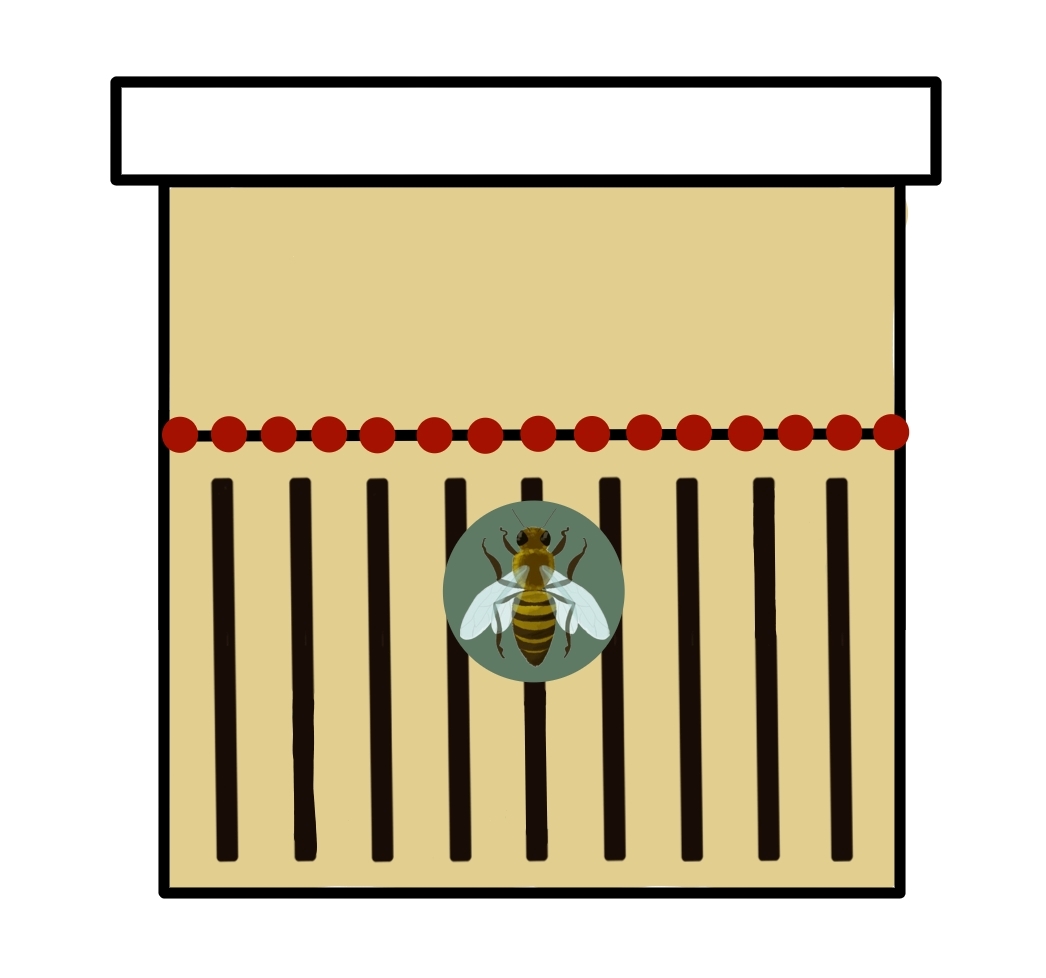
If your goal is to keep hive numbers steady while keeping swarming in check, the vertical Demaree split method is well worth the try. Over past years, I have read many sources who promote the Demaree split method. Once again I can only thank the multitude of researchers, authors and videographers that have gone before and given me this extraordinary opportunity to discuss another aspect of management for this amazing insect. I would also like to thank my granddaughter, Erika Goretski, for researching and referencing a number of resources and then using an open source computer painting program to draw the Demaree illustrations provided for this article.
