
Click Here if you watched/listened. We’d love to know what you think. There is even a spot for feedback! Read along below!
Bee Birthdays?
By: Tracy Farone


Happy Spring – Happy Birthday! Every year in March, I turn another year older. For those of us that have had more than a few, we may not get as excited as we once did. However, birthdays are significant, both in the appreciation of time given to us and from a medical perspective. This got me thinking: Do honey bees have birthdays? A bee B-day…? But seriously, is this a thing in apiculture, and if it is, what significance does it have? Well, a literature search on “honey bee birthdays” only produced a plethora of bee-themed party decorations.
However, in medicine, one of the first pieces of data we collect from a patient is something called “Signalment.” Signalment information includes innate objective information about a patient that could have significance in health implications. It is the first part of any physical examination. Items would include species, race, sex, weight, height, and age…often as a birth date. Understanding these items allows a doctor, a veterinarian, or any caregiver a better understanding of the care needed for this patient and the conditions that are most likely to affect them.
With honey bees, “birth dates” could be perceived in several ways: the emergence of a single bee as an adult, the beginning of a complete superorganism colony, and/or the introduction of a new, mated queen to a colony. Even seasoned beekeepers may still find it fascinating to watch a new little bee emerge from its cell, and we as an industry heavily rely on our ability to make new colony splits. So how and why should we consider birthdays in honey bees? Here are a few considerations of how we already track or should track bee birthdays to promote better honey bee health.
Birthday Hive Records
Keeping accurate records is one of the best lines of defense for identifying and controlling diseases. All agricultural animals (besides honey bees) are required to follow USDA regulations for animal ID/tagging. Age of the animal is a key piece of information in agricultural IDs. Animals with IDs can be more easily tracked, examined, treated, or quarantined, if needed. Beekeepers should at least know how many hives they have on any given date, which colony is which (names and numbers), and their location. Age (start) of the hive should also be recorded for each colony. Is this a new nuc, split, swarm, or a big fat honey hive that has overwintered for years? Record this data!
Queen Records
Keeping track of queens/re-queening could also be viewed as a type of birthdate or re-birth for a colony. Beekeepers do a pretty good job keeping track of queens’ birthdays or at least their birth years with the international queen color marking system. The vibrant color markings are a bit birthday festive in nature. These five-year rotating colors are as follows, Blue indicating years ending in 0 or 5, White 1 or 6, Yellow 2 or 7, Red 3 or 8, and Green 4 or 9. 2026, for example, is a white year for this year’s queens. These markings make it easy to tell how old your queens are and often the colony. Did she overwinter or is she a new unmarked queen? Some beekeepers prefer to re-queen every year as a management practice, others allow for older queens if their production is up to par. Personally, I’ve seen some three-year-old queens do quite well, others swarming in 3 weeks. Learning to mark queens and attempting to keep track of their origins is an important skill for beekeepers to master. Certainly, queen status is a key factor to the success of any colony and their beekeeper, since queen failure is a commonly reported cause of hive loss.
Birthday Timing
Many agricultural animals are born in the Springtime. This provides an advantage for most young animals to develop in the more favorable conditions of Spring and Summer as opposed to Winter. Honey bees are no exception. Most new colonies are made in the plenty of Spring. As brood production greatly increases within a colony, thousands of new individual honey bee “births” occur, ultimately resulting in the production of swarms or splits. In many parts of the country, April and May see whole colonies double, triple and even quadruple in number.
Some animals produce their babies during Winter conditions, such as “hibernating” mother bears. In honey bees, individual births should see a moderate increase as Autumn approaches. This is important for the adequate production of Winter bees, a known key factor in the overwinter survival of colonies. Beekeepers should make note of both individual and colony birth rates, during Spring and Fall examinations to determine appropriate management planning and preventative measures required of their colonies.
Clinical Implications of Bee Birthdays
In any agricultural animal, life stage consideration is critical to management. The age of a honey bee colony should also be taken into consideration in the management of colonies. Much like cattle farmers putting heifers in one field and cows in another or perhaps in a production parlor, beekeepers should keep younger, weaker colonies separate from older, more mature production hives. Consider that splits, swarms, and nucs will develop at a different rate compared to seasoned hives. Younger hives will be more susceptible to robbing, disease and nutritional stress and will likely need extra support from their beekeeper. Older hives may produce honey and pollen. Younger hives need time to grow and will need supplementation. Bee birthdays determine these management variations.
Veterinarians automatically treat domestic young animals for parasites, as every animal is essentially born with worms. Parasites are more devastating to younger, weak animals. Young honey bee colonies also need to be diligently monitored and treated almost automatically for their parasites such as varroa and hive beetles.
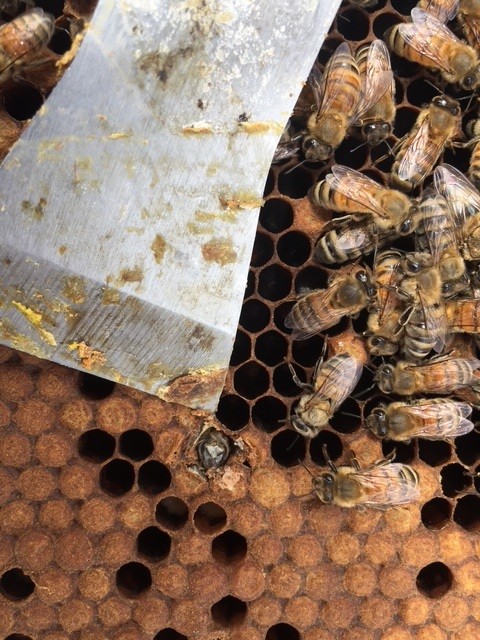
While the birthing process is fascinating in any animal, complications can occur and success is not always guaranteed. Looking within the honey bee hive, individual bee births can point to good health with normal, vigorous brood patterns or to various diseases with death on emergence noted on exam. Spotty brood patterns can indicate the lack of individual emergence success and should implicate further diagnostic action. EFB, AFB, sac brood, varroa, viruses, and PMS can all deter normal “bee birth” emergence.
Think Spring
In beekeeping, we spend a lot of time tracking and talking about hive losses…the time of our colonies’ death. Perhaps focusing our attention on the implications of bee birthdays could be a fresher management perspective. Keeping up to date records, utilizing biosecurity measures, performing timely inspections, reading the frames, knowing queen status, managing life stage risks, providing appropriate nutritional and anti-parasitic support, and understanding clinical signs of disease are all related to knowledge of…bee birthdays. Employing these management techniques has been proven to lead to more…bee birthdays. Welcome Spring!
