
Click Here if you listened. We’d love to know what you think. There is even a spot for feedback!
Read along below!
New(ish) Beekeeper Column
Communications Within the Colony
By: Richard Wahl
Methods of Communication
As the new beekeeper’s skills improve they will begin to note the ways in which bees use scents, bee dance movements and sound to serve as a means of communication among the bees. These forms of communication play a crucial role in coordinating the colony’s needs, such as adjusting the number of bees required to gather resources like water, pollen, nectar or resin. Pheromone scents passed by the queen and worker bees alert them to her presence and help to organize tasks within the hive. Specific dances may also direct bees to resource-rich locations or, in the case of a swarm, signal the best site for a new home. The buzz of the bees is another subtle yet important form of communication. The noise level will vary and can provide insights into different levels of bee activity in the hive. As discussed in a previous article, the hive colony can be thought of as a superorganism because the collective behaviors and actions of individual bees contribute to the success and survival of the whole colony. This makes it imperative for information to be passed efficiently among independent workers for care and protection of the queen and is essential for the colony’s survival and reproductive success.
Smells and Scents
It is well known among beekeepers that bees release chemical signals called pheromones which play a crucial role in regulating social behavior and coordination of tasks. Pheromones released by the queen indicate that she is present and serve to suppress the egg laying desire of the other unfertilized worker bee females. Worker bees release scents or pheromones that maintain hive organization and communication related to nursing, guarding and foraging. The smell inside a beehive can be a mixed blend of natural scents. Honey has a sweet floral aroma reflecting the nectar or pollen source of the flowers that the bees visited. New wax has a more earthy scent often experienced when turned into a candle slowly burning away. A faint odor from the brood (larvae and pupae) and the bee propolis, a resinous substance used as a filler and glue to close small cracks, often adds a slight woody or herbal note to the smell. This combination of scents is often very pleasant and makes for a unique olfactory experience in the hive when noted by the beekeeper. If the smells in the hive are more putrid or seem to be bad it can be a signal to monitor colony health. Sour or rancid odors may indicate the presence of disease such as foulbrood, excessive mold growth or other conditions and should be investigated. Unpleasant scents serve as a warning that the bees may need attention to maintain the colony’s health.
Dancing Bees as a Form of Communication
Honey bees are known for their complex honeycomb structures and intricate forms of communication. One fascinating aspect of bee behavior is their ability to relay the location of food sources to their hive sisters with a series of distinct dances. Using the sun as their reference point, bee dances provide information about the distance, direction and quality of an available food source. Even on cloudy days the bee’s ability to see a range of ultraviolet light, unable to be seen by humans, allows their use of the sun’s position as an aid for navigation. The bee’s use of dances to pass on information, include the round dance, the waggle dance, the tremble dance, and the shaking dance. A bee keeper can on occasion witness these dances seen during a frame inspection, which when understood, play a unique role in the colony’s resource collection efficiency and survival.

The Round Dance
The round dance is used by bees to pass on information about nectar and pollen food sources that are nearby. If a forager bee discovers a food source that is relatively close, say within 50 to 100 yards, she will return to the hive and do a round dance. The more profitable the food source is, the longer the dance lasts. The dancing bee may stop on occasion and discharge some of her honey crop collection and then continue the dance at another location on the comb. In this way other bees receive a taste of the value of the food source, its nectar or sugar content and the type of flower to be visited. The returning bee may also be covered in the smell of the flower source as another clue for the bees that are receiving the information. Researchers have found that the round dance involves the returning forager moving in a circular or figure eight pattern on the comb to indicate the nearby food source but does not provide distance or direction information. The dance alerts other foragers to fly around and search in the immediate area. The greater the value of the resource the stronger and more agitated the messenger bee’s movements become. I have since wondered if when watching a bee dance, what would happen if I turned the held frame from a horizontal to vertical position. Would the dancing bee reorient to the frame’s new position relative to the sun? This might be something to try the next time I see a bee dancing on the frame comb’s surface.

The Waggle Dance
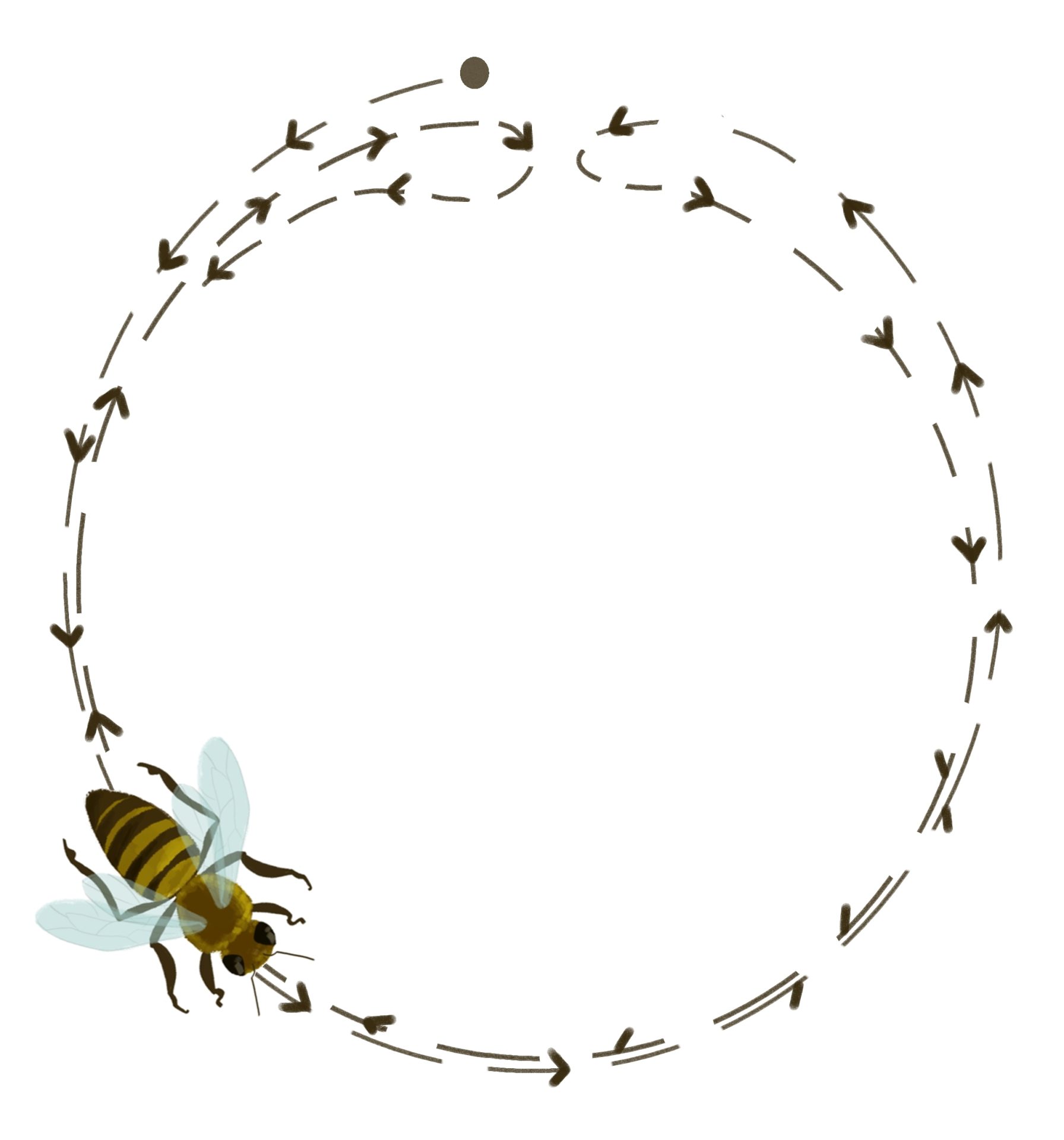
The waggle dance is the most publicized dance form and serves as a very sophisticated means of bee communication. The bees use this dance to pass on detailed information about food sources farther away from the colony’s hive. If a forager finds a food source more than the 50 to 100 yards away, she returns and performs the waggle dance. This is a combination of the round dance with a straight “waggle” run through the middle. A figure eight pattern is used where the bee returns to the starting point on one side of the waggle, moves forward in a straight line while shaking her abdomen and then turns to the other side to return to the starting point. The length of the straight line waggle is interpreted by the receiving bees as distance while the degrees off the vertical axis of the hive are the degrees of direction left or right from the sun’s current position. The more intense the waggle, the farther away the food source is. As with the round dance, the bee may also be carrying the scent of the flowers that have been visited. This combination of spatial and waggle time lapse cues allows other bees to effectively navigate toward the food source, even if it is far from the hive. The waggle dance demonstrates that bees have excellent navigational skills, a thorough understanding of their environment and the ability to communicate much needed information to their hive sisters.

The Tremble Dance
Another form of mobile communication used by the bees is the tremble dance. While the round and waggle dances are employed to convey the location of food sources to other bees, researchers have found the tremble dance serves to recruit more bees to process incoming nectar. When a forager bee returns to the hive after collecting nectar, she may perform the tremble dance by moving slowly across the comb in a series of vibrating, side-to-side movement signals named by researchers as “trembles.” During the forward movement of the dance, the returned forager bee frequently changes direction at various angles in an effort to recruit more bees to nectar management. The tremble dance is a call to action and alerts other worker bees within the hive that there is nectar that needs attention, prompting them to begin accepting the nectar from returning foragers and encouraging more bees to store it or turn it into honey and to initiate the water evaporative stage by fanning. The transfer of nectar from a returning forager to an internal worker bee in scientific terms is called “trophallaxis”. If this direct passing (trophallaxis) of nectar from a foraging bee to a receiving bee requires more help, the foraging bee will use the tremble dance to recruit additional bees to receive and store the incoming nectar throughout the hive. By using the tremble dance to regulate the hive’s workforce the food supply can be maintained at an optimal state.
In addition to facilitating nectar processing, the tremble dance also signals that the hive’s external food resources are abundant and that additional foragers may be needed to collect more nectar. This aspect of the tremble dance helps regulate the colony’s foraging efforts and ensures that there is a constant and efficient flow of nectar coming into the hive. In this manner, the tremble dance plays a critical role in maintaining the hive’s internal functions, promoting both the best management of internal food resources and the efficient collection of nectar. The tremble dance is an important component of honey bee communication helping to coordinate hive activities to ensure the colony’s food stores are well stocked.
The Shaking Dance
The shaking dance is one of the less common dances performed by bees but is still an essential aspect of their communication effort. This action is not so much a dance as it is a signal of a need for help. It occurs when a forager bee that has already discovered a food source wants to encourage other bees to forage more intensively to add to the hive’s food supply. The shaking involves the bee vibrating her wings accompanied with a side to side movement while grabbing another bee with her front legs. This movement is used as a signal that the shaker bee wants assistance with some task. The grasping and movement of the shaker is believed to notify the receiving bee that the shaker needs help grooming or that she has located a food source and is trying to recruit others to help gather more food. While the tremble dance seems to more often be a call to action to process food stores already in the hive, the shaker action seems to be used to increase the foraging actions outside the hive. It is more often seen as a method of motivation among the bees to increase food gathering efforts. I would be more inclined to call this the wake-up dance or the rabble-rouser dance.
Bee Dance Summation
The round dance, the waggle dance, the tremble dance and the shaking dance each play a crucial role in the life of a honey bee colony. These communication actions ensure the survival and efficiency of the hive. These dances allow bees to coordinate their behavior whether sharing the location of a nearby food source or organizing the efforts of workers within the hive. The varied nature of bee dances demonstrates the social organization of the superorganism colony and demonstrates the importance of hive communication. Bee dances are not only fun for the beekeeper to observe but serve a crucial role in the preservation of the hive and show one of nature’s remarkable communication methods among the insect community. I have wondered if a combination of the shaking to alert bees to engorge themselves with food sources before a swarm event is coupled with the waggle dance to signal the first external hive resting point location, since it seems that preparations to swarm begin a week or two before the actual swarming event. I would be inclined to call these bees rabble-rousers since they are instigating the older bees to engorge on honey and keep the queen moving so she loses weight in order to join a swarm that may take place a week or two later. This idea is supported by the evidence that queen cups and supersedure cells are prepared well in advance. Perhaps this is something researchers could further pursue to determine just how long before a swarm that pre-swarm preparations begin.

The Buzz of the Bees
The level and type of buzz in a hive can be used to gauge the colony’s mood and provide insights into differing levels of bee activity and the state of the hive. When the bees have a relatively constant buzz at a lower intensity the colony can be assumed to be in a stable, routine state engaged in typical foraging and hive management activities. This level of steady noise is considered to have a calming, rhythmic quality. It may be used in therapeutic practices to create a peaceful environment resulting in reduced stress; stimulating relaxation and a sense of calm much the same as natural white noise is used. If during a hive inspection the noise level remains at a constant low continuous intensity, with the bees going about their business, the beekeeper can take some assurance that his intrusion is not disturbing the bees to a provocative extent. On the other hand, a hive that has an increase in volume or becomes higher pitched and a bit more erratic may indicate the colony is sensing the intrusion as a threat and there may be underlying problems worthy of analysis. If the hive becomes threatened by a predator, the bees may amplify their buzzing to alert the colony to danger in preparation for defense. A sudden increase in noise could also suggest that the bees are preparing to swarm at some later date and a check for swarm cells may be warranted. Swarming preparations will often commence two to three weeks before the actual event. The buzzing of the hive is a multi-layered, form of communication. Subtle changes in the pitch, intensity and rhythm of the buzz can tell beekeepers a great deal about the hive’s current state.
Communication: The Key to a Successful Hive
Honey bees have remarkable systems of communication that go beyond sounds and gestures. They rely on a series of pheromones, tactile cues and visible signals to pass important information throughout the hive. Specific chemical signals can trigger unique responses in other bees that influence behaviors and actions dependent on the desired outcome. While pheromone scents can signal the a variety of needs such as queen presence, defense, brood care or swarming, the bee dances usually signal the need for more participation in nectar processing or foraging efforts.
When I began working with bees sixteen years ago I became a voracious reader of books and research as well as a video watcher of anything related to bees. It has never ceased to amaze me when in a subsequent year I witness some action by my bees that I might have read about years prior validating what I had previously read. Although I can recall reading many of the things I now write about, I cannot pinpoint which author, book or video in which I may have first encountered the subject matter that I see happening in my hives. I can only thank the multitude of researchers, authors and videographers that have gone before and given me this extraordinary opportunity to discuss the many aspects of this amazing insect. I would also like to thank my granddaughter, Erika Goretski, for researching and referencing a number of resources and then using an open source computer painting program to draw the bee dance illustrations provided for this article.
