
Click Here if you listened. We’d love to know what you think. There is even a spot for feedback! Read along below!
Off the Wahl Beekeeping
New(ish) Beekeeper Column
Sustainable Beekeeping (Part 2)
By: Richard Wahl
A Continuation
In last month’s issue I wrote about what I feel are key factors in any beekeeper becoming self-sustainable. Besides saving the expense of buying new packages, nucs or queens each year, bees that are adapted to your own local area and environment would seem to have a better chance to survive our variable Winters. In last month’s issue I summarized the sub-topics of mite management, feeding your bees, working with splits and managing swarming. In this month’s article I will conclude with portions on the use and benefits of nucleus hives (nucs), keys to good winterizing practices and finally some techniques as to how to raise your own queens. Becoming more proficient in these areas should help in becoming a self-sustainable beekeeper. To continue with these key factors here is more on nucleus hive techniques and uses.
Nucleus Hives (Nucs)
A nucleus hive can be described in many ways. Although it is usually thought to be a smaller enclave of bees residing in a five frame nuc box, it can be almost any size from two frames up to a partially filled ten frame deep super or even larger. I have worked with the smallest two frame arrangement and also have had a nucleus colony move into an empty double deep hive containing twenty frames. The key element is that the nucleus contains bees in all stages of development with a laying queen, nectar and pollen supplies and enough bees to cover several frames in order to take care of the new eggs, larva and brood. Although bees moving into an empty hive is more likely to be called a swarm, it may only take them a few days before comb is drawn, if not already provided, and the queen starts to lay eggs. I have seen queens that lay eggs in comb that has only been half drawn out to its full size. While the egg takes three days to become a larva and another six days before it is ready to be capped the bees continue to complete the cell in that nine day window. Once the capping of brood begins then the new swarm can be considered a nucleus colony as during that time forager bees will also be bringing in pollen and nectar. On the other hand if the swarm moved in with a virgin queen that was required to go out and mate before starting to lay eggs, it could take up to three weeks before the swarm could be considered a nucleus hive. More typically a nuc is the result of a split accomplished by the beekeeper for the variety of reasons covered in last month’s issue.
Purposes of Nucs
As stated in last month’s article one of the key reasons to do a split is that it may preclude the hive from swarming. By pulling frames from an established over wintered hive the beekeeper is creating a nucleus colony that can become a new hive. With at least a frame of brood and a frame with pollen and nectar as a food source, the split can be considered a nuc, particularly if the original queen is also moved to the starter nuc. Once it is seen that the queen is laying eggs and established in the nuc, it may be put up for sale, used as a resource for other hives or simply left to become its own new hive. As published in the recent May 2024 issue, my “Nucleus Hives” article stated any nuc for sale should contain at least two full frames of brood laid by the attending queen and a frame of nectar and pollen as a minimum. If the beekeeper is making splits it is up to the beekeeper to decide if the original hive will get a newly purchased queen or be allowed to make their own new queen from an existing egg, larva or queen cell. A donating hive or the receiving nuc allowed to renew its own queen may take up to five weeks before it becomes a fully functioning colony of bees. All this was covered in greater detail in the previous May issue. Likewise the use of a double deep nuc as a stand-in swarm trap was covered in that issue.

Different Nuc Systems
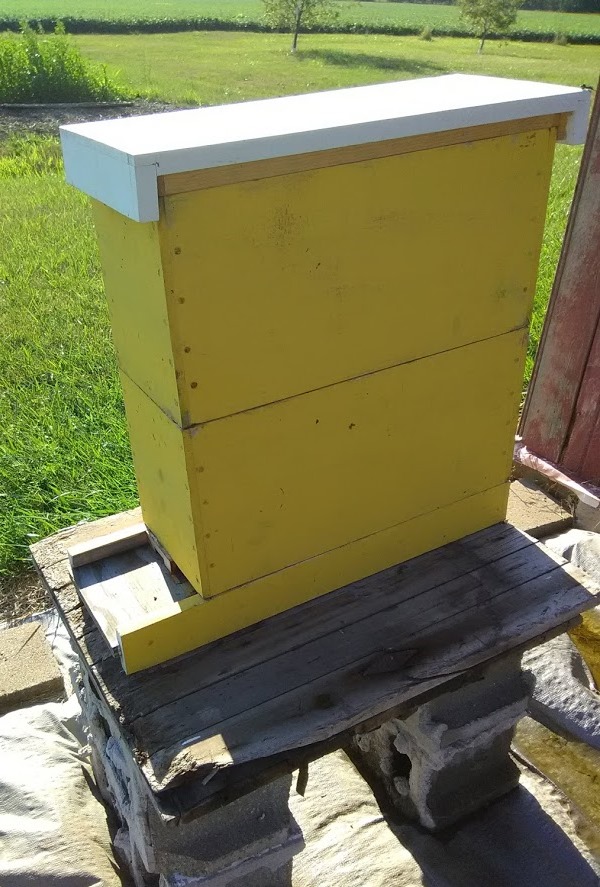
Nucs can come in many shapes and sizes. My first attempt at working with nucs was to simply split a ten frame super down the middle with a divider so that I had two four frame nucs. With a small workshop behind my garage I built several four frame nuc boxes to sit as second story four frame deep supers over the split ten frames super with only four frames on each side below. The key is to be sure there is no way for the neighboring queens to get in touch with each other. I have had no problem with both nuc openings being toward the same front side of the split super provided that both nuc populations are of relatively the same strength. I have had side-by-side nucs survive through the Winter in this arrangement. Working with four frame nucs provides many options. After a split this past Spring it became apparent that one of my hives did not replace a removed queen. Since it was a strong population of bees that had not accepted a newly acquired queen I decided to try something a bit different and marry a strong double stack four frame nuc between the two ten frame supers. I did this by placing the two four frame nucs adjacent to each other over a newspaper sheet which was over the bottom ten frames super.

My hope was that the residing nuc queen would take over the entire arrangement. I then placed another piece of newspaper over the adjacent nuc boxes with the second ten frames deep over it. Both sheets of newspaper had several small knife slits in them to give bees a place to start to chew through the newspapers. A week or so later the bees were working together and I removed eight of the least filled or pollen saturated frames so all was condensed into two ten frame deeps. Since the original hive had a good start on two honey supers that had been on the original two super hive, which had not replaced a queen, the addition of the two story nucs that replaced the queen became an even stronger hive. The result was that I was able to remove two fully capped honey supers by early July from this co-mingled hive/nuc arrangement. That hive continued to produce additional full honey supers taken later in the Fall. In another instance I was a bit lazy one Summer and left a double ten frame deep with mostly empty frames sitting in the middle of my bee yard. Although I checked it for hive beetles or wax moths each time I attended to the apiary, I always ran out of time to disassemble it. Then one day I noticed bees bringing pollen into the “empty” hive. To my amazement I had a swarm that decided to move into the frames in these mostly “empty” supers. Since the queen was already laying and unmarked, that clue told me she was not from my hives as my queens were all marked. I gained a nucleus colony without even having to catch the swarm, they just moved in.
Continuing with different trials I once set two hives tight against each other and placed a queen excluder over the adjoining portions of each hive. The remaining open halves of the hives below were covered with five frame nuc covers. The idea was that perhaps two earlier split hives could more readily fill honey supers faster if working together. Above this I placed two honey supers over the middle half of each hive below so that worker bees from both hives could work the same honey supers.

Since there was a top entrance in the inner cover open to the honey supers the bees could also enter and exit there if they chose. One day inspecting the honey supers I noticed I had a third queen laying eggs in the honey supers. Whether this was a small third swarm that moved in, a thin virgin queen that had squeezed through the central queen excluder or the bees moving an egg from one of the hive cells below, I will never know. But I had another nucleus hive which I quickly moved into their own nuc replacing the honey super brood frames with empties to allow the two hives below to continue to produce honey and the honey super brood and egg frames to become their own nucleus hive.
Another way to use small nucs is in what may be called a queen castle. Queen castles come in different shapes but their main function is to be for nurse bees to care for the new or virgin queen while she goes out on mating flights. At some point when she begins to lay eggs it indicates the presence of a newly mated queen that can be sold or moved into a new queenless nuc or hive. I like the ten frame super queen castle that has four distinct separated areas each holding two frames. Much like the two four frame nucs made from a ten frame deep each section must have a separate entrance for those bees and be divided so queens cannot get to each other. In this manner a newly emerged queen can go out to mate and develop her egg laying skills before being moved to a new nuc/hive or sold. If using this method one frame should have a mostly empty or empty drawn comb side so the new queen has a place to lay eggs while the other frame has a supply of pollen and nectar with some portion of the frames covered in larva and capped brood to encourage a laying queen. The key element with any nuc starter hive is to keep a close watch on it as emerging brood can increase the nuc population at an astounding rate. Just as overcrowded hives can be expected to swarm, the same is true of an overcrowded nuc if not given enough space. I have found that having a few nucs available as a resource reserve throughout the year provides me many more options to maintain my own self sustainability and/or provide another small income source if sold.
Winterizing
The act of winterizing one’s hives actually starts in mid to late Summer. This is when the mite population starts to expand and the reproduction of additional worker bees begins a slow decline. Keeping mite counts to a minimum through late Summer and Fall will go a long way toward the success of the hive surviving through the Winter. Mite management techniques were covered in September’s issue. Feeding is another component of getting ready for Winter. That was also covered in last month’s issue. A two parts sugar to one part water syrup mix is the accepted norm until night temperatures routinely fall below freezing. Once that happens I like to switch to granulated sugar placed over waxed parchment paper over the top frames of the brood chamber. By this point all honey supers will have been removed, cleaned out by the bees and put into storage. The easiest way to have bees clean out extracted honey supers is to place the empties over the inner cover and under the outer cover. In this way the bees come up through the inner cover center hole and remove any remaining honey from the honey supers. This works particularly well when the honey super did not come from the extraction hive it was originally placed over. Bees are much less likely to begin storing more honey in supers to be cleaned out as it seems pheromone from the originating hive creates a sense of robbing from the “to be cleaned out honey super” rather than an urge to store more honey. Additionally, only the bees in the hive can get to the super without fear of attracting wasps or other bee robbers.
Another factor in winterizing is when to use blanket, sleeve or some other type outer insulation. This is probably the least of Winter concerns as bees have survived our colder Winters without this protection in many apiaries. It is just another insurance measure and may have more to do with making the beekeeper feel better than its benefit for the bees. One aspect of insulation that I do strongly believe in is a one or half inch piece of insulation that sits inside the outer cover and over the inner cover. I use this insulation piece cut such that it fits neatly inside the outer cover year round. It works just as well during Summer to temper the heat from the hot Summer sun emanating through the outer cover. I also like the use of a homemade Vivaldi spacer over the inner cover. This is just a two to three inch spacer over the inner cover with four or five holes drilled on the short sides of the spacer. Cover the inner cover hole with screening so bees cannot get into the several layers of burlap placed in the spacer that wicks up condensation from the hive. The spacer holes on each end allow circulation to dry the burlap out.
If not already in place it is also a good idea to put in the entrance reducer to provide less space for Winter drafts and also cut down on space for voles or mice to enter. As Fall changes to Winter, it may also be a good idea to use robbing screens if the apiary has had previous problems with robbing in the Fall. Any mouse guards placed on the hive in the Fall may remain until Spring as long as bees have an adequate opening to leave and return on Winter cleansing flights. Naturally, Winter lends itself well to a time for any cleanups, painting or preparations for the next season.

over sugar feeder over deep super
Queen Rearing
I left queen rearing as the last item since it can be very easy if time is not of the essence or it can be a bit more challenging if raising queens becomes a side endeavor with any of the methods suggested that follow. When I do splits I generally allow the portion that does not have a queen to make their own new queen. As long as a frame of brood with eggs and one to three day old larva is present the bees will choose a cell to make a new queen. They can be assisted by scraping the bottom third of a cell and a few cells just below it away to make room for a queen cell. I like to do this on several three day old egg cells as well as the smallest larva cell or two. The queenless bees will generally make three or four queen cells using this technique. If queen cells are made on different frames one of the frames can be moved to an additional starter nuc. Although it takes the new queen four to five weeks to mature, mate and begin laying eggs I have had good luck with this method. One could also try grafting queens, not as hard as it appears; use the Hopkins method with a horizontal frame over a recently queenless super, or try the Doolittle method with a nuc and queen excluder over an existing hive. There are also graftless methods including the Cloake board, the Miller or the Jenter system. Raising queens can be done successfully using any of these methods. As with all things in beekeeping, applicable steps by the developer should be researched and followed.
Conclusion
Complete articles could be devoted to any of the previous seven individual sub-topics as the new beekeeper becomes more proficient in the trade. It should be obvious that all of the areas are linked to each other and it is often difficult to encapsulate one area without touching on another. I have simply summarized those areas in which I feel the newer beekeeper needs proficiency in order to avoid the necessity to repurchase packages, nucs or queens each year. If a beekeeper becomes a bee manager, learns from mistakes, takes notes to avoid past missteps and strives to improve their techniques, I firmly believe the most basic hobbyist can reach a point of enduring succession with their bees. Once the bees are recognized as an organism and the beekeeper provides adequate support, the struggle for ongoing continuation lessens and beekeeping becomes a very rewarding, less costly adventure.
Richard Wahl began learning beekeeping the hard way starting in 2010 with no mentor or club association and a swarm catch. He is now a self-sustainable hobby beekeeper since 2018, writing articles, giving lectures and teaching beginning honey bee husbandry and hive management.
