
Click Here if you listened. We’d love to know what you think. There is even a spot for feedback! Read along below!
Military Veteran and Beekeeper, Roger Sorben
By: Becky Masterman & Roger Sorben


Photo credit: Rachel Beard
I met Roger Sorben last Summer at a Minnesota Beekeepers Association Field Day and was lucky to visit one of his apiaries later in the season. Roger’s beekeeping story is grounded in service and family. I enjoyed talking with Roger about his beekeeping operation and decades of military service and wanted to introduce him to Bee Culture readers.
Masterman: Which came first, beekeeping or military service?
Sorben: Beekeeping came way before military service, because I was probably about 10 years old when I first got introduced to the beekeeping. My dad would go out and help the neighbor with bees. I just rode along for the fun of it. I had my veil and my gloves and rode along in the truck with Dad.
It just progressed from there. Eventually my parents bought their first yard of bees, started out with 60, and increased to 150 hives. Our neighbor had about 700 hives, so I got to be involved with the small commercial operation.
Also, I got some of my own and that became an FFA project. I got to do presentations and demonstrations at the State Fair a couple of times. It provided a lot of opportunities. The military came later when I was in college, and I decided to use that to help pay for college. Forty years later, I finally figured out how to get out of the military.
Masterman: Your beekeeping and your military service both spanned over 40 years?
Sorben: Pretty much 50 years plus for the, the bees, and 40 years plus in the military.
Masterman: That’s fantastic. Can you share a little bit about your military career?
Sorben: I joined the National Guard up in Moorhead, Minnesota, when I was going to college. I was originally a clerk typist in a personnel section, then into supply, eventually back into personnel, and became a warrant officer. I finished off my military career as a Chief Warrant Officer 5, which is as high as you can go as a warrant officer.
So, it was a very good career. I did have one deployment to Iraq in 2007- 2008. I went with an aviation battalion out of St. Paul. Great experience, and as being a personnel officer, the best thing about it was I didn’t have to use the part of my job where you have casualty reporting, because my unit had no wounded, no KIAs, so that was the greatest thing about our deployment, is our unit didn’t have any casualties. And, of course, those 2 years were the only 2 years that I haven’t kept bees in the last 50 years.
Masterman: What does your beekeeping operation look like now?
Sorben: I try to have around 70 hives located over 8 locations, anywhere from 2 hives up to 30 that are in my backyard. I’ve got some of them on migratory pallets. It’s always nice to move 4 hives at a time with the forklift or the skid steer. I’ve got one greenhouse apiary where I’ve got 16 hives real close to their greenhouses. It’s a wide variety of different yards.
Masterman: Have you participated in any beekeeping veteran programs?
Sorben: I did go through the Hives to Heroes program. That is a great program, a lot of modules to go through, you know, self-study, self-paced. But it was a very good learning experience, especially picking up some things about diseases, mites, and what to look for there.
Masterman: What kind of outreach work do you do?
Sorben: I’m a member of our local beekeeping club, the Ripple River Beekeeping Group in Aiken. We do a field trip usually in the Spring, so that we can talk about hive inspections, trying to help a lot of the new beekeepers. And then they’ve come out and looked at my sideline operation for honey extraction.
The other thing is I like teaching children and we’ve had groups come out. Last September was the biggest day that I’ve ever had for doing that. We had 33 first and second graders come out. It’s pretty intimidating when the school bus pulls up in your yard, and out come all the kids, but I had some help with a neighbor that’s a beekeeper, and also my daughter and her husband.
We split the 33 kids into three groups and we would take one group and they would go and learn about the PPE, the bee suit, the veil, the tools used, here’s the parts of the hive, and go through all of that. We had acquired enough small bee suits so that then that group would go, and we’d get them suited up, and I’d take them out into the bee yard. We went opened up a small hive where I had a good chance of finding the queen, and so we would look through that hive, find the queen. Put her back and then went to another hive where we needed to take a honey super off, and so we would take and blow the bees out of the honey super. It was great to see 11 little, kids looking like, spacemen running around in suits and having a great time.
And then the third rotation of it was to take them into, our garage where we had the extraction outfit all set up, and they would, extract two supers of honey so we’d have one full extractor load, and then bottle some honey. They got to see the whole round robin thing of it and when I’d bring a group back from the bee yard, we’d say, okay, now find another, student the same size as you, and help them switch.
And then, about a half hour later, I had a homeschool group come, and so there were another 30 kids, and we did the same thing. So I had over 60 students that one day. That was a lot, but it was a great time.
I am also involved with the Long Lake Conservation Center, up here in Aiken County. I have 4 hives out there, and part of their program is learning about nature, and so there’s times where they will ask me to come out and do a program for the campers. We’ll go out, open up the hives, and get the kids all suited up. Go through, check out the hive, and then, of course, the best thing is at the end of any of these presentations is getting out the little mini tasting spoons and tasting honey straight out of the hive or straight from the extractor.
Masterman: You have incorporated your family into your beekeeping operation?
Sorben: Yep, my wife’s a big help all year long because we sell the majority of our honey just with a sign at the end of the driveway. Either she’s selling some of the honey, or I am.
I have a daughter and her family come from Columbus, Ohio, my daughter in Ironton and her husband, and then I’ve got a son in Fergus Falls. The boys get to go out and take all the honey off the bees, and then in the next couple of days, we’ll do the majority of the extraction. It is great to have the entire family involved in the honey extraction. My daughter will haul honey back to Ohio, and she’s got her neighbor group, and her teacher’s group, and everyone else that she sells to. She’ll take 300 pounds of honey back at a time. There’s times where, when we go to visit. We’ll bring a couple more hundred pounds, because they need more.
Masterman: Will you share your honey super organization strategy?
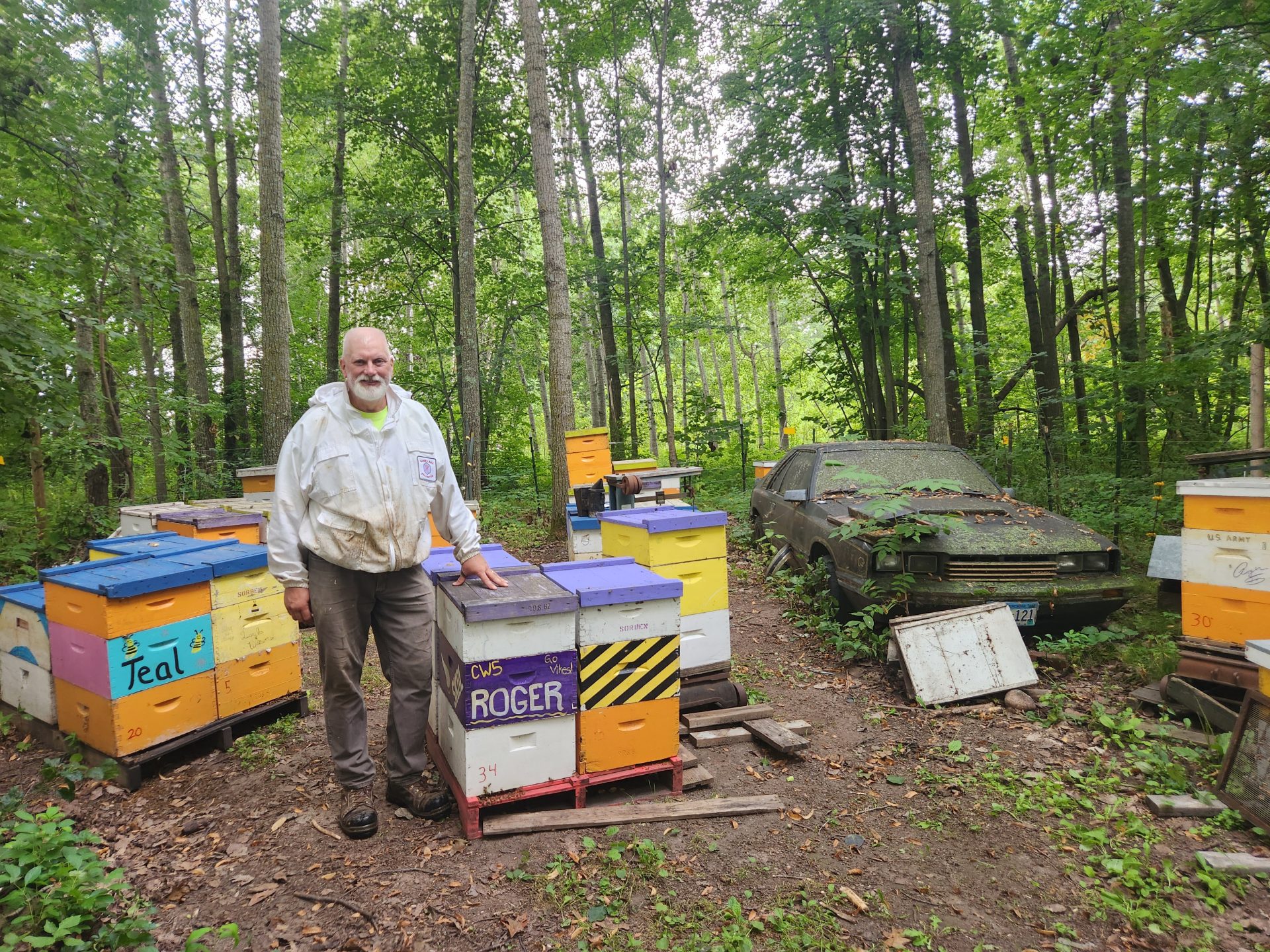
Sorben: It started out when I was in my FFA project, just to identify my honey supers. I painted them and used an orange color so that they were easily identifiable. And then, going on, I’ve just decided to use bright colors and it’s ended up being that I’ve got, several different colors. I can use a different color in each bee yard, so I know when we’re extracting, I can say these orange ones are coming from the backyard, these yellow ones are coming from this yard. It’s kind of fun to be able to identify the supers, and see what honey is coming from them.
Masterman: Thank you very, very much for sharing your beekeeping and military story with us. I really appreciate it, Roger.
Sorben: Thank you.
