
Click Here if you listened. We’d love to know what you think. There is even a spot for feedback! Read along below!
The History of the Continuous Spin Wax Separator and Maxant Industries
By: Ross Conrad


Hang around beekeepers long enough and you’re likely to hear of Charles Mraz (1905-1999) who founded Champlain Valley Apiaries in 1931. A prominent beekeeper and innovator in his time, Charlie inventing the fume board used to speed up the removal of full honey supers from the hive, and is recognized as the father of apitherapy in America and a long-time proponent of the use of bee venom to treat rheumatic diseases. Not as well-known is Charlie’s son, William (Bill) Mraz (1935-2026), who was trained as an engineer and took over Champlain Valley Apiaries after Charlie retired. Bill had the attitude that if you needed to solve a problem with no apparent solution, you just needed to invent something. Bill was always inventing. He invented and designed a bee hive reversing machine (an article topic for another time), a bee venom collection device, and an early version of a Honey Wax Separator that separates wax cappings from honey during the honey extraction process. I was working at Champlain Valley Apiaries at the time when he built his first wax separating machine. A co-inventor of the Honey Wax Separator is Theodore Maxant, the son of William Maxant, the founder of Maxant Industries that has specialized in manufacturing honey processing equipment for over 50 years.
Maxant Industries got its start when William Maxant bought out the old Neises Extractor Company and had all the parts shipped to one of his factories in Ayer, Massachusetts. Theodore Maxant is in his 80s and currently serves as the Chief Executive Officer of Maxant Industries. Prior to coming to Maxant Industries, Theodore had his own business, Maxant Iron & Steel, that build municipal buildings such as schools, hospitals and courthouses.
I spoke with Theodore in April and he filled me in on the story behind the wax separating machine and the founding of Maxant Industries. “My father was a beekeeper with about 100 hives and he had an extractor that was made of galvanized metal and had a lot of painted black iron parts. He was never happy with it. The family business was making textile machinery and in the early 1970s when a conglomerate came along and bought out the textile machinery business, instead of spending his money on boats and vacation homes, my father decided to get into the bee equipment business. ‘Cause that’s what he liked. He didn’t have any brothers or sisters to argue with. He only had me.
“I graduated from Rensselear Polytechnic Institute (RPI) in mechanical engineering and I’ve been gifted in the design of machinery. It just comes to me easily. It is one of the things my father resisted. I said, ‘Dad, everybody is using aluminum castings and all these other things in these extractors, and he was still using tin solder to put a lot of the parts together. ‘This is obsolete I said. People are going with water jet cutting machines and gluing machines and all kinds of new synthetics are coming out.’ ‘No, no, no, no, no, I’m not changing. This is the way we’re going to do it.’ And he used to crate the machines in wooden crates made out of lumber. I said, ‘Dad you can’t keep doing that. The crate costs you more than the machine. You should go to cardboard and pillars.’ ‘No, no, no, no, no, I don’t believe in cardboard’ he’d say. You know how it is when your father is 80 years old and you’re 40. It doesn’t work.”
I asked Theodore if he was involved in building the first production models of the honey wax separator that Bill Mraz invented. “For quite a few years when my father was still alive there wasn’t room for both of us in this business together. My father was sort of like Caesar, he had to run the show. I said Okay, so I made my own life but after my father died, he left the business to my sister. My sister didn’t want it so she sold it to me for a dollar so she could collect the rent check on the big factory building. That’s when I become aware of the Model 7000 Wax Separator.
“I never knew it existed because in the early stages back in the 1970s when my dad first formed the company, I stream-lined a lot of his machinery, the extractors and all that other stuff, but once the factory was up and running, we decided to go our separate ways. Somewhere during those next 30 years, my father and Mr. Charles Mraz of Middlebury, Vermont came up with this machine. The earliest blueprints I could find in the archives were all done in Middlebury, Vermont by his son who was a very capable draftsman.
“I think they made seven to ten machines and they were all hand built. But they had a flaw which didn’t come to light until after I bought the company from my sister. The owners of these machines wanted a part that was no longer available. That part was a ball screw. The ball screw is designed to operate on a horizontal plane so that it goes back and forth like a shuttle on a loom. Well, the Mrazs’ and my father put the ball screw vertical so that the driving mechanism went up and down, instead of side to side, and it wore out the bottom of the ball screw.
“The ball screw was manufactured by a company in Connecticut that made parts for jet fighters because that’s how they controlled the elevators on jet fighters at the time, you know with ball screws. Well once that aerospace company got bought out by somebody else and they moved everything to Texas, you couldn’t get the ball screw anymore. So here are these guys with these machines that wouldn’t work because the cutting knives wouldn’t go up and down. So, I went to one of the customers who had somehow gotten a replacement ball screw and watched the machine in action. I wondered to myself, ‘Does this thing have any competition at all?’ I asked, ‘What would you do if you didn’t have this machine?’ The beekeeper goes, ‘Uhm, we’d go back to the old method which is too slow.’
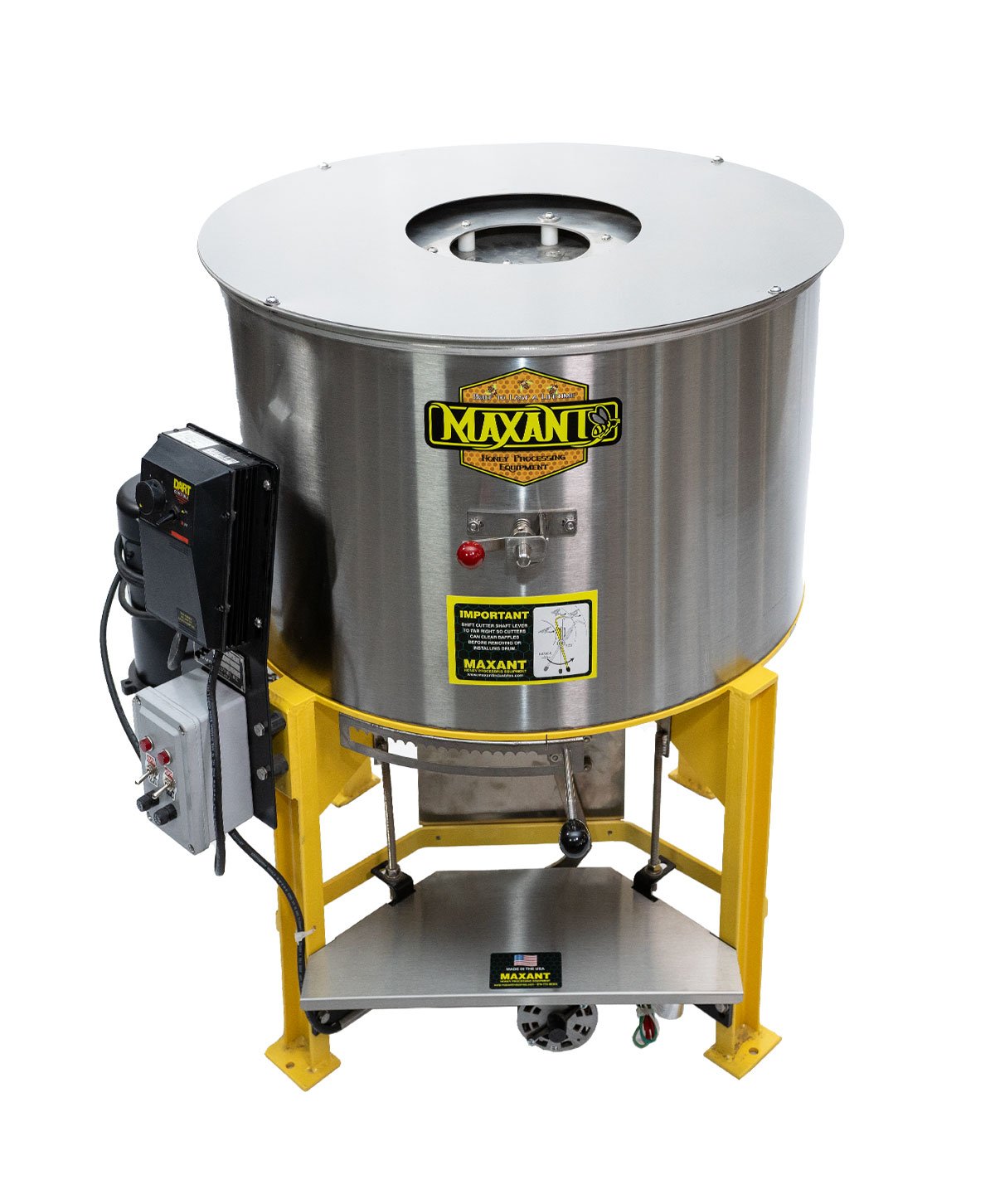
“So, it took me three years to redesign the machine. Instead of making the ball screw drive the knives up and down, I used a gear motor that sort of works on the principle of an old locomotive drive wheel, up and down, up and down. But the problem was you have to be able to shift the knives in and out depending on how much honey flowed and wax built up. So how can you have a solid shaft that shifted? Finally, I came across the idea of cutting the shaft in two and making it two parts instead of one. That was the breakthrough that led to the current Model 7000 Continuous Spin Wax Separator.”
Given the relatively small pool of commercial beekeepers that need honey processing equipment, I asked Theodore about the competition for the Model 7000. “Our competition today is the Cook & Beals who have a similar machine. It does the same thing, a high-speed drum that spins and separates the wax from the honey. But the way to remove the wax is the difference between the Cook & Beals and our machine. In the Cook & Beals machine, the honey has to be heated with a pre-heating system. The wax is removed in liquid form and is paddled off with paddles. Our machine is just the opposite, and as the wax emerges, we have knives that shave it off, so it must be solid. I think the Cook & Beals can handle more volume though because it is a much bigger machine. Our machine is capable of doing about 30 barrels a day. But, the 7000 doesn’t take up a lot of space. It is only about 3 feet across. A pretty compact unit. I thought we’d sell a lot of parts, especially knives, ‘cause of the knives cutting the hard wax. Ha! The knives are made out of the best quality tool steel and then we send them down to Wooster, Massachusetts to get them hardened and tempered, so they hardly ever wear out. All that revenue I was thinking about from selling spare parts never really happened.”
Prior to the development of the centrifugal cappings spinner, honey would be separated from the wax by heating the mixture and removing the liquid wax. Unfortunately, this also tended to degrade the quality of the honey. According to Theodore, “Yeah, we have a tank that does that too. A sort of entry level machine. We also have machines, centrifugal wax separators, built for people with 50-to-100, or 200-400 hives – sort of middle-of-the-road machines. The Model 7000 is for the really big guys that are selling honey by the barrel, not by the bucket. They’ll have 400-frame extractors running and its almost a continuous flow of honey. All this stuff goes into an auger and it’s pumped into these high-speed centrifugal honey wax separators and its continuous. All day long. There’s no pause. So, it’s not for the beginner or even the sideliners. It’s for the professionals.”
I asked Theodore what the future holds for Maxant Industries. “I’ve got this company structured so that the current management will have complete control and can make the decision, if and when the time comes when a buyer approaches. Who will that buyer will be? I certainly don’t want some type of hedge fund that wants to buy it and flip it. If the buyer were someone like Dadant where we both mesh, or could mesh, then I would feel comfortable about that. But there isn’t a heck of a lot of choices out there left. Kelley is out of the business as far as making machines goes, so it’s just Dadant and us and a few smaller shops like Cook & Beals. Unfortunately, Cook & Beals doesn’t have the where-with-all to acquire what we have here. This is a pretty big operation. The building is 3000 square feet and it’s brand new. The old factory is gone. We lease the land to Global Energy. They have 4000 gas stations. So instead of getting a rent check from me, my sister’s getting a rent check for the land from Global Energy. So, she’s still happy, and I took the money that I’d earned in the iron and steel business and I built this factory. It’s very modern. The operating expenses are low. So, we can weather the ups and downs of economic fortunes. That’s the problem with these merger and acquisition guys. They come in and buy you out with somebody else’s money. That somebody then wants to see a return on it so they suck out everything they can and then they flip it. Well, that’s not going to happen hopefully with this business. I think we’re strong enough. We have solid cash flow and we have no debt whatsoever. We’ve already attracted buyers that we’ve turned down.”
This interview was lightly edited for clarity and length.
