
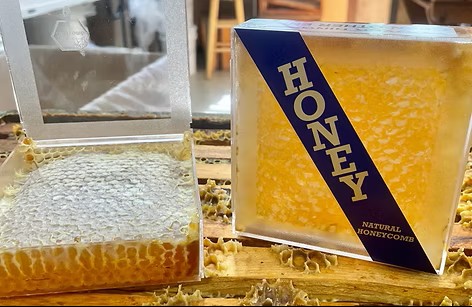
Launching the New Hogg Halfcomb Frame!
Herman Danenhower & Kelsey Yob


Photo courtesy of Betterbee.
Herman Danenhower of Danenhower Apiaries, LLC has been engaged in beekeeping since 1972 in Pennsylvania’s historic Pennsylvania Dutch region. Over the course of his career, Danenhower has focused on developing practical systems that improve efficiency, product quality, and accessibility in comb honey production.
In 1993, Herman acquired the Hogg Halfcomb system from the inventor John Hogg, a Michigan beekeeper. Herman then implemented the Hogg Halfcomb cassettes into his production, which allows honey bees to produce market-ready comb honey directly within individual cassettes. This approach minimizes post-harvest handling, preserves product integrity, and delivers a consistently clean and uniform presentation. The result is a high-quality comb honey product with significantly less beeswax noted for its purity and delicate structure which can be more appealing to the consumer.
At the core of this method is the Hogg Halfcomb System. Designed to integrate with standard Langstroth equipment, the system incorporates 40 cassettes in 10-frame equipment or 32 cassettes in 8-frame equipment. These are arranged within a single super pack engineered to fit a 4¾-inch comb honey super. The halfcomb system does not require foundation, rather the cassettes are sprayed with pure bee’s wax. The configuration enables producers to maximize comb honey output while maintaining compatibility with widely used hive components.
Recognizing the needs of smaller-scale and sideline beekeepers, Danenhower later developed the Hogg Halfcomb Frame. This frame is designed to replace two standard frames in either a shallow or medium super, allowing beekeepers to produce eight half-comb units per frame. It provides an accessible entry point for those wishing to produce comb honey for friends and family or for direct-market sales, without investing in the full super pack system.
Each Hogg Halfcomb Frame accommodates eight cassettes — four per side — and features a snap-together design for straightforward assembly. The frame is available in configurations for both medium and shallow supers, while the cassettes remain uniform in size across both frame types, simplifying equipment management and replacement ordering.
Importantly, the two systems can function in a complementary manner. For example, a beekeeper utilizing the full Hogg Halfcomb System who has a few partially completed combs within the super pack can transfer those unfinished cassettes into a Hogg Halfcomb Frame for completion. This flexibility allows producers to reduce waste, improve finishing rates, and maximize marketable yield from each nectar flow.
Field placement and timing are key to production success. Danenhower recommends positioning the frame in the center of the super, flanked by three frames of drawn comb on either side. When the super is added just prior to the primary nectar flow, colonies have demonstrated strong acceptance and consistent comb construction within the cassettes.
Harvesting is designed to be efficient and equipment friendly. To separate the frame for cassette removal, a dull knife or hive tool is used to gently crack the four corners of the frame. When done properly, the frame separates without damaging the alignment pins. A suction cup can then be used to remove the first cassette with ease, after which the remaining three cassettes can be removed without difficulty. Refill packs containing eight replacement cassettes and covers are available for purchase to support continued production cycles.
By combining compatibility with standard equipment, scalable investment options, and clearly defined management practices, Danenhower’s Hogg Halfcomb innovations represent a practical and adaptable advancement in comb honey production for both commercial and small-scale operations. Producing honeycomb of any kind is challenging but rewarding when you are successful!

Please contact us at
Website: https://www.hermans-honeycomb.com
Phone: 610-248-7197
For distributor locations.