
It’s What’s for Breakfast, Lunch and Dinner
Click Here if you listened. We’d love to know what you think. There is even a spot for feedback! Read along below!
By: Theresa J. Martin


Over 250 years ago, George Washington was a forward-thinking beekeeper at his Mount Vernon estate. He kept bees as partners in a balanced ecosystem, recognizing their importance for crop pollination and food production. Washington is famous for consuming honey daily on hoecakes — a thin, savory Southern pancake made out of cornmeal — demonstrating his appreciation for honey’s flavor and nutritional value. Washington was also innovative. Unlike beekeepers of that time period who killed colonies housed in tree gums to harvest honey, Washington created “stacked boxes” to allow honey to be removed from the top box with less disturbance of the bees and brood nest in lower boxes (Figure 1).1 Current day research demonstrates that honey is nutritionally superior for bees compared to sugar syrups, an insight Washington intuitively applied long before science confirmed this.
Honey bees evolved over 30 million years to build a relationship with flowering plants that produce a sweet nectar to draw in honey bees for this reproductive partnership between an insect and a plant. Honey bees consume nutritionally superior honey as their carbohydrate source and natural pollen as their protein source. High-quality nutrition enables individual bees to maintain strong immune systems and increases the colony’s resistance to stress caused by pesticides and pathogens. Conversely, poor nutrition causes physiological and behavioral problems that can be sublethal, such as reduced brood rearing, less effective foraging, shorter adult lifespan, and smaller fat bodies.
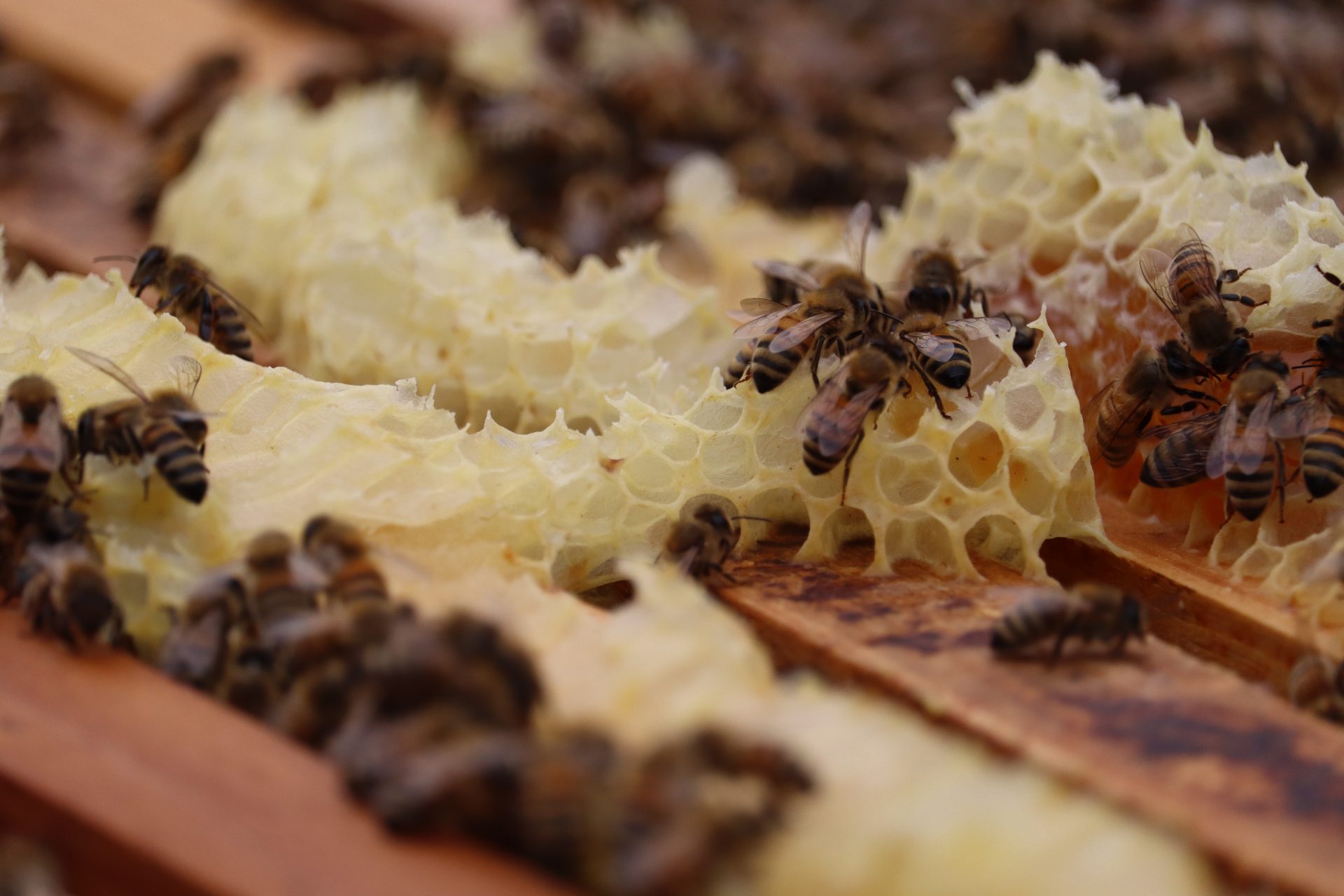
Forager bees collect nectar from flowering plants, which they convert into honey. The concentration of sugar contained in nectar varies by plant species, from 5–92%. Nectar contains minerals, vitamins, gluconic acid, formic acid, fats, enzymes, and microorganisms not found in sugar syrup or high fructose corn syrup. “Because of this, honey is more nutritious for bees than syrup” (Cornell, 2022, p. 81). In addition, nectar converted to honey possesses “significantly higher antibacterial activity compared to bee-processed syrups” (Bugarova et al., 2021, p. 1)2 (Figure 2).
Colonies require protein for brood production and the development of young adults, which they acquire from pollen (Figure 3). Pollen provides proteins, amino acids, lipids, starch, sterols, vitamins, and minerals. Workers process the pollen, converting it into bee bread by mixing it with nectar and bee saliva. The processing encourages lactic acid fermentation for preservation and improved digestion. The availability of diverse and abundant pollen positively affects nurse bee physiology and tolerance to pathogens. The amount of protein in different pollens varies widely from 5–40%. Excellent pollen sources contain at least 25% protein. The best peer-reviewed science indicates that natural pollen is a superior versus artificial pollen substitutes.3
Colonies stockpile nectar and pollen when resources are abundant in the landscape. The colony must consume food constantly and use stored resources during dearth periods. A dearth is when few plants are flowering, such as during late Summer or over the many months of Winter. The amount of honey and pollen the colony consumes varies widely, depending on climate, colony size, brood rearing amount, and time of year. The average amount of honey a colony needs for Winter consumption ranges from 40 pounds to 100 pounds. Annual pollen consumption ranges between 30 and 120 pounds.4

by checking that larvae are floating on a pool of brood food, as shown here.
Photo Credit: Dorothey Morgan, used with permission


displayed weight to get an approximate total hive weight. This colony is ready for Winter, weighing about 156 pounds (78 * 2) which is above my Winter target of 140 pounds.
Photo Credit: Theresa Martin
Honey Is Best for Bees
Beekeepers sometimes over-harvest honey in Summer or Autumn, with the hope that the Fall nectar flow will be sufficient to backfill for what the beekeeper took. If the Fall flow does not materialize, the beekeeper feeds back nutritionally inferior syrup. This is sometimes a planned strategy to maximize profits from honey sales because the beekeeper recognizes that he or she can sell honey for more than the cost of sugar. The beekeeper may not recognize that Winter bees must live approximately five months and are responsible for rearing the first generation of workers the following Spring. Given the many stresses on the bee immune system, the added challenge of consuming even slightly inferior Winter nutrition increases the likelihood of the colony dying before Spring. Taking a longer-term viewpoint, overwintered second-year colonies usually make more honey than first-year colonies or splits replacing deadouts. While the beekeeper may profit from increased honey sales in the short term, if the bees are dead, those dead bees will never make honey in subsequent years.
In addition, some resources recommend beekeepers remove the majority of honey in Autumn and feed back syrup, suggesting that syrup is healthier for Winter bees than honey. However, the conditions that create this advantage are specific. First, the honey in the hive must be high in mineral content and indigestible sugars, as in the case of honey dew honey. Second, the climate must be cold, such that the bees are unable to take cleansing fights for multiple months. These two conditions combine to increase the likelihood of dysentery.5 Otherwise, honey is nutritionally superior and linked to overwinter survival, as supported by the four peer-reviewed studies cited below.
Leave More than Enough Honey
Beekeepers focused on bee health as the optimal pathway to increased productivity leave more than enough honey for the bees to consume during the Autumn dearth and especially during the longer Winter dearth (Figure 4). One way to ensure this is to shift honey harvest timing. Instead of the traditional timing of harvesting honey immediately after the nectar flow ends, the beekeeper harvests honey after the dearth ends and at the beginning and during the next nectar flow. This makes it more likely the bees will have enough nutritionally superior, nectar-derived honey to consume during each dearth period and during Winter. Another advantage of harvesting during a nectar flow is that robbing is less likely, and the bees are less defensive.
In addition, beekeepers can weigh hives before pulling honey. I weigh my hives using the Cabela 330 pound hanging game scale and harvest honey during nectar flows when the total hive weight is 160-180 pounds. To ensure my colonies have sufficient honey stores to consume during Winter, I send them into Winter weighing about 140 pounds (Figure 5). I derived this weight for my colonies located in Kentucky using resources provided by Cornell University in central New York state, which recommends 160 pounds as their Winter target weight.6
In this way, I work to ensure my colonies are consuming nutritionally superior honey. Quality nutrition supports the colony’s immune system and allows the bees to combat the many stresses challenging them. Superior nutrition contributes to improved health, which drives increased productivity in the long run.
Theresa J. Martin is the author of Dead Bees Don’t Make Honey: 10 Tips for Healthy Productive Bees, which includes a Foreword by Dr. Thomas Seeley. Theresa has achieved 99% colony survival and honey production that is twice the local average in her eight years as a beekeeper, with 20–25 colonies in Kentucky. She can be reached at theresa@littlewolf.farm
REFERENCES
1Dr. Tammy Horn Potter provides a thorough and engaging cultural history of bees and beekeeping in the United States, exploring their impact on American history.
Horn, T. (2006). Bees in America: How the Honey Bee Shaped a Nation. University Press of Kentucky.
2Multiple peer-reviewed sources determined that honey delivers health benefits and improved survival versus sugar syrup and high fructose corn syrup.
Bugarova, V., Godocikova, J., Bucekova, M., Brodschneider, R., Majtan, J. (2021). Effects of the carbohydrate sources nectar, sucrose and invert sugar on antibacterial activity of honey and bee-processed syrups. Antibiotics, 10(8), 985. https://doi.org/10.3390/antibiotics10080985
Cornell Master Beekeeper (2022). Master beekeeping part II: The science and art of beekeeping. Cornell University College of Agriculture Life and Sciences.
Quinlan, G., Döke, M. A., Ortiz-Alvarado, Y., Rodriguez-Gomez, N., Koru, Y. B., Underwood, R. (2023). Carbohydrate nutrition associated with health of overwintering honey bees, Journal of Insect Science, 23(6). https://doi.org/10.1093/jisesa/iead084
Wheeler, M., Robinson, G. (2014). Diet-dependent gene expression in honey bees: honey vs. sucrose or high fructose corn syrup. Scientific Reports 4(5726). https://doi.org/10.1038/srep05726
3While this article focuses on the nutritional value of honey, here are resources for those interested in the nutritional contribution of natural pollen.
Di Pasquale, G., Salignon, M., Le Conte, Y., Belzunces, L. P., Decourtye, A., Kretzschmar, A., … & Alaux, C. (2013). Influence of pollen nutrition on honey bee health: do pollen quality and diversity matter? PLOS ONE, 8(8), e72016. https://doi.org/10.1371/journal.pone.0072016
Noordyke, E. R., Ellis, J. D. (2021). Reviewing the efficacy of pollen substitutes as a management tool for improving the health and productivity of western honey bee (Apis mellifera) colonies. Frontiers in Sustainable Food Systems, 5, 772897. https://doi.org/10.3389/fsufs.2021.772897
University of Florida Honey Bee Lab (2025, February 28). Pollen & Bee Bread Beekeeping Academy Ep. 61 (Video). YouTube. https://www.youtube.com/watch?v=uFZgLwcU8_o&t=32s
4Burlew (2014, August) provides an excellent overview of honey consumption, with a focus on Winter amounts and methods. Ellis, et al. (2020) details pollen consumption amounts.
Burlew, R. (2014, August). The remarkable amount of honey your bees need for Winter. Honey Bee Suite. https://www.honeybeesuite.com/how-much-honey-should-i-leave-in-my-hive/
Ellis, A., Ellis, J. D., O’Malley, M. K., Zettel Nalen, C. M. (2020). The benefits of pollen to honey bees. University of Florida/IFAS Honey Bee Research and Extension Lab. https://edis.ifas.ufl.edu/publication/IN868
5Randy Oliver describes the conditions for Winter dysentery, including nine cited resources.
Oliver, R. (2019). The Causes of Dysentery in Honey Bees Part 1. Scientific Beekeeping. https://scientificbeekeeping.com/the-causes-dysentery-in-honey-bees-part-1/
6Cornell University provides excellent resources, including weight calculations for successful overwinter survival.
Cornell CALS (n.d.). Overwintering. Cornell Collage of Agriculture and Life Sciences. https://cals.cornell.edu/pollinator-network/beekeeping/overwintering
