
Click Here if you listened. We’d love to know what you think. There is even a spot for feedback! Read along below!
By: Stephen Bishop

In ancient times, Hercules was the most heroic of mortal men. However, due to some chicanery by the gods, Hercules briefly went insane and did some terrible things. To atone for these misdeeds, King Eurystheus commanded Hercules to perform twelve labors — think of them as ancient forms of community service since most involved ridding communities of monstrous creatures menacing the populace. For his first labor, Hercules had to kill the Nemean Lion, which had grown to a mammoth size from overeating Nemeans. Hercules strangled the lion with his bare hands.
“Simple enough,” Hercules said to his chariot driver Iolaus, “on to the next labor.”
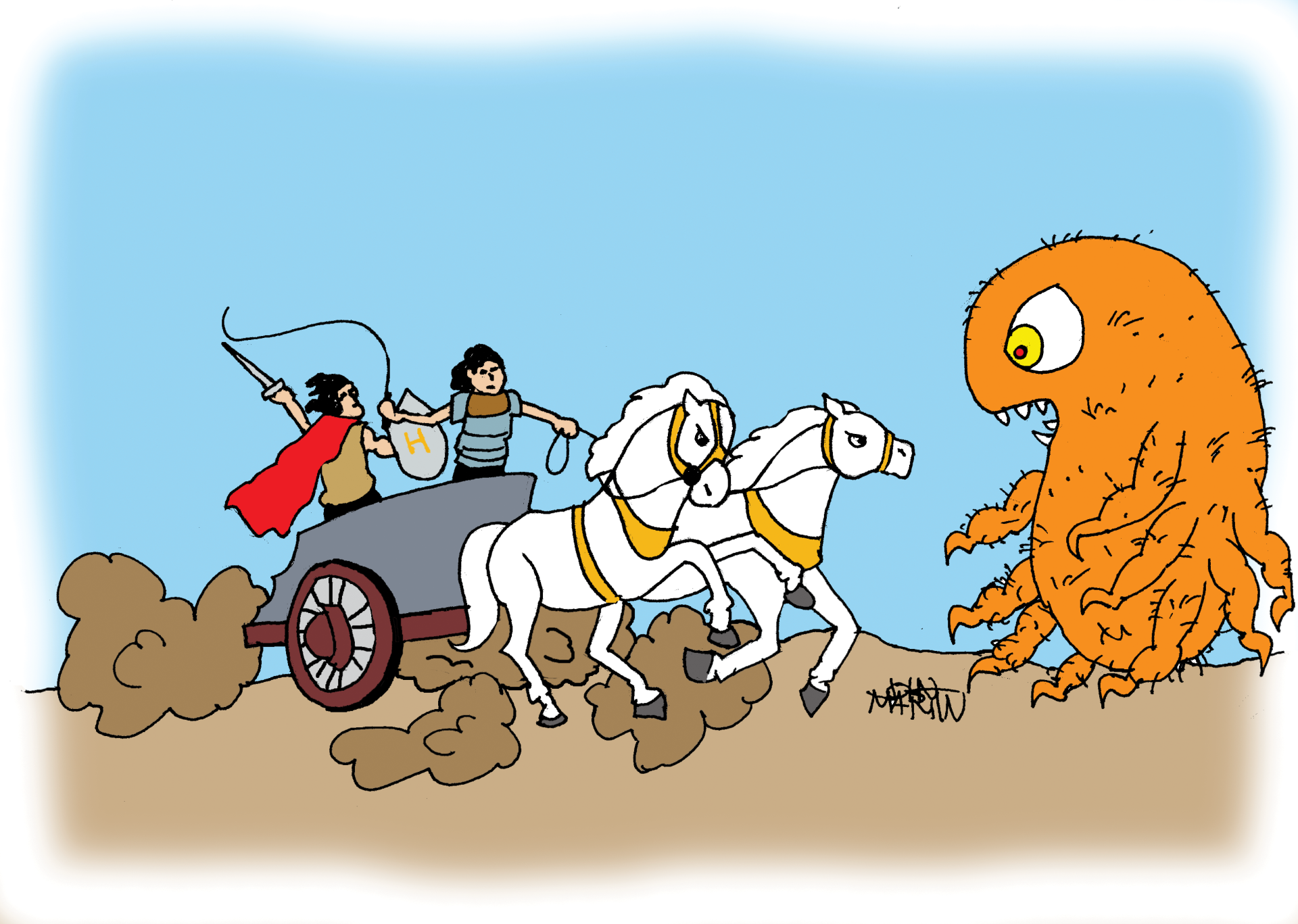
“Yes, sir!” Iolaus said, snapping the reins. Under tow of the galloping horses, Iolaus and Hercules departed for Lerna, a town plagued by the monstrous multi-headed Hydra, which inhabited a swamp on the outskirts of town. Iolaus and Hercules rode forth, through fields of sorrel and buttercup, until they finally arrived at the stinking swamp. There, at the Hydra’s lair, a giant creature emerged, a creature so ugly and vile that it is beyond words to describe. The sheer hideousness of the beast caught Hercules off guard.
“You look a lot more hideous than I was expecting,” Hercules said to the creature, “are you the Hydra?”
“No,” said the creature, “the Hydra had to call out sick today. I’m the substitute monster, formally known as the Mite of Destruction, but you can call me Varroa.”
“Nice to meet you, Varroa,” said Hercules, “I’ll make this fair and fight you bare-handed, like I did the Nemean Lion. Prepare to die.”
And so combat commenced between the heroic Hercules and the hideous Mite. But Hercules soon found himself outmatched, for every time he struck a blow to the Mite, two more daughter mites popped out of it. Smaller in size (about the size of a dinner plate), these daughter mites jumped and latched onto Hercules’s back and started siphoning out his hemoglobin. Hercules soon felt weak and sickly and downright anemic.
“Alas, I have met my match,” Hercules thought. Iolaus, seeing his master was in grave danger, lit a torch with which to attack the beast. It did little good, and soon Iolaus was also beset with a back full of mites. All hope was lost until an errant spark escaped from Iolaus’s torch. The spark started a nearby brush fire in a field of wood sorrel and buttercup (both belong to the Oxalis genus). Soon, a billowing cloud of oxalic acid smoke arose, encompassing the swamp and killing the mother mite and her daughters. But sadly, though Hercules and Iolaus killed the mites, their health continued to dwindle and soon they perished from symptoms of parasitic mite syndrome.
Moral: Don’t be a hero. Treat early for mites.
For more revisionist history and ravings about farm life and beekeeping, subscribe to Stephen’s weekly newsletter at misfitfarmer.substack.com