
Tracking Tropi
Click Here if you listened. We’d love to know what you think. There is even a spot for feedback! Read along below!
By: Jay Evans
After millennia of infesting Asian honey bee colonies, Tropilaelaps mites discovered they could survive and thrive in colonies of the western honey bee, Apis mellifera. The most widespread Tropilaelaps species was first described in association with the giant honey bees of India, and later with the managed Asian honey bee, Apis cerana. Like Varroa, Tropi mites then found that the scents and habits of A. mellifera were as attractive as their original hosts, and the potential was, well…worldwide. The threat of Tropi to A. mellifera, did not go unnoticed, leading to decades of increasingly active research. Major questions include how is Tropi moving into new populations of western honey bees, how do these mites impact honey bees, and how can bees and beekeepers fight back?
One certainty is that Tropi can expand its range in jumps and leaps, presumably aided by humans and bee movement alongside bee biology. A potential barrier to Tropi migration, and arguably Tropi success outside of the tropics, is the fact that Tropi adults are famously short-lived on adult worker bees. Without brood for feeding, these mites are generally thought to perish within days, not weeks. Nevertheless, Aleksandar Uzunov and colleagues have shown recently that Tropi can survive for sufficient time on worker bees during swarm events to meet the first new brood of established swarms (Uzunov, A., Janashia, I., Chen, C., Costa, C., Kovačić, M., & Gill, M. C. (2026). Swarming promotes Tropilaelaps mercedesae (Mesostigmata: Laelapidae) dispersal in Apis mellifera (Hymenoptera: Apidae). Journal of Economic Entomology, 119(2), 1473–1477. https://doi.org/10.1093/jee/toag027). This ability to hunker down helps explain the presence of apparently viable Tropi mites on a cluster of Apis dorsata bees collected recently on an ocean-going container ship (Ramirez JL, Tembrock LR, Zink FA, Fife A, Gilligan TM, Chen Y, Evans JD, Mottern J, Smith-Pardo AH and Ochoa R (2026) Interception of an Apis dorsata swarm with Tropilaelaps mercedesae and Kuzinia morsei mites on a cargo vessel inbound to the United States. Front. Insect Sci. 6:1829350. doi: 10.3389/finsc.2026.1829350). These mites were weeks away from the original colony of the swarm of bees they lived with. The bees were captured without drawn comb and with no evidence that they had produced brood at all during their sea travels (although this could not be absolutely ruled out). Still, the mites persisted. Fortunately, shipboard workers knew these bees posed a risk, and authorities swiftly eliminated this risk while the boat was far from U.S. shores. Here, the presence of a swarm on deck was adequate cause for action, but what about Tropi already on land and within established western bee colonies? Efforts are ramping up to find practical and sensitive methods for detecting Tropi early and accurately.
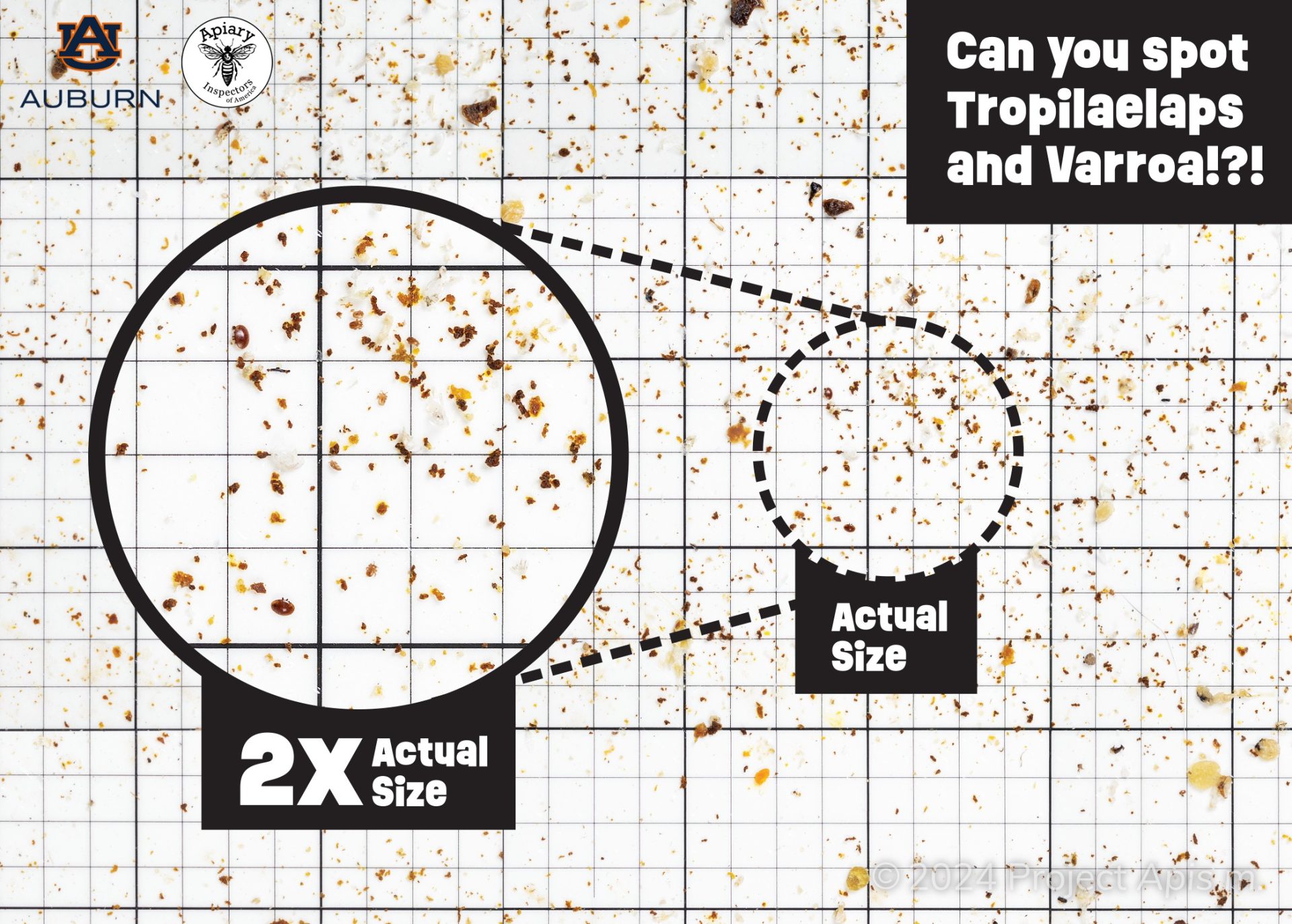
Increased attention on Tropi mites in the early 2000’s led to new detection methods, including ‘bumping’ open brood cells as a way of dislodging active mites (Pettis JS, Rose R, Lichtenberg EM, Chantawannakul P, Buawangpong N, Somana, et al. (2013) A rapid survey technique for Tropilaelaps mite (Mesostigmata: Laelapidae) detection. J Econ Entomol: 106(4): 1535–1544 https://doi.org/10.1603/ec12339). In 2018, Maggie Gill and colleagues did one of the first head-to-head tests of potential detection methods (Gill MC, Chuttong B, Davies P, Etheridge D, Panyaraksa L, Tomkies V, et al. (2024) Assessment of the efficacy of field and laboratory methods for the detection of Tropilaelaps spp. PLoS ONE 19(9): e0301880. https://doi.org/10.1371/journal.pone.0301880). Across 60 colonies with generally low mite levels, they found that uncapping and scrutinizing 100 capped brood cells was the most sensitive method, while standard mite checks using powdered sugar fared nearly as well and were arguably less damaging to colonies. Other washes (e.g., alcohol), mite drop from bees narcotized with CO2, the ‘bump’ test, and the use of sticky boards were all less sensitive in detecting mites.
Two recent studies have pitted multiple detection methods against each other, adding insight and ‘nuance’. In the first, Rogan Tokach and colleagues in the U.S. and Thailand tested adult bee screening, including powdered sugar and alcohol washes, against brood screening and the use of sticky bottom boards (Tokach, R., Aurell, D., Chuttong, B., & Williams, G. R. (2026). Sensitivity of current Tropilaelaps mercedesae monitoring methods in Apis mellifera colonies. Scientific Reports, 16(1), 16778. https://doi.org/10.1038/s41598-026-46467-0). Their study showed equally high sensitivity using sticky boards left for 70 hours and uncapping of 200 brood cells (26 of 26 infestations noted and 24/26, respectively). Of the rapid-survey methods that one could do while cruising through an apiary, bumping brood frames was far more sensitive (an estimated 50% accurate notification rate when colonies had 1.5% brood parasitism level) than washes or sugar shakes of adult bees. They also produced a nice video of Tropi detecting (https://www.youtube.com/watch?v=eiBnkJazgCE) and, with many others, including USDA and Project Apis m, have a great Tropi ‘landing page’ at (https://www.honeybeepests.org/tropi-resources). Cooper Nat Schouten and colleagues from Australia and Papau New Guinea carried out a similar study and, being most recent, were able to compare their results against past studies of 13 proposed detection methods (Schouten, C. N., Lees, K., Roberts, J. M. K., Brewster, E. T., Gabriel, F., & Tonny, K. (2026). Evaluation of methods for early detection of Tropilaelaps mites in European honey bee (Apis mellifera) colonies. Scientific Reports. https://doi.org/10.1038/s41598-026-52776-1). Here, sticky boards (24 hours, with amitraz on the boards to kill mites) fared well, with an estimated sensitivity of 71% in colonies with low infestation rates, followed by both worker brood uncapping and a ‘rapid’ uncapping method using “Veet Expert Hair Removal Wax Strips” (first noted by Uzunov and colleagues). The very best detection method involved a swab test of hive surfaces (2 x 30 seconds) followed by genetic analyses using Tropi-specific DNA ‘primers’. This test was 100% accurate in identifying Tropi, although the authors note that Tropi DNA could be either from present mites a signal of mites from past. Still, for frontline detection of Tropi, those results are impressive. Unfortunately, DNA tests can be pricey and delayed, and the authors estimated those to cost $29 Australian dollars per sample (ca. $US20 currently). Sticky boards with acaricides were actually more pricey than this thanks to the labor involved, while various washes and the bump test were about $AU9. Brood uncapping had similar costs to the DNA test and arguably will be hard to economize given the trained labor involved. In contrast, DNA labs could likely innovate a far less expensive rate over time. Brood uncapping can offer an instant diagnosis, a highly attractive prospect compared to DNA tests, most of which require a trip to a lab for processing.
Thankfully, there are a few detection methods available to help beekeepers and others notice and act upon Tropi mites. For now, be grateful that people ranging from sailors and stevedores to our federal (USDA-APHIS) and state port guardians have Tropi on their watchlist.


