
Click Here if you listened. We’d love to know what you think. There is even a spot for feedback! Read along below!
Directional Discourse
By: Stephen Bishop
Not to brag, but I may be one of the only humans on Planet Earth capable of admitting my inability to navigate in the right direction. Yep, I’m prone to getting lost. I didn’t used to be this self-aware. I used to adamantly insist that I had the directional precision of a honey bee. A mere glance at the sun’s position in the sky, and I could make a bee line to my destination, no GPS needed, no compass necessary. For brevity’s sake, I won’t bore you with the details of my directional downfall: suffice it to say, being lost in the woods for hours and being rescued by your grandma’s Labrador has a humbling effect on a man.
So, these days, I don’t pretend to know where I’m going. I just outsource navigation to the two females in my life, Siri and my wife. Sometimes my wife will get jealous of Siri and try to overrule her GPS-guided capabilities. This usually doesn’t end well. My wife has the bad habit of getting her left and right wrong fifty percent of the time. To clarify, she knows her left from right — it just gets lost in translation somewhere between her brain and vocal chords. This can make driving to new destinations quite tense.
ME: Do I turn left or right?
WIFE: Left, wait, no the other left.
ME: (Swerving across several lanes of traffic, horns blowing in the background) You mean right?
WIFE: Right, that’s where I pointed.
ME: Well, you said left but pointed right. Can’t we just let Siri guide us?
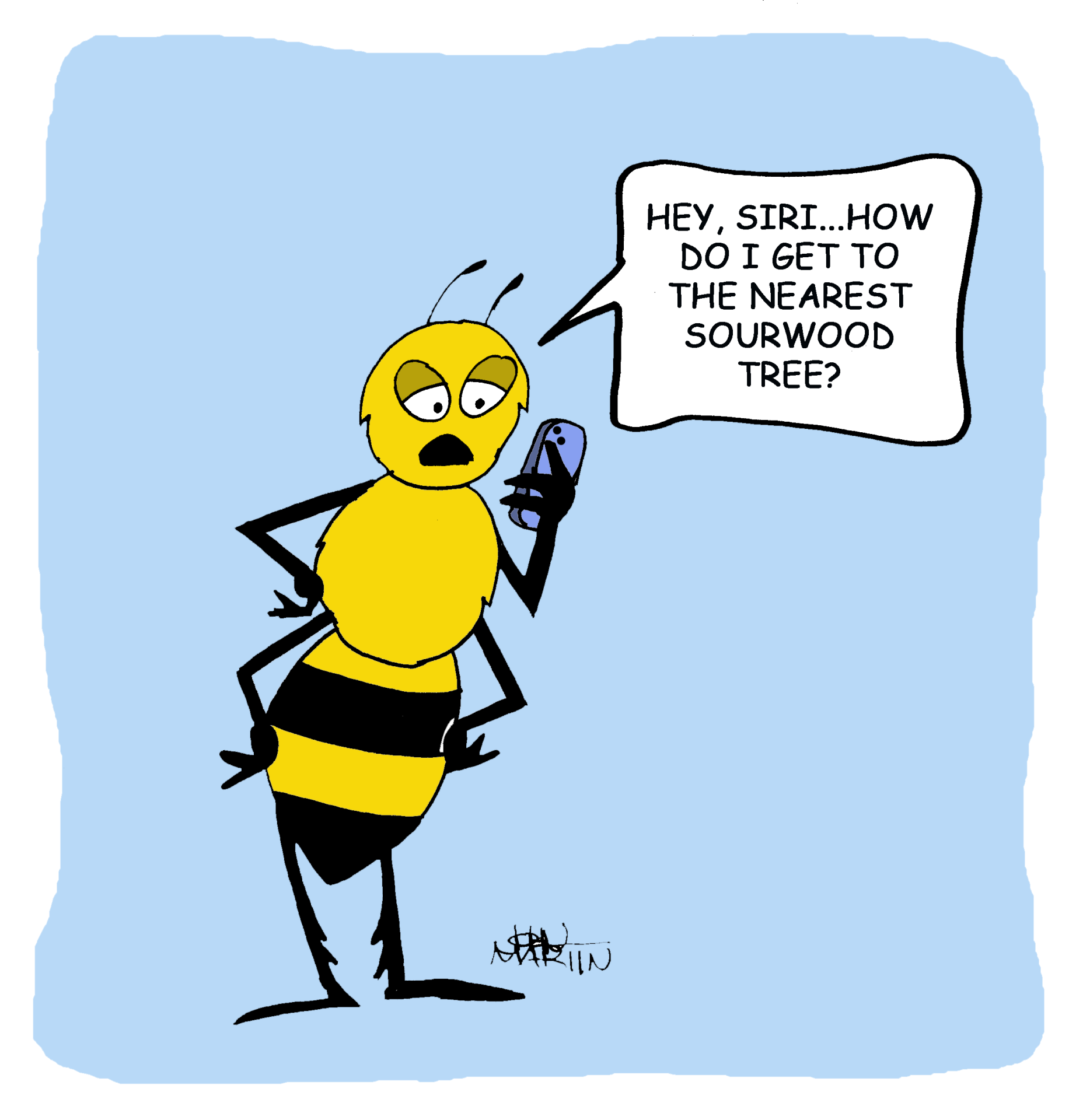
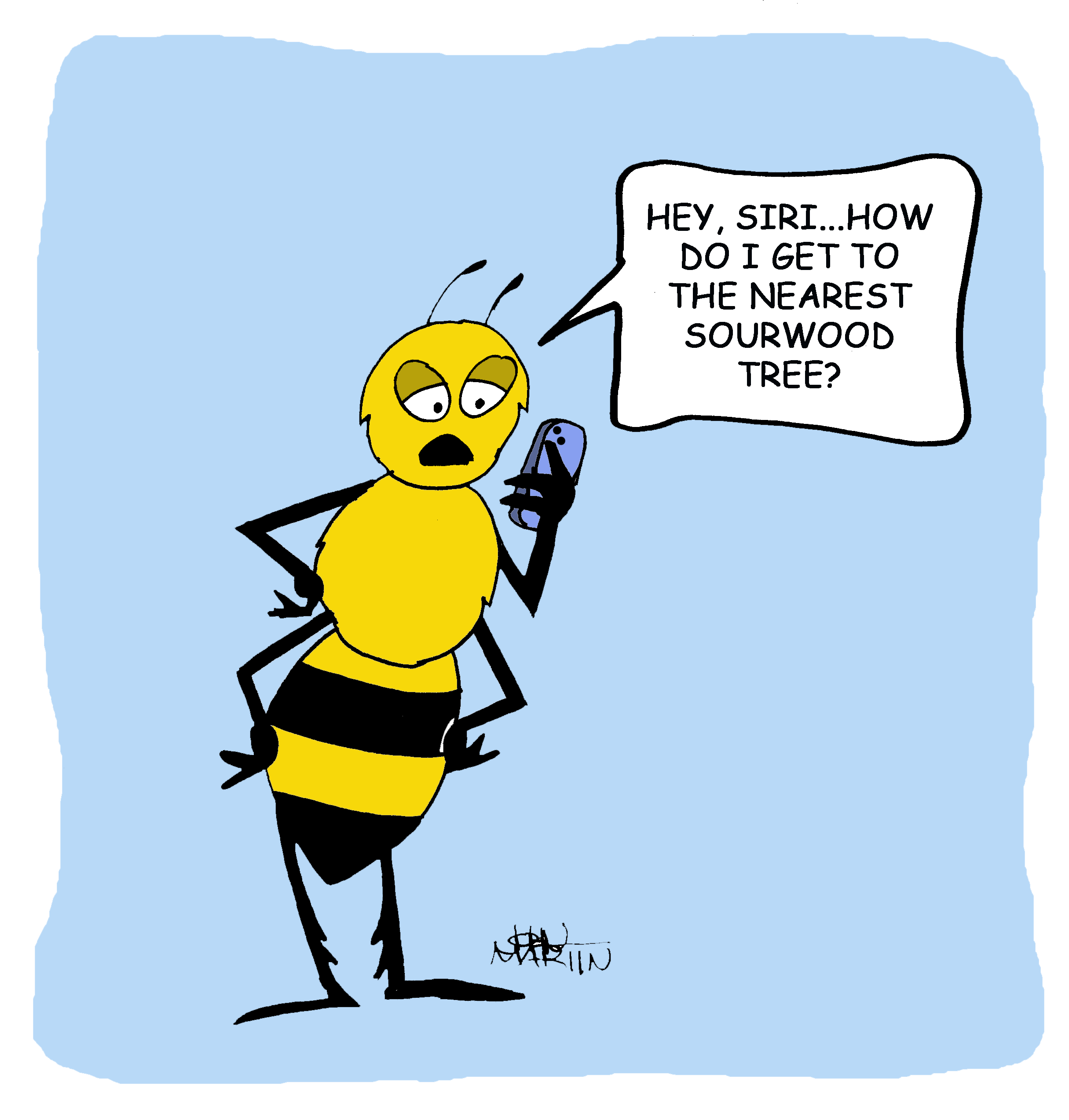
SIRI: Renavigating
It’s amazing to me that honey bees, creatures with a brain the size of a salt grain, have a better sense of direction than I ever will. Think about it this way. A honey bee weighs roughly 0.00025 pounds. That means I’m 720,000 times bigger than a honey bee (I’ll let you do the math on how much I weigh). A honey bee’s home range, in which it is presumably capable of navigating without getting lost, is roughly four miles from the hive, or 50 square miles. That means if the honey bee was my size it’s equivalent navigational range would be 36 million square miles. That means a human-sized honey bee would be able to navigate an area larger than Europe and Asia combined without getting lost. Granted, I was an English major so my math might be way off, but rest assured if you ever get lost and your phone is dead or doesn’t have signal, a human-sized honey bee should be able to point you in the right direction, at least if you know how to interpret the waggle dance.
Nowadays, if you stop and ask directions, people look at you like you’re crazy. But before the invention of GPS navigation systems and smartphones, giving and receiving directions among the human species was a bit of an art form. People took pride in their ability to clearly communicate landmarks, routes, and whereabouts. Many farmers I know can still do this, all while more or less giving you the whole history of the countryside while pointing you in the right direction. But directing is slowly becoming a lost art. I know this because, as a beekeeper, one of the most common questions I get is “Is this honey local?” To which I reply, it “depends on where you live.” At this point, it’s not uncommon to watch young folks struggle to describe the general whereabouts of their domicile. So call me old-fashioned, but I miss the primitive days when people knew where they lived and could tell you how to get there. In fact, sometimes I feel a little guilty marketing local honey to people who don’t know their locality, much less how to navigate to it.
