
Click Here if you listened. We’d love to know what you think. There is even a spot for feedback! Read along below!
And the Native Bees We Love
By: Nam Chi Anoche

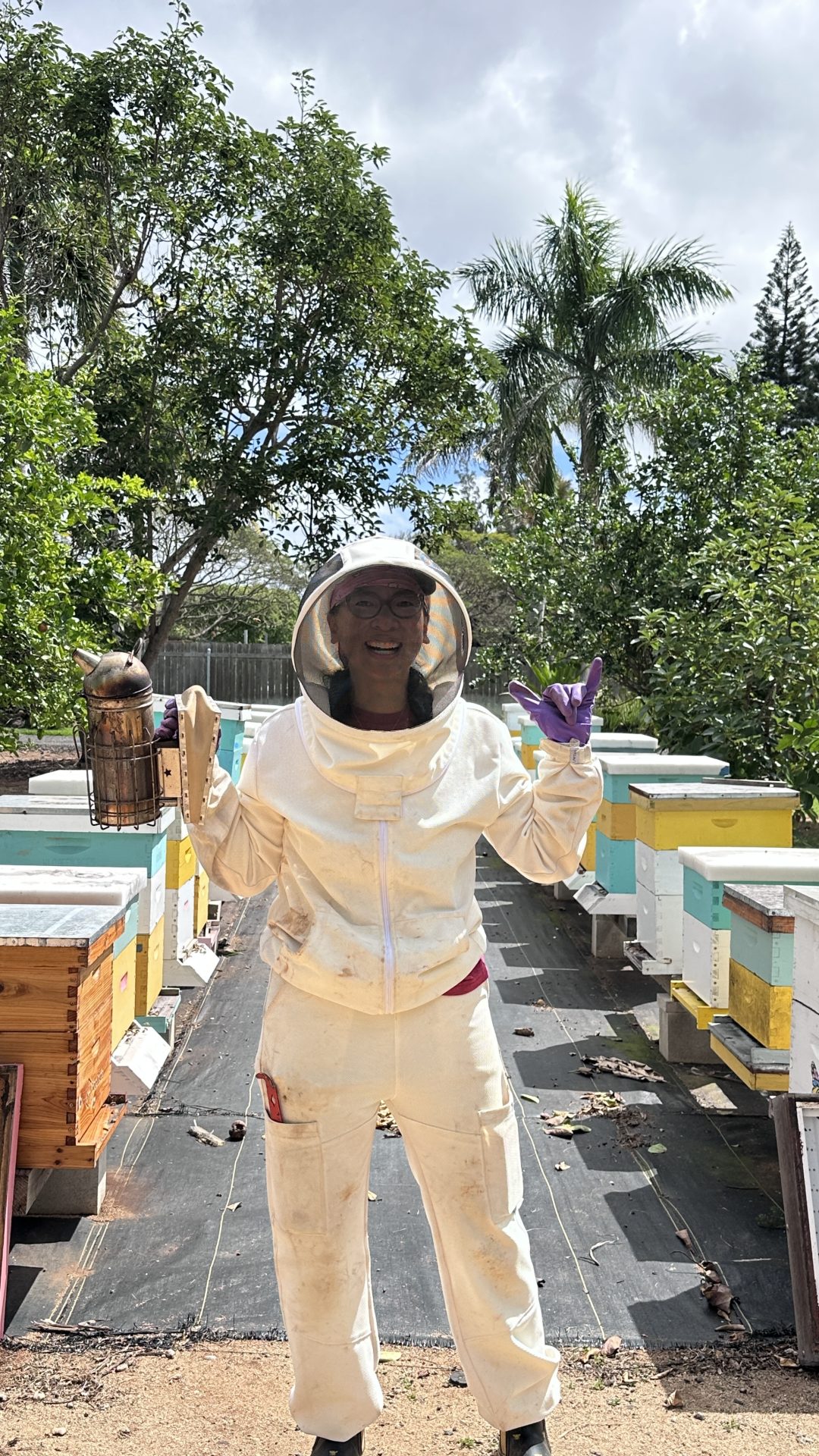
My name is Nam Chi Anoche, and I’m on the master beekeeper track at the University of Florida. I reside in Honolulu, Hawai’i, and the apiary that I sequester myself in is called Hānai Hives located in North Shore, Hawai’i. Trekking the two-hour roundtrip drive to the quiet and quaint countryside of the northern border of the island of O’ahu, my norm is the bustling city, plagued with the loud noises of construction, parties, and rush hour traffic in Waikīkī. When I’m not at the apiary that I call my sanctuary, you can find me looking for Nalo Meli Maoli or the native Hawaiian Yellow-Faced Bee on the white sands of the Turtle Bay Ritz-Carlton. We Hawaiian beeks refer to this fun size cousin of Apis by their genus name, Hylaeus.
My beekeeping journey started off four years ago where the pandemic life as a restaurant worker was not plentiful nor fulfilling. Boredom had me snooping around on my laptop where I discovered a show on a beekeeping couple. My mind wandered back to grade school where I always had a fascination for Apis mellifera scutellata. My eyes were glazed, witnessing my first bee swarm on a bench on school property as my homeroom teacher rushed over to slam the door and cover up the windows as the beekeeper arrived in a cloud full of smoke, clenching onto a tin can with a handle.
World Bee Day 2022 was my first official day at an apiary, a hidden jewel called Hānai Hives nestled in the mountainside of Sunset Beach, North Shore, Hawai’i. Hānai means “to adopt” in Hawaiian. My hive has been adopted for almost four years, and my fascination for bee science grew the first year of beekeeping. My satiety for knowledge only grew as the months went by the first year, and Katie suggested that I contact her beekeeping buddy and preservationist confidant, entomologist, Dr. Jason Graham.
When Dr. Graham and I had a chance to connect long distance as he since moved away from Hawai’i, my eagerness led my imagination to go wild and uninhibited. Dr. Jason Graham harnessed my hyperactivity through the suggestion of research with Hawai’i’s native bees. My shock was noticeable upon the mention that there were other bees other than honey bees in Hawai’i.
My vision of a Hawaiian bee was a thought of a big, fluffy, rainbow, bumblebee that hung out in a big ball of colony. Instead, I was presented with a black, ant-like creature that was a quarter the size of a honey bee that lived in solitude inside a thin tubelike structure on the beach. Here in O’ahu, once abundant and thriving, Hawai’i’s native bees were driven to the ocean due to urban developers and predators such as ants.
Hylaeus traveled by driftwood in tubelike structures as thin as coffee straws about a million and a half years ago to Hawai’i and rapidly spread throughout all the islands. The nests were protected by a cellophane-like substance secreted by the Dufour’s gland in the abdomens of the females. Due to the unique atmosphere of the volcanic origins, they speciated to sixty-four different species.


Waikīkī was once green and lush and Apis arrived at the shipping dock in 1857 with the intention of pollination. The bee cousins can be seen together pollinating on Hawai’i’s native Naupaka shrub and the non-native Heliotrope tree on the coasts of O’ahu. Thriving native bee nests can be found inside hollowed out branches of the Heliotrope, while honey bees buzz around them for their rations of nectar and pollen.
With the growing popularity of raw, local, Hawaiian honey, native bees do not make any because they are too small and only make enough to feed their young and themselves. Instead of rows of honeycomb, Hylaeus nest in holes in rocks, and coral where prime real estate is favored with an ocean view. Their mandibles are not strong enough to chew through wood and heavily rely on holes of hollowed out stems provided by other bees to nest in as well.
Hānai Hives and beekeeping in Hawai’i gave me opportunities to not only discover myself as a beekeeper, but to grow my mind. Katie’s motto is to grow healthy bees and mindful beekeepers. Sustain honey bees, but wild bees as well. The uniqueness of Hawai’i’s only bee that is endangered, coupled with this year-round honey flow of Hawai’i’s native flora and fauna is the capstone of what makes raw, Hawaiian honey magnetic to daily tourism. What is there left to say other than to be a beekeeper in Hawai’i is to fall in love with the flora and fauna of the Hawai’i islands and its only native bee.
Nam Chi Thi Vu Anoche has been beekeeping since 2022 and is a current Master Beekeeping student at the University of Florida Honey Bee Research and Extension Laboratory. When not doing hive inspections, she does research on the endangered, native, yellow-faced bees of Hawai’i.
