
The Fast Track to Beekeeping Experience
Click Here if you listened. We’d love to know what you think. There is even a spot for feedback! Read along below!
By: David Burns


You cannot become a good beekeeper simply by reading books, attending conferences or classes or by watching YouTube. Good beekeepers are made from gaining years of experience. But not just experience, but meaningful experience and this can take many years. It can often take a minimum of five years to truly gain a solid, working foundation in beekeeping. During these first five years, many beekeepers give up because they either lose their hives in the Winter and give up or it’s too challenging not understanding how to deal with all the issues a colony can present.
One of the challenges of becoming a successful beekeeper is that so much of what we need to know can only be gained through many years of hands-on hive inspections. This means that the first few years of beekeeping, without experience, can be very frustrating and unsuccessful.
For most beekeepers, hive inspections start in March or April. Follow my math. If we are inspecting our bees, twice a month, from March through October, this equals sixteen inspections. Sixteen inspections during the first year doesn’t provide many opportunities to gain much experience. Only sixteen times to learn to spot a queen, recognize eggs, larvae and pupae. Only sixteen times to learn the art of judging the brood pattern, stored resources or sharpening your skill at killing small hive beetles scurrying under a sea of bees. If five years is the sweet spot of finally gaining enough experience to reach a level in beekeeping we would associate with being a good and confident beekeeper, then it means we would need eighty meaningful inspections under our belt to observe and see various scenarios in beekeeping.
But what if we could accelerate this process?
This could reduce the number beekeepers who quit after their first year and it would help beekeepers keep healthier bees and make fewer mistakes. How can we take five years’ worth of conventional inspections and gain that much experience in one single season? By giving ourselves more opportunities to learn. Consider a five-frame Learning Box.
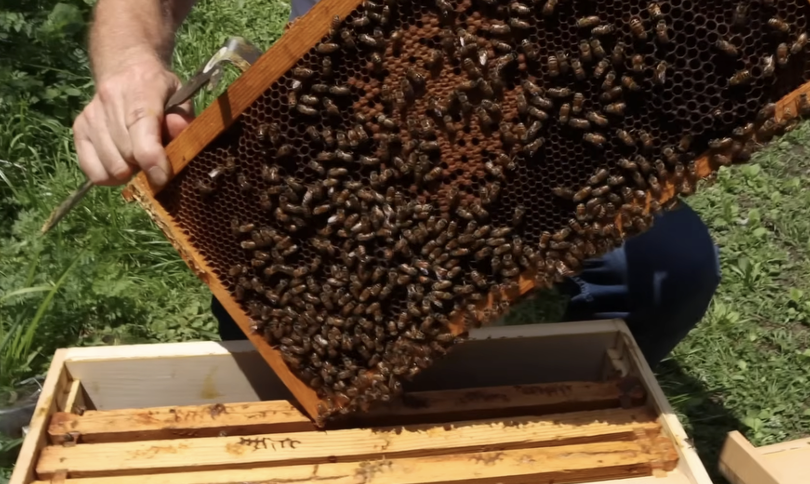
Over the last few decades, I have enjoyed learning about bees from a five-frame Learning Box. Essentially it is a five-frame nuc, but I like to call it a Learning Box. It is simply a small hive dedicated to being an education hive. Back to our math. If eighty inspections brings us to five years of experience we would need to open our big production hives roughly ten times a month. Inspecting our large hives a little over twice a week could be challenging for most beekeepers and stressful for our bees.
Consider opening a smaller, five-frame nuc two or three times a week. This would provide many essential and meaningful learning opportunities every week. Since these inspections are performed in our Learning Box, the increased frequency of inspections is not as stressful to a smaller Learning Box as it would be to a larger production hive. We become better beekeepers and gain confidence by observing and inspecting our bees over and over. This is why a small, Learning Box can become so valuable in accelerating our experience level. With fewer frames, we can focus more on the bees, their behavior and growth.
A typical beekeeping season provides about thirty-five weeks to gain experience through hive inspections. To accumulate the equivalent of five years’ worth of conventional inspections during that time, we would need to inspect our Learning Box about 2.3 times per week, or about ten times per month. This breaks down to two inspections most weeks and a third inspection about every third week. Because the Learning Box is small and its purpose is education rather than honey production, you can open it much more, to experiment, make mistakes and learn from what you observe.
Obviously, this approach has a few drawbacks. You cannot experience five years of seasonal challenges or gain five years of experience managing a twenty-frame brood area in a larger hive. I recommend continuing inspecting your production hive every couple of weeks but use the Learning Box to accelerate the fundamental skills and hands-on experience that are much easier to develop in a smaller colony. For example, learning to identify eggs or find the queen can mean tearing down the larger hive frame by frame. All of us have had the elusive queen that after looking through twenty or more frames we find her on the first frame we inspected but missed her. Learning to find the queen can easily be practiced repeatedly in a five-frame Learning Box. Once these skills are sharpened, they can then be transferred over and applied when inspecting our larger hive.
The Learning Box offers concentrated and repeated practice with less at stake. This is where experience can be gained more quickly. Years’ worth of frame manipulation can be compressed into one season. Honey bee biology that may take years to fully understand can begin to make sense in a single season through a greater number of repeated inspections.
I’ve used this approach for years. I love being able to go out to my apiary in the middle of the day and pick up my Learning Box and carry it to a picnic table to spend as long as I want observing what the bees are doing. Sure, foragers will gather in the air where the Learning Box used to be, but they’ll wait. They will still be there when I take it back. No harm done. You can sit and practice finding your queen or even picking up your queen or marking her without having a large hive opened in the hot sun.
The Learning Box is easy to start in the Spring by just moving a couple of frames over from a larger hive with eggs and watch the bees raise a new queen. As the season progresses and your Learning Box fills rapidly you can share some of these resources with weaker colonies to keep your Learning Box from swarming from being overcrowded. In the Fall you can try your hand at overwintering it or combine the frames to strengthen weaker colonies going into Winter.
To help me in mentoring others, I prepared 32 lessons for those using these Learning Boxes to help gain more experience during their first season. Each of these lessons is designed to provide experiences that might otherwise take years to learn. Some of these lessons include using a refractometer to measure moisture content in open nectar cells, to using a push-in queen cage for mite control and even trying grafting larvae for queen rearing.
I realize nothing will replace years of beekeeping experience. A Learning Box will not give you five Winters or five swarm seasons in a single year. But learning to become a better beekeeper really is about repetition, seeing things over and over. Learning to recognize patterns in your bees, learning to quickly identify issues and to learn what is really happening and making decisions to solve problems.
Consider a Learning Box to help you develop the confidence you need to become a good beekeeper or use it as you mentor others. If you’d like to know more about how to use Learning Boxes as a great tool to gain beekeeping experience, check out my YouTube channel by going to YouTube and searching for David Burns Beekeeping.
