
Does it make a difference in overwintering success?
Xianzhong Wang


Overwintering honey bee colonies is a challenge wherever bees are kept, particularly in northern climates. Colonies can perish in Winter for a myriad of reasons, including condensed water dribbling down on the Winter cluster. As a result, many beekeepers use an upper entrance to vent moist air and reduce moisture level inside the hive. This type of setup is appropriately known as venting hive. Another approach to keep condensing water away from the Winter cluster, i.e., condensing hive, is becoming more popular among beekeepers (Hesbach, 2020; Tardif, 2023). The condensing method uses no upper entrance but heavy top insulation to force the rising warm air to the sides of the hive, where it condenses and drips down the wall of the hive. The debate on and the practice of these two contrasting approaches have helped all beekeepers improve the understanding of biology of overwintering bees, particularly backyard beekeepers because hobbyists are willing to spend more time and other resources per hive than sideliners or commercial beekeepers. As a result, for the first time in the last two decades, Winter losses are lower for backyard beekeepers than for sideliner or commercial beekeepers in the 2024-2025 season, while they typically sustained more Winter losses than the larger-scale operations (AIA, 2025).
After comparing my own method of overwintering bees in my backyard and the condensation concept, I realized that I may have subconsciously used venting and condensing at the same time. This realization leads me to ask this question: Venting hive or condensation hive – Does it make much difference in overwintering success? Here I am summarizing how I overwinter honey bees in my backyard apiary in central Indiana, USA (USDA Hardiness Zone 5b-6a). The main objective of this article is to make the less experienced beekeeper think about the pros and cons of these contrasting concepts before committing to either one, or maybe try both setup side by side and observe for any difference. While these are two fundamentally different approaches to overwintering honey bees, the goals are identical, i.e., to have colonies come out of Winter alive and strong. I hope the detailed description of my approach, which was modified from methods used by successful beekeepers in wet and cold Winters, will contribute to the healthy debate on using venting or condensing methods in overwintering honey bees in northern climates.
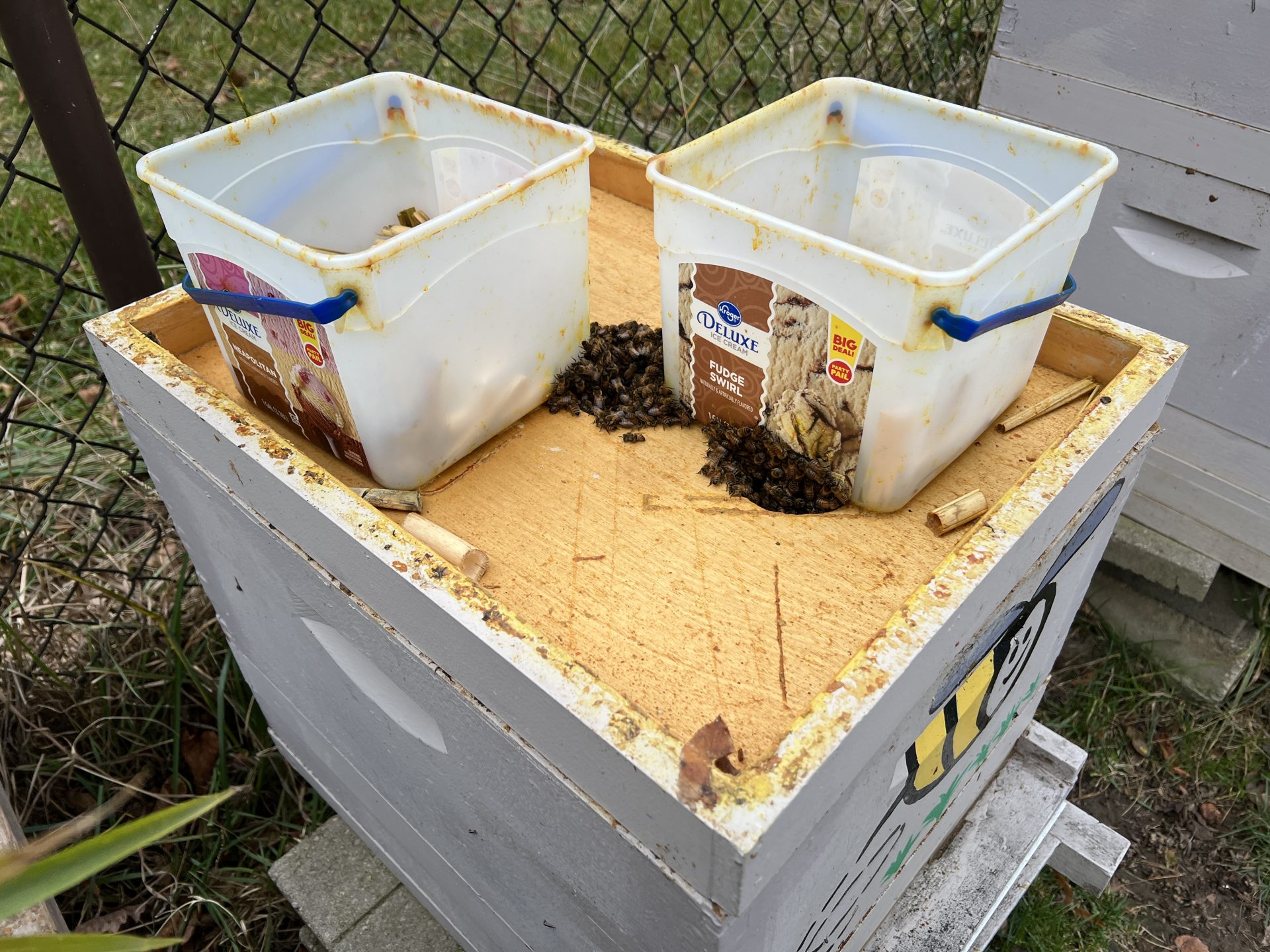
In my small-scale operation with six colonies in my backyard, all bees are consolidated into a single deep and fed heavily with 2:1 sugar water (2 parts sugar: 1 part water by weight) in early October (Figure 1). A shim with an upper entrance is placed on top of the single deep and a 2-3” thick sugar board placed on top of the shim in late November (Figure 2). A moisture quilt with 3” loosely packed pine shavings is placed above the sugar board (Figure 3) and a 1’’ foam board (Figure 4) is placed above the moisture quilt. The hive is then covered with a telescoping lid with a piece of Reflectix stapled on the underside (Figure 5) and weighed down with a heavy cement paver (Figure 6). All hives are wrapped with tar paper in late November or early December. The upper entrance, approximately 1/3-1/2 square inch in size, is left open (Figure 7).
Here are the R-values of the materials placed above the single deep. Sugar board of 2-3” thickness: 0.5; Moisture quilt of 3” loosely packed pine shavings: 5; 1” foam board: 4; Reflectix (R-21) attic wall insulation: 3, which is the lowest R-value for Reflectix according to the manufacturer; Telescoping outer cover with aluminum sheet: 0.5. Total R-value: 13.
This is how moisture produced by the overwinter cluster circulates inside a hive with this setup. Some moist air exits through the upper entrance and leaves the hive altogether. The amount of moisture leaving through the vent is dependent on the size of the upper entrance. Since the venting hole in the single deep in my setup is small (1/3-1/2 square inch in area), the amount of water lost is small under normal winter conditions. During the days with high-wind advisory, the vent can be quickly closed with a piece of duct tape (Figure 8) and re-opened when high wind dies down. Closing and re-opening the vent takes just a few seconds. It probably does not make the bees feel much better but definitely makes the beekeeper feel a lot better in the middle of winter with no spring in sight and no other beekeeping errands on hand.
Warm air that does not exit the hive gets absorbed by the hardened sugar board and softens the sugar, making it easier for bees to use as supplemental food. Warm air can also get through the opening in the center of the sugar board, which becomes increasingly larger as sugar is continuously consumed by the bees. This proportion of warm air can be absorbed by the pine shavings in the quilt box. It can also get through the loosely packed pine shavings until it reaches the underside of the foam board, where it is forced sideways and condenses. This works like in a condensing hive, just at a smaller scale. The small amount of condensed water dripples down to the sides of the moisture quilt and wets the pine shavings on the edges. Much of the pine shavings remains dry at the end of Winter and can be reused for the following Winter.
Honey consumption for a normal-size colony with this setup is estimated to be 6-7 deep frames of honey because there are usually 3-4 frames of honey left at the beginning of Spring nectar flow. The overwintering percentage of this setup has been high in my backyard apiary where six hives are kept. Over the last four seasons since I started using this method, only one weak colony, which should have been combined with another before the onset of Winter in 2025, failed to overwinter. The average overwintering rate has been 23/24, or 96%.
My 4-years of practice and observations certainly do not provide sufficient evidence to conclude convincingly if I am getting the short ends of sticks of venting and condensing approaches, or having the best of two worlds. More studies are warranted to demonstrate whether one approach has a clear advantage over the other in overwintering honey bees in terms of survival rate, colony strength, consumption of resources during Winter and moisture-related fungal diseases. A preliminary conclusion, however, can be safely drawn. Hive setup is likely of secondary importance whereas maintaining a strong colony, reducing mite load and providing adequate winter food are of primary importance. Emphasis should be placed on management of primary importance before everything else to ensure satisfactory overwintering and productive colonies the following season.
References
*AIA (Apiary Inspectors of America). 2025. Preliminary results from the 2024-2025 US Beekeeping Survey: Honey bee colony loss and management. https://apiaryinspectors.org/US-beekeeping-survey-24-25.
*Hesbach, W. 2020. The Condensing Colony. American Bee Journal, February 2020.
*Tardif, E. 2023. Hive thermodynamic. Youtube: Hive Thermodynamic. February 21, 2023. https://www.youtube.com/watch?v=PY4O4M-Bo6s.
