
Roman Bondarenko, Beekeeper and Apitherapy Specialist

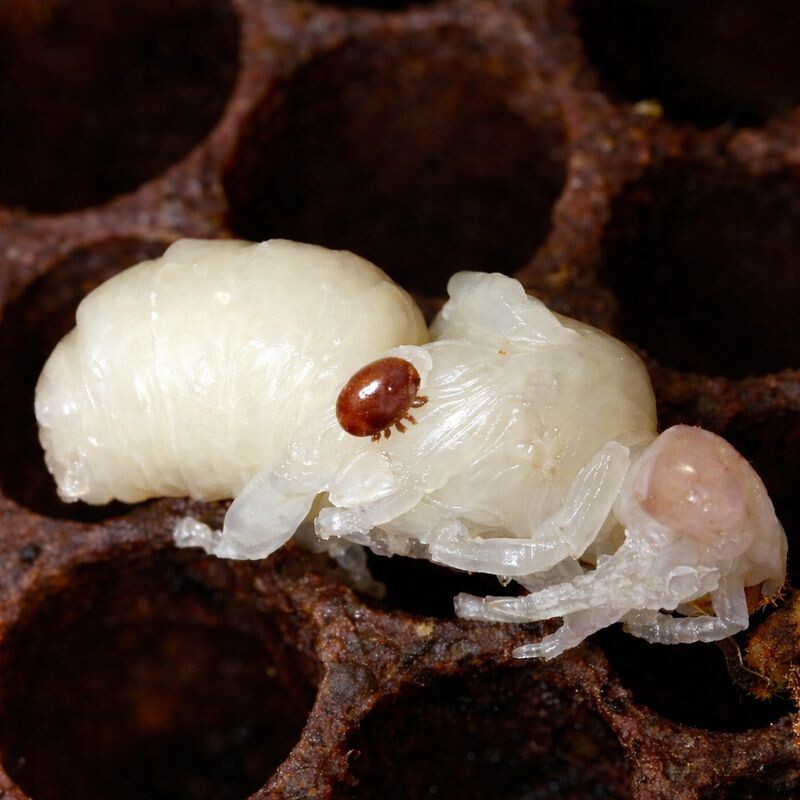
Varroa destructor is an external parasitic mite that feeds on both brood and adult honey bees and is one of the most destructive pests of U.S. bee colonies. Infestations weaken colony viability, reduce worker lifespan, and promote the spread of viruses, often leading to colony loss within a single season if left unmanaged ( Figure 1).
Varroa mites are now widespread across North America, and any infested colony can spread mites to nearby hives through drifting, robbing, or swarming. As a result, Varroa control is a core responsibility of modern beekeeping and requires regular monitoring, informed decisions, and an integrated pest management (IPM) approach rather than reliance on a single treatment.
One of the most frequent mistakes in Varroa control is delayed or inconsistent monitoring. In colonies with active brood rearing, mite populations can double approximately every month. Effective management therefore requires regular sampling, typically several times per year, including Spring, early Summer, late Summer, and before Winter.
Another common error is relying on visual signs, as mites are rarely detected by casual inspection. Quantitative sampling methods, such as sugar shakes or alcohol washes of about 300 bees, provide reliable data for comparing mite levels with established thresholds.
Improper sampling technique can also lead to false confidence. Collecting too few bees or shortening the shaking or washing time can significantly underestimate mite levels. Consistency in method and sample size is essential. Alcohol or soapy water washes generally provide the most accurate counts and are considered the gold standard for monitoring.
Equally important is verifying treatment effectiveness. After any intervention, colonies should be re-sampled to confirm that mite levels have actually declined. Many treatments fail due to unsuitable weather, brood presence, or improper timing, and untreated failures can have severe consequences later in the season.
Treating strictly by calendar date rather than by measured mite levels is another major pitfall. IPM principles emphasize treating only when thresholds are exceeded. In many regions, a Summer threshold of approximately 3–6% infestation (roughly 9–18 mites per 300 bees) is commonly used as a trigger for action.

Effective Varroa control follows the seasonal biology of the colony.
Spring: As brood production resumes, early monitoring is critical. If mite levels are elevated, beekeepers can consider early treatments or management techniques that create a temporary brood break, such as colony splitting. Older comb and aging equipment can quietly compound mite and disease pressure over time. Spring is also an ideal time to begin rotating out old brood comb (Figure 2).
Summer: Mite populations often increase rapidly during the peak season. Monitoring should continue every four to six weeks. Cultural methods such as drone brood removal can significantly reduce mite reproduction by exploiting the mites’ preference for drone cells. Splitting strong colonies mid-Summer can also help interrupt the mite life cycle ( Figure 3).
Late Summer and Early Fall: This is the most critical period for Varroa control. As honey flows end, mite levels frequently peak, while the colony begins rearing long-lived Winter bees. Any colony exceeding threshold levels should be treated promptly using appropriate organic or long-duration treatments compatible with honey harvest practices. Follow-up sampling is essential to confirm success.
Fall and Winter: Protecting Winter bees is a primary goal. If brood rearing declines or stops, treatments targeting phoretic mites — such as oxalic acid applications — can be particularly effective. Sampling during very cold conditions can be unreliable, so timing and local climate must be considered.
Throughout the year, management decisions should be driven by data rather than dates. Monitoring before and after treatments remains central to success.

A sustainable Varroa program relies on combining multiple control tactics.
Genetics: Using mite-tolerant or hygienic bee stocks can improve colony resilience. While resistant bees are not Varroa-proof, they can reduce infestation growth and complement other controls.
Cultural and Mechanical Controls: Maintaining strong, well-nourished colonies reduces vulnerability. Practices such as screened bottom boards may provide modest mite reductions over time. Regular requeening helps maintain brood health and colony stability.
Brood Breaks: Deliberate interruption of brood production is one of the most effective non-chemical Varroa controls. During broodless periods, mites cannot reproduce, allowing treatments to target the remaining phoretic population more effectively.
Chemical Controls: When thresholds are exceeded, organic miticides such as formic acid, oxalic acid, or thymol-based treatments can be used responsibly. Strict adherence to label directions regarding dosage, temperature, and timing is essential. Rotating treatment types annually helps slow the development of resistance.
Apiary Hygiene and Records: Clean equipment, regular comb rotation, and good sanitation reduce disease pressure that compounds Varroa damage. Quarantining new bees or equipment before introduction prevents accidental mite spread. Detailed recordkeeping allows beekeepers to track trends, evaluate treatment efficacy, and identify chronically vulnerable colonies.
Varroa mites remain a serious threat to honey bee health, and no single control method is sufficient. Consistent monitoring and seasonally appropriate, integrated management are key to keeping mite levels low and colonies productive over time.

References
1. Honey Bee Health Coalition. (2022). Tools for Varroa Management: A Guide to Effective Varroa Sampling & Control (8th ed.). Keystone Policy Center.
2. Ramsey, S. D., Ochoa, R., Bauchan, G., et al. (2019). Varroa destructor feeds primarily on honey bee fat body tissue and not hemolymph. Proceedings of the National Academy of Sciences, 116(5), 1792–1801.
3. Jack, C. J., & Ellis, J. D. (2021). Integrated pest management control of Varroa destructor (Acari: Varroidae), the most damaging pest of Apis mellifera colonies. Journal of Insect Science, 21(5), Article 6.
