
Lost as Interpreted By the Closure of Beltsville
Agricultural Research Center (BARC) in Maryland
By: John Miller
Is this closure of a specific facility – charged with fulfilling a broad mandate actually a tragedy? No doubt for the nine full time positions, nine families face relocation to other Federal labs, resignation, or a job search in other sectors, is unwelcomed. Scientists who have gathered a trove of institutional memory about American beekeeping – a trove spanning decades, with samples of perhaps defining genetic material – to be tossed into the dumpster? This is a tragedy.
New science explodes old ways of doing science. Things change.
Recently, several states have initiated, or enhanced university bee research facilities. And maybe this is how bee research should be done, at the states level – where Texas is not as vast as America, it is vast. Where California, with its 265 and counting specialty crops, exceeds all other states in specialty crops. To North Dakota, the number one honey producing state in the nation – by a solar system – for over 20 years – North Dakota established a bee research lab. Are the states the rightful place for bee research?
It’s time to have a fresh discussion of bee research. What is the role and goals of bee research? Should a different approach to bee research occur? Readers, and writers in Bee Culture have opinions.
The Idea Is: Readers, take some time and review the next several pages. What can we; you, me and us do to bring positive attention to beekeeping? Fill out the survey; include comments and suggestions. Old things are lost. New things are found. To share your comments/participate and add feedback about this article, visit: https://forms.gle/dRbY9FrTBWnbrwE58
BUILDING A NATIONAL HONEY BEE THREAT DIAGNOSTIC SERVICE
By: Bill Shepherd, VitalBees
Concept & Working Framework
Detecting and defending against the threats killing U.S. honey bee colonies.
DRAFT FOR DISCUSSION — v0.1 · July 2026
A working document, circulated for the input and shaping of the research community. Nothing here is settled; the open questions in Section 6 are the point.
- The threat, and why now
U.S. beekeepers now lose 40–55% of their colonies in a typical year, and the Winter of 2024–25 was the worst on record — commercial operations reported losses around 60%, on the order of 1.7 million colonies. Behind those numbers is a quieter failure: when a colony dies, or a whole operation collapses, the beekeeper usually never learns what killed it. Cause of death goes unrecorded, so the same threats recur, unnamed and uncountered, season after season.
The one place that could answer the question is closing. The USDA-ARS Bee Research Laboratory at Beltsville, Maryland — home since 1891 to the nation’s only free, national, mail-in bee-disease diagnostic service — is being decommissioned along with the entire Beltsville Agricultural Research Center. No successor has been established. The free national backstop the extension system quietly relied on is vanishing at the exact moment the losses are at their worst.
This document proposes to fill that gap — not by rebuilding an old lab, but by building the system that should replace it. - The vision: a threat-defense system, not a lab
The instinct when a federal capability disappears is to recreate it. That would be a mistake. A single mail-in lab that tells a beekeeper what killed their bees weeks after they’re already dead is a post-mortem service — useful, but reactive, and not what beekeepers most need.
The goal here is a defense system: detect a threat early, identify it precisely, and put an effective countermeasure in the beekeeper’s hands fast enough to matter. Four linked functions:
-Early detection — a distributed network that sees threats coming, not one that waits for samples to arrive.
-Precise identification — standardized, trusted diagnostics across the full range of colony threats.
-Effective countermeasure — every diagnosis returns not just a name but a recommended action.
-Next-generation tools — push the test out to the beekeeper (field and rapid diagnostics) while keeping interpretation and data central.
That closed loop — detection to diagnosis to defense, with the data flowing back into a national picture — is the difference between counting the dead and repelling the threat. - What we defend against: the four threats
The old service was named for “disease,” which undersells the job. What kills colonies falls into four categories of threat — the four P’s:
-Pathogens — American and European foulbrood, Nosema/Vairimorpha, chalkbrood, viruses.
-Parasites — Varroa, tracheal mite, and the incoming Tropilaelaps.
-Pests — small hive beetle, invasive hornets.
-Poisons — pesticide exposure and bee-kill incidents.
Proposed for the group to ratify, the diagnostic scope tiers naturally — which lets the effort be built (and funded) in stages:
Tier 1 — Restore the core
What Beltsville actually did: foulbrood (AFB and EFB), Nosema, Varroa, tracheal mite, chalkbrood, small hive beetle — and, critically, culturing AFB and screening it for antibiotic resistance. That last capability is the single hardest to replace and has essentially no free successor today.
Tier 2 — Modernize for how bees actually die now
A virus panel, Nosema species identification, Varroa miticide-resistance testing, and pesticide-residue/bee-kill diagnosis — the gaps the old service never fully covered, now central to the losses.
Tier 3 — Biosecurity and early warning
Exotic-threat surveillance: Tropilaelaps, invasive hornets, and novel viruses — detecting the next threat before it establishes.
The flagship, threaded through all three tiers, is the colony post-mortem: a beekeeper submits a dead-out and gets back a cause-of-death across all four threats, with a recommended defense. It is what beekeepers desperately want, and it is the reason the full menu belongs under one coordinated roof rather than scattered.
- Models to learn from — and leapfrog
We are not the first to build a national agricultural diagnostic network. Two federal systems are the closest structural templates, and both are previous-generation — worth studying for their hard-won lessons, and worth deliberately surpassing:
-National Plant Diagnostic Network (NPDN) — a network of land-grant university plant-diagnostic labs with shared standards, regional hubs, a national data repository, and “first detector” training. The model works — but it has been held on flat funding for over a decade, and its labs are now strained. The lesson: standardized methods and a shared database are powerful; single-source funding is a slow death.
-USDA National Animal Health Laboratory Network (NAHLN) — the animal-health equivalent: federal, state, and university labs running accredited, standardized assays with surge capacity. The lesson: this is how you make a distributed network produce consistent, trusted results — and how a durable funding line (a Farm Bill appropriation) keeps it alive.
These are 2002-era architectures: federal, single-source-funded, slow mail-in turnaround, mostly reactive. The opportunity is to leapfrog them on two axes:
-Speed — field and rapid diagnostics (lateral-flow strips, portable LAMP molecular tests, portable nanopore sequencing, smartphone imaging with AI, emerging biosensors) that move detection to the yard, from mail-in-and-wait to near-real-time.
-Span of effect — proactive national threat defense with recommendations flowing back to every beekeeper, not one-sample-at-a-time testing.
Best-in-class systems from beyond agriculture show how the pieces fit: CDC’s PulseNet (shared methods plus a shared database that surfaces outbreaks no single lab could see); sentinel surveillance (a network of watch-sites that reads a moving threat cheaply); the UK’s BeeBase (beekeeper-facing registration, disease mapping, and alerts — a working closed loop); and open genomic tracking (real-time views of how resistance and viruses evolve). None of this required inventing anything; it requires assembling the leap the federal system never made. - The current landscape — and the gap
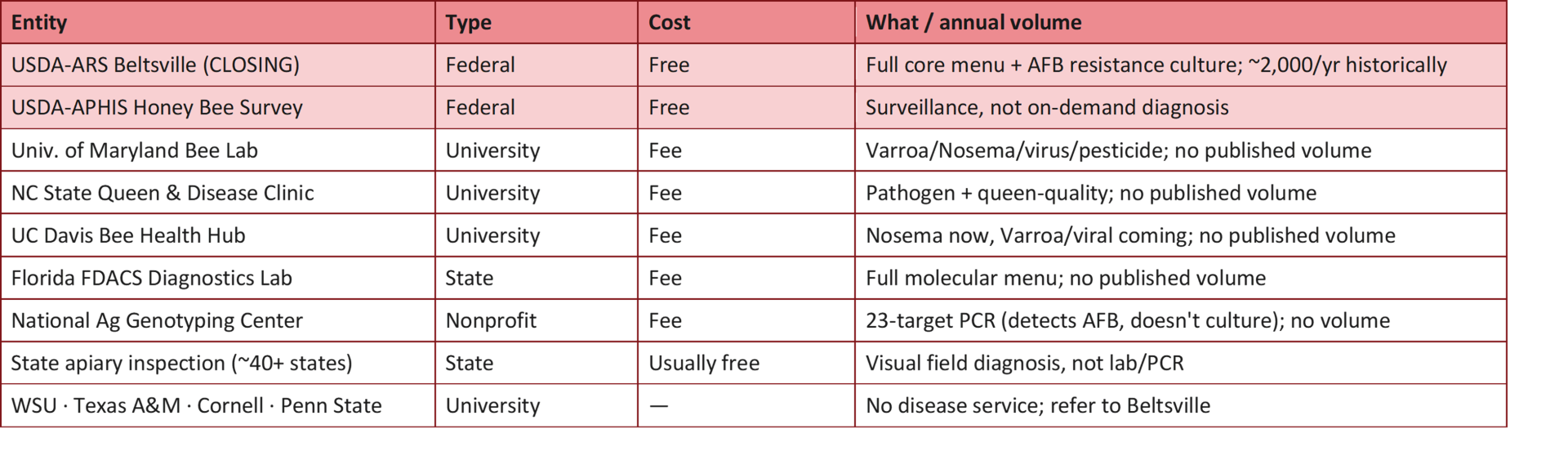
A census of who diagnoses bee threats for U.S. beekeepers today (summarized in the appendix) makes the gap precise:
-A great deal of diagnostic activity exists — a handful of fee-for-service university labs (Maryland, NC State, UC Davis), one full state lab (Florida), a national nonprofit PCR lab (NAGC), and field inspection in ~40+ states.
-But almost none of it reproduces what Beltsville provided — a free, national, on-demand laboratory that cultures AFB and screens it for antibiotic resistance. Every remaining lab option is fee-for-service; state inspection is visual field diagnosis, not lab culture or PCR.
-And there is a measurement vacuum — essentially no entity except Beltsville has ever published an annual diagnosis count. There is no measured national capacity waiting to absorb the demand — which means the need is real and unmet, not redundant.
Closure also removes the referral endpoint that flagship programs — Washington State, Texas A&M, Cornell, Penn State — currently point beekeepers to. The system doesn’t just lose a lab; it loses the place everyone else was sending people. - What we don’t yet know — the open questions
This is the heart of the document, and the reason the research community is needed. Public research could establish the landscape but not the operating truth. The framework can’t be finalized until these are answered — and the people best positioned to answer them are the researchers who raised this concern in the first place.
The specific gaps:
-Real demand and volume — how many beekeepers actually used Beltsville, and how many samples a successor would truly need to handle.
-The right service model — a central hub, a distributed university network, or a standalone lab: which best preserves standardized methods, fast turnaround, and the AFB culturing/resistance capability?
-Operating economics — what a diagnosis actually costs, and what a node costs to run per year.
-The AFB antibiotic-resistance question — must culturing and resistance screening be centralized, and who is positioned to do it?
-The “poisons” question — is pesticide diagnosis part of the free core, or a referral tier? At what cost, with which partner labs?
-Governance and reporting — who issues reports, how they reach state apiary inspectors, and how the effort complements existing labs rather than duplicating them.
-Next-generation readiness — which field and rapid technologies are proven enough to deploy now versus needing development.
-Durability — the funding architecture that keeps this alive past any single grant (the trap that ended Bee Informed Partnership and is starving NPDN). - The ask: a steering committee and a research commitment
Two things are requested of this group:
First, agreement on the framework — the threat framing, the four-P scope, and the leapfrog vision above, refined by your input.
Second, a small steering committee and a commitment to fill the gaps. The committee would form from the researchers already engaged on this question — the group that surfaced it at COLOSS and on the Bee Culture thread is the natural nucleus. Its charge: ratify the scope and model, divide the open questions in Section 6 among people best positioned to answer them, and shape the resulting framework into a fundable proposal.
The near-term commitment is concrete and bounded: claim a gap, go get the real numbers, and bring them back. That is what turns this concept into a proposal. - The funding horizon — possible paths
This document carries no budget; costing the effort is one of the open questions above. But it is worth widening the field of who might fund it, beyond the bee-world sources the community already knows. Possible paths, in three groups:
On-mission anchors (the base case)
–Project Apis m. — the most mission-aligned bee-specific funder and a hub that also routes National Honey Board and Costco money; the natural first call.
–Almond Board of California — the largest single pollination dependency in the country and the longest track record of funding bee-health research; Varroa is already a top priority.
-Foundation for Food & Agriculture Research (FFAR) — its public-private matching model is practically built for a privately-anchored backstop to a withdrawn federal capability.
Beyond the horizon — national “science for a better world” foundations
Larger, non-obvious foundations that fund science and conservation infrastructure. None has a bee precedent, so these are relationship-driven paths to explore, not open applications — but they are where a national-scale ambition could find national-scale support:
-David & Lucile Packard Foundation — funds conservation science and agriculture, and runs a standalone science program; the strongest agricultural-conservation fit among the big general foundations.
-Gordon & Betty Moore Foundation — the closest narrative match to data-driven conservation science, and a funder of scientific infrastructure.
-Schmidt Sciences — funds national scientific measurement and monitoring platforms; a real-time national threat-detection network is structurally the same kind of bet.
-Walton Family Foundation — funds “a sustainable food and agriculture system”; protecting the pollination backbone fits that thesis.
Genuinely additive — pollination-dependent corporate paths
Non-obvious because the community doesn’t usually think of them as funders, but each has a direct stake in colony health:
-Costco — already funds honey-bee-health science through Project Apis m.; the clearest corporate food-supply logic.
-The Wonderful Company — runs tens of thousands of its own colonies; a diagnostic service is operational risk management, making it a plausible funder and first customer at once.
-General Mills/Häagen-Dazs — the one consumer brand with a real history of funding bee research, worth reactivating.
-Paul G. Allen Family Philanthropies — funds science-driven conservation infrastructure; a long-shot with a high ceiling if a relationship exists.
A note on integrity
One category should be declined on principle: the pesticide manufacturers who fund bee-habitat programs. A service whose job includes testing for pesticide kills cannot take money from the makers of those pesticides without compromising the credibility of its core mission. Stating that boundary up front is itself a signal of the initiative’s independence.
- Proposed next steps
This document is step one, not the proposal. The intended sequence:
1. Review with Jerry Hayes and refine the framing.
2. Confirm the steering committee and its members.
3. Divide and research the open questions in Section 6 — the real numbers.
4. Reconvene to assemble the framework: model, scope, governance, and durability plan.
5. Build the funding proposal from an evidence base the community owns.
The prize is worth the coordination: a modern, durable, national system that finally lets U.S. beekeepers know what is attacking their colonies — and defend against it.
Appendix — U.S. bee-threat diagnostic landscape (summary)
Condensed from the full census (companion spreadsheet). “No published volume” is an honest finding, not a zero.

To share your comments/participate in add feedback about this article, visit: https://forms.gle/dRbY9FrTBWnbrwE58