
Click Here if you listened. We’d love to know what you think. There is even a spot for feedback! Read along below!
By: Theresa J. Martin

I attended the Eastern Apiculture Society (EAS) Conference on July 27-29, and came home with new knowledge, new questions, and a renewed appreciation for how much there is still to learn about honey bees.
One of the highlights of the conference for me was the opportunity to spend time with Dr. David Tarpy outside of the scheduled conference activities. I transported David to and from dinner, which gave me the rare chance for one-on-one conversation with one of the leading honey bee researchers in the country. Those conversations were just as valuable as the conference sessions themselves.
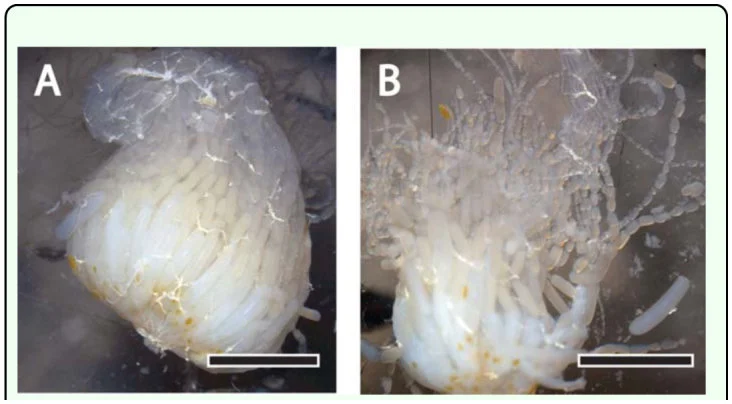
One research paper David and I discussed reveals that queens lay significantly larger eggs in queen cells than in worker cells (Wei et al., 2019). The queen can control the size of the eggs she lays and egg size varies considerably, by as much as 50%. David explained how remarkable this is from a biological perspective. A queen does not simply produce eggs from a single source — she has hundreds of ovarioles, and somehow, she is able to select eggs with the characteristics needed for queen development (Figure 1). The level of precision involved in this process is truly amazing and reminds us that there is still much we do not understand about honey bee biology.
When we both first read this paper, our first reaction was, “Wow, that is incredible.” But after thinking about it, our next reaction was, “Well, of course she does.” She is laying the potential future queen of the colony she created — the next inheritor of her genetics and legacy. It is another reminder that honey bees are more sophisticated than we often give them credit for and that evolution has equipped them with remarkable adaptations that enhance the survival of the colony.
The second research paper we discussed challenges a common assumption among beekeepers: that a way to evaluate the effectiveness of the queen is by assessing brood pattern. David collaborated with then- PhD student Katie Lee, where they exchanged queens between colonies with good and poor brood patterns and found that the brood patterns after the exchange did not change significantly (Figure 2). The results of this study suggest that a poor brood pattern is not a reliable indicator of queen quality and is not necessarily a sign of a poor queen. Instead, other factors such as disease, nutrition, pesticides, and colony conditions play a major role.
Both of these studies reinforced an important lesson for me: honey bee colonies are complex systems. As beekeepers, we sometimes oversimplify, as well as give the queen credit — or blame — for much of what we observe.
I returned from EAS grateful for researchers like David Tarpy, whose lifelong dedication to honey bee research and willingness to support beekeepers makes a difference far beyond the laboratory. I hope to pay it forward by sharing this learning with the readers of Bee Culture Magazine. The more we learn about honey bees, the more we realize how much there is yet to discover.
Theresa J. Martin is the author of Dead Bees Don’t Make Honey: 10 Tips for Healthy Productive Bees, which includes a Foreword by Dr. Thomas Seeley.

REFERENCES
Jackson, J. T., Tarpy, D. R., & Fahrbach, S. E. (2011). Histological estimates of ovariole number in honey bee queens, Apis mellifera, reveal lack of correlation with other queen quality measures. Journal of Insect Science 11(82), 1-11. https://doi.org/10.1673/031.011.8201
Lee, K. V., Goblirsch, M., McDermott, E., Tarpy, D. R., & Spivak, M. (2019). Is the brood pattern within a honey bee colony a reliable indicator of queen quality? Insects, 10(1), 12. https://doi.org/10.3390/insects10010012
Wei, H., He, X. J., Liao, C. H., Wu, X. B., Jiang, W. J., Zhang, B., Zhou, L. B., Zhang, L. Z., Barron, A. B., & Zeng, Z. J. (2019). A maternal effect on queen production in honeybees. Current Biology, 29(13), 2208–2213. https://doi.org/10.1016/j.cub.2019.05.059
