
Are We Any Better Off?
Click Here if you listened. We’d love to know what you think. There is even a spot for feedback! Read along below!
By: James E. Tew


and a young James Tew, 1979.

Why 100 years?
In recent years, I have entered a “reflective” period in my relationship with my bees. In my fifty-plus years of being involved in this craft, I have tried most of the common aspects of keeping bees. At one time, my brothers and I had around two-hundred hives. I started with two and went crazy for bees. Now, as a super senior citizen, I am back to about ten marginally managed colonies. It would appear that I will end essentially where I started.
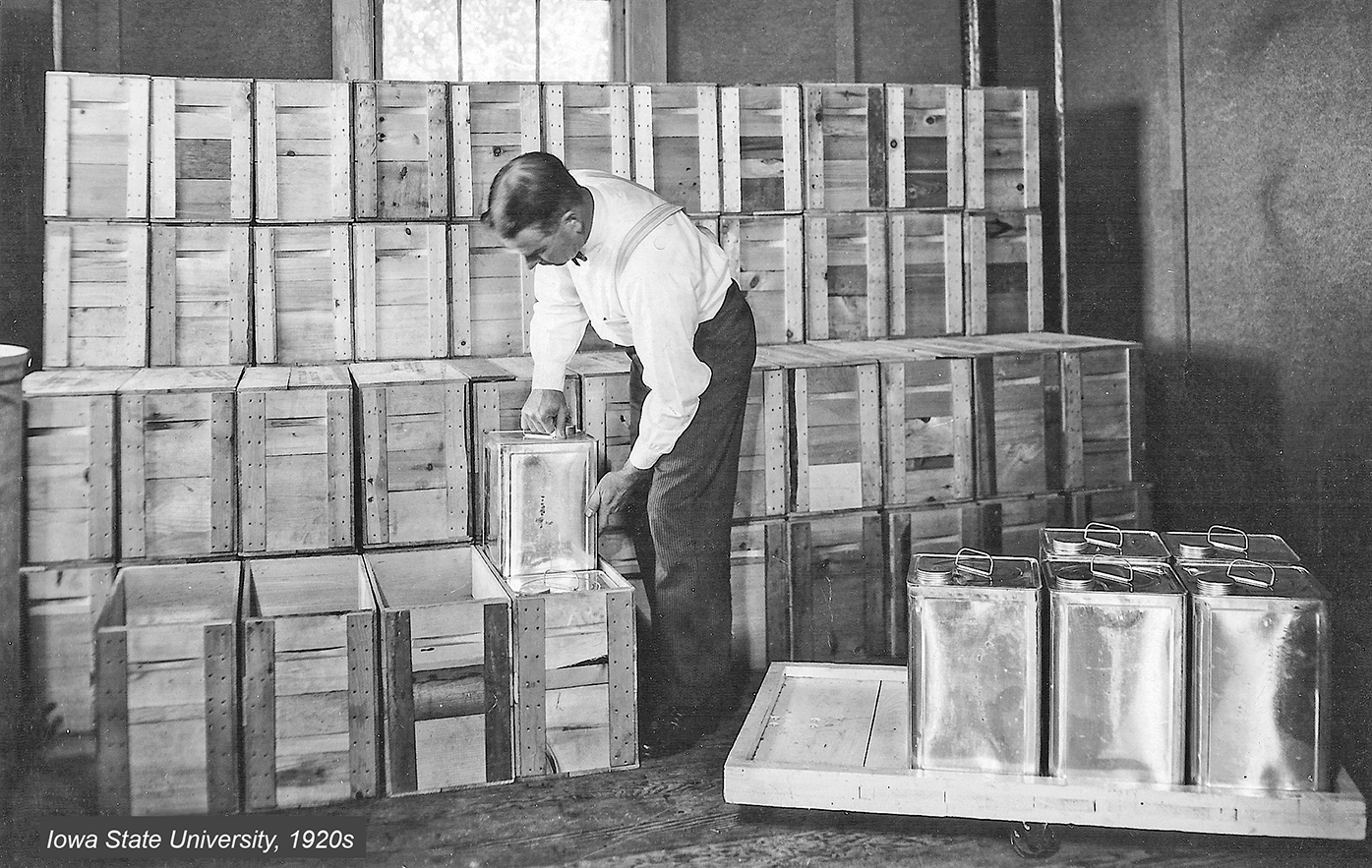
During my journey, I have had the opportunity to experience many core changes in beekeeping management procedures. Metal 60-pound tins changed to plastic 5-gallon buckets. Plastic use in our craft has skyrocketed. Podcasts and web-based information is now a fundamental aspect of keeping bees. While much has changed since 1926, many things are exactly the same. Why one-hundred years of beekeeping? Honestly, it’s just a nice round number. As I have already written, I just want to reflect some in this piece.
Can you believe this?
Can you believe that one hundred years ago, we already had removable frame hives (1851), comb foundation (1843), and the centrifuge extractor (1865). Essentially, one hundred years ago, beekeeping, as we know it today, already existed and had already existed for more than fifty years. Even so, for nearly one-hundred more years, box hives and gums persevered. Even I remember them.
And can you believe this? Just like today, beekeepers could not agree on what type of removable frame hive to choose as the standard – large brood nest or small brood nest hives. Everyone agreed that it was a good thing to be able to remove frames from hives, but what kind of hive? The Langstroth hive didn’t win overnight. It took years and considerable amounts of experience before the hive that we know today, rose to the top of the hive pile. Sarcastically, I write that we truly are a modern bunch.
A different slant on our part of our beekeeping history
Our traditional beekeeping history is well documented in numerous books, publications, webpages and videos. The famous beekeepers are all clearly remembered. The hardworking, faceless, nameless beekeepers, who are now gone, are the ones I sometimes fret over.
A bridge engineer, who worked for the State of Ohio, and was always quick to support state beekeeping initiatives with hard cash – a friendly, outgoing man who loved bees and beekeeping – comes to my mind. As happens, he died abruptly. Fifteen years later, I have to scramble to find anyone who remembers him.
Clarence Eck, a lath-plasterer by trade, was the early bee man of Wooster, Ohio. Like-minded people would meet on randomly selected weekends to talk bee stuff while sitting around his coal-burning stove in his woodshop.
From those early talks, the Tri-County Beekeepers’ Association was formed in Wooster, Ohio, a county beekeeping group which now hosts an annual one-day meeting that generally draws in about 600-1000 participants. I estimate that around 15,000-20,000 beekeepers have participated in the workshop, inspired by Mr. Eck and those early beekeepers, and yet I only have a single bad photo of Mr. Eck. Yep, for all that he contributed to our local beekeeping group; one lousy photo is all I can find.
Or there was the gentle grade school principal; a kindly, white-haired fellow we all wish could have been our principal. He kept a neat-as-a-pin apiary in his Ohio back yard within sight of Interstate 71. He was a natural teacher, so he naturally taught any and all about the mysteries of beekeeping. Now, the beekeepers who remember him are fading, too. (There is an award, the Charles Divelbiss Award given in his name at the Eastern Apicultural Society meeting.)
There are tens of thousands of people like these people who were significant players in our beekeeping history, people who made quiet, common contributions to beekeeping, but who have now passed. We have no national “Beekeepers’ Wall of Fame.” We have no way to acknowledge these nameless beekeepers’ contribution other than to realize that we are presently standing on their shoulders. But beekeepers of the future will stand upon our shoulders. That’s just how things work.
So, one hundred years – would I want to go back to earlier time? No, I would not, but increasingly, I respect the little-remembered people who have preceded us and were quietly influential in doing their part to make productive beekeeping possible for the rest of us who followed along.
Beekeepers then and now
So, what is modern beekeeping? If our industry was mostly in place one hundred years ago, what does that say for our present state? I have no specific science to report, no specific surveys, only suspicions and observations.
Beekeepers today still exhibit the passion shown in the writings of beekeepers now gone. We still want a giant honey crop every year but can consistently devise explanations for why it didn’t happen. We like gadgets and we freely share information. In many ways, beekeepers have not changed during the past century.
But in other ways, we are very different. Few of us presently make our living from agriculture. Even so, today’s agriculture is radically different from what it was a hundred years ago. Now, beekeepers are as likely to be an airline pilot, physician, automotive technician, or building contractor as we are to be a farmer. That is a significant change from beekeepers past who mostly from family farms. The beekeeper today is increasingly urban, not rural, but today’s beekeepers are not alike.
Traditional vs. modern beekeeping
If I ask group participants to hold up their hands if they freely use plastic frames and plastic hive equipment, I estimate that about one-half of group uses plastic. So, the other half of us still use wood frames and wood boxes. Nothing right or wrong about that. Plastic equipment has been knocking at our beekeeping door since sometime in the 1970’s. So far, we still don’t have plastic equipment that bees like as well as they like wood, but the plastic competition is getting better. I surmise that two types of beekeepers are evolving – traditional and modern.
Traditional beekeepers
In my opinion, traditional beekeepers only use wood – or only wood as much as possible. They will frequently use eyelets and wire frames. Box-jointed wood boxes are used that are cross-nailed, are assembled – as all beekeepers have done for the past one hundred years. There is nothing wrong with this procedure. It has worked well for us for a long time.
In an article I submitted many months ago, I casually asked if eyelets and frame wiring had passed into antiquity? I commented that I now use foundation inserts and no longer wired my frames. Wow!! Did I hear from you on that count! Yes, many beekeepers still wire frames the old way and have no intentions of changing. Right on!
Modern beekeepers
Modern beekeepers freely use plastic frames, foundation, bottom boards and boxes and tend to accept Varroa mite control as a way of life. Normally, modern beekeepers are mostly new to our craft, but not necessarily. While I still prefer wooden frames, I don’t really have the time to assemble them, nor do I have the money to pay someone else to do the job. Saying to myself that wood frames are somewhat better, I rip into a box of plastic frames and shamelessly use them. So, am I a modern beekeeper or a traditional beekeeper gone bad? (Maybe both)
I don’t think that either group is more or less right than the other. People bring different expectations to beekeeping – some are nostalgic (like me) while others just want their garden pollinated. Whatever floats your boat is what you should do in selecting your beekeeping equipment.
But it must be stated that plastic equipment is a major change in equipment fabrication, but not a change in beekeeping procedures. As things continue to change, I suppose the smell of new plastic will elicit pleasant memories for future modern beekeepers. Sooner or later, everything changes.
The smells are the same
My mention of odors reminds me that some aspects of beekeeping are exactly the same today as they were one-hundred or even one-hundred fifty years ago. The smell of a languishing smoking smoker or the smell of new pine wood is hard-wired in my mind as the smells of beekeeping. The odor of new beeswax foundation is unchangeable, or the ambience inside my bee equipment barn. How can I describe that collage of barn odors? I think it’s musty equipment, decaying bees, propolis and wax all mixed into the “essence of the storage building.”
The smell of a goldenrod flow is the same now as all those years ago. When I first smelled a goldenrod crop coming in, I nearly panicked thinking that my hives had serious cases of American foulbrood. The delicate smell of extracting honey or the sour odor of fermenting honey would not have changed at all. For all these reasons, I rank beekeeping odors as one aspect of beekeeping that has changed the least during the past one hundred years.
Biology is much the same
Bees still swarm under the right conditions. Queens are still superseded under the right conditions and worker bees still readily sting under the right conditions. Some flower types still need bees for pollination services. Wintering biology is the same as 100 years ago and nectar hoarding behavior is essentially unchanged. But the bees are somehow different. We have manipulated their parentage so that today’s bees are gentle, large, and sometimes colorful. That is different from the small dark, aggressive bees of a century ago.
Pollination Activities
Commercial pollination has grown in importance as agricultural practices have changed. Beekeepers of yore moved bees for honey production, but there was little need nor understanding of the principles of supplemental pollination. Moving bee colonies great distances to pollinate plants is truly a modern adaptation and is now critical to commercial beekeeping survival.
Bee health problems
Bee health problems are more complicated now than they ever have been in the past. A century ago, the primary control of American foulbrood was a hot fire while exotic pests like Varroa and small hive beetles were completely unheard of. Consequently, one of the things that have changed the most during the passing years has been the pest complex with which bees and beekeepers must contend. This has been a significant negative change.
Where are we now?
Some things, like extracting equipment and pollination potentials, are much better. Other things like beekeeper interest and basic bee biology are unchanged during the past century. Our biggest challenge seems to be dealing with new pests and predators and finding new beekeepers to fill the ranks of those who move on. All things considered, beekeepers’ attitude and their bees are remarkably unchanged during the past 100 years.
“Men may degenerate,” says an old traveler, “may forget the arts by which they acquired renown; manufactories may fail, and commodities be debased, but the sweets of the wild-flowers of the wilderness, the industry and natural mechanics of the bee, will continue without change or derogation.”
From Burroughs’ Birds and Bees – Sharp Eyes and other Papers, 1887
Thank you
Thank you kindly for reading the piece. I do enjoy the assignment that I have each month.
Dr. James E. Tew
Emeritus Faculty, Entomology
The Ohio State University
tewbee2@gmail.com
Host, Honey Bee
Obscura Podcast
www.honeybeeobscura.com
