
What Winter Feeding Can Do For Your Bottom Line
By: Anne Marie Fauvel, Honey Bee Vitality, LLC & Dr. Brandon Hopkins, Washington State University

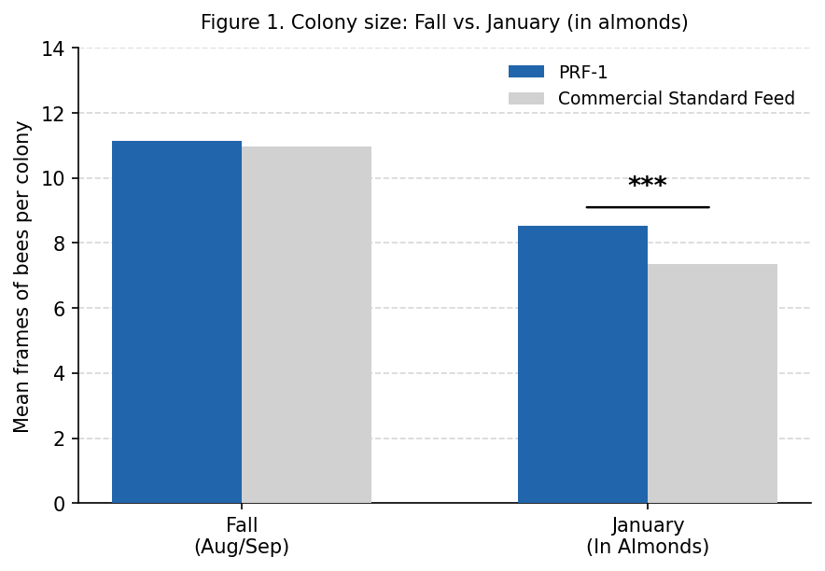
Both groups started equal in Fall. *** p < 0.001. Source: Kulhanek et al. 2026.

Key Takeaway
A newly published scientific study — the largest and longest of its kind — demonstrates that feeding honey bee colonies a nutritionally complete pollen-replacing feed in the Fall and Winter produces measurably stronger, healthier colonies heading into almond pollination, and that these benefits persist well into Spring. The economic implications are substantial: a hypothetical operation of 100 colonies could generate over $12,000 in additional gross revenue in the first year alone, with gains compounding exponentially over time.
Introduction/Background
Winter losses remain one of the most stubborn and costly challenges in commercial beekeeping. In 2024–2025, more colonies were lost in the U.S. compared to any previously recorded year. At the same time, the Fall and Winter months represent a critical window: this is when bees produce a specialized, long-lived adults known as “Winter bees,” whose quality determines how well a colony survives the Winter, rebounds in the Spring and how strong it will be for early pollination events like almonds and beyond.
Most commercial beekeepers already invest in supplemental protein feeding during the Fall. The problem is that current pollen substitutes on the market are nutritionally incomplete — they lack essential amino acids, sterols, and other micronutrients that bees need to produce healthy Winter bees. Until recently, no manufactured feed existed that could fully replace natural pollen.
A new study published in the journal Insects (Kulhanek et al., 2026; https://doi.org/10.3390/insects17030243), co-authored by the researchers behind the earlier Royal Society B paper (Bogaert et al., 2025; https://pmc.ncbi.nlm.nih.gov/articles/PMC12000826/) puts this complete feed to the test under real commercial beekeeping conditions — at a scale never before attempted for a nutritional study of honey bees. Please note that the present authors of this article are also authors on the publication.

The Study: Real Beekeepers, Real Conditions, Practical Science
The research team partnered with five commercial beekeeping operations in California and Idaho — each managing more than 2,000 colonies. These are experienced beekeepers who already practice fall protein supplementation using well-regarded commercial pollen substitutes. The study compared their existing feeding practices against APIX Pollen (referred to in the paper as Pollen-Replacing Feed 1, or PRF-1), the nutritionally complete feed developed by APIX Biosciences.
Colonies in each operation were divided into two groups — one fed PRF-1, the other fed the beekeeper’s chosen available commercial supplement — and assessed colonies multiple times: Fall (start of feeding), January (during almond pollination), and March (after almond bloom and back at the home yard). In total, over 900 colonies were monitored across two years, making this the largest-scale and longest-term trial of honey bee protein supplementation ever conducted. Critically, the beekeepers themselves performed all colony management and feeding, exactly as they would in their normal operations. Colony assessments and data were collected by a third party.
Results: Stronger Colonies Heading into Almonds
By January, colonies fed PRF-1 averaged 1.19 more frames of bees than those fed the commercial standard — a 16% advantage — despite starting the Fall at equal sizes. This matters enormously in almond pollination, where contract fees are tied to colony strength.
Among PRF-1-fed colonies, 67.9% met the eight-frame average pollination threshold in January, compared to only 57.2% of colonies fed commercial supplements. That 10.7 percentage-point difference in premium-grade colonies translates directly into higher rental fees.
Results: The Benefits Don’t Stop at Almond Bloom
What makes this study particularly striking is what happened after almonds. Almond pollen is among the most nutritionally rich forage available to honey bees. One might expect that a period of high-quality pollen during bloom would even out any differences between diet groups. It did not.
Assessed in March — after almond bloom and back at each operation’s home yard — PRF-1-fed colonies still outperformed the comparison group by a wide margin. They had 2.57 more frames of bees (a 36% increase in population) and 0.79 more frames of brood (a 40% increase in brood production).
To understand whether these gains reflected higher-quality Winter bees — not just more of them — the researchers equalized colony sizes at the start of January for one subset of colonies and watched how they grew through March. PRF-1-fed colonies added 1.22 more frames of bees during that Spring build-up period. This tells us something important: the quality of Winter bees produced under complete nutrition drives faster Spring population growth, independent of starting size.

The Economic Implications
The researchers ran an economic analysis based on a hypothetical 100-colony operation, using 2024 industry pricing for almond pollination ($181 per hive), apple pollination ($58.10 per hive), and honey production ($1,439 per hive average).
In Year 1, PRF-1-fed operation (100 colony example) generated $1,931 more from almond pollination alone (from more premium-grade hives). After almonds, the larger colony populations meant more five-frame nucleus colonies, or “splits”, could be produced: 194 for the PRF-1 group versus 143 for the commercial supplement group. Accounting for all revenue streams (almonds, apple pollination, and honey), the PRF-1 operation earned $12,066 more in gross revenue per 100 colonies in its first year — or $120.66 per colony.
Because healthier colonies have greater Winter survival success and build up faster in Spring, the financial advantage compounds dramatically over time.

Practical Applications & Future Implications
This study addressed a fundamental question that many beekeepers are asking: does a more complete feed actually make a difference in the real world — with real variability in management, climate, and colony health stressors? The answer, replicated across five commercial operations, two years, and hundreds of colonies, is yes.
The benefits held across all operations regardless of their location (California or Idaho), management style, or the commercial supplement they had been using previously. Varroa loads and pathogen prevalence did not differ between diet groups, confirming that nutritional quality — not disease pressure — drove the observed differences in colony strength and survival.
Every other major livestock species has access to a scientifically formulated, nutritionally complete diet. The evidence now strongly suggests that honey bees should too. For commercial beekeepers preparing colonies for almond pollination—and for the broader agricultural system that depends on those colonies — the transition to a complete pollen-replacing feed in the Fall and Winter may represent one of the most impactful management changes available today.
The full study is available open access at: https://doi.org/10.3390/insects17030243
References:
Bogaert, T., Reams, T., Maillet, I., Kulhanek, K., Duyck, M., Eertmans, F., Fauvel A.M., Hopkins B. & Bogaert, J. (2025). A nutritionally complete pollen-replacing diet protects honeybee colonies during stressful commercial pollination — requirement for isofucosterol. Proceedings of the Royal Society B: Biological Sciences, 292(2045), 20243078.https://pmc.ncbi.nlm.nih.gov/articles/PMC12000826/
Kulhanek, K., Bogaert, J., Fauvel, A. M., Hopkins, B., & Bogaert, T. (2026). Enhanced Honey Bee Colony Strength and Economic Returns from Fall and Winter Feeding with a Complete Pollen-Replacing Feed. Insects, 17(3), 243.