
Click Here if you listened. We’d love to know what you think. There is even a spot for feedback! Read along below!
Laboratory Protocols Help Cover Up Chemical Contamination in Bee Hives
By: Ross Conrad


A funny thing happens sometimes when I sit down to write an article. I start by gathering a bunch of information, interviews and resources with a particular story in mind. In this case I planned on writing about the alarming amount of pesticides being found in Vermont bee hives, and the somewhat encouraging news that Vermont has followed New York to become the second state in the country to pass a law banning the use of neonicotinoid treated seeds. However, as sometimes happens, when I sat down and poured through what I had gathered to write this month’s article, a very different and more compelling story emerged.
Pesticide Residue Testing: Laboratory protocols help cover up chemical contamination in bee hives – America’s beekeepers may well be on the brink of breaking through a long history of false negatives when it comes to pesticide testing.
Beekeepers seem to be finally gaining ground on the perpetual issue of pesticide contamination in hives. This success is starting to translate into policy changes and laws that just may allow beekeepers to start to see a reduction in the exceedingly high colony losses the industry currently experiences. For far too many beekeepers, losses of 40-50% annually have become the new normal ever since farmers started planting treated seeds in a big way in 2005-2006.
Here in Vermont it is estimated that 99% of all the corn and 34% of all the soybeans planted in the state are from neonicotinoid treated seeds. The experiences of beekeepers throughout the state have caused many to suspect that the use of these treated seeds is negatively impacting the health of their bees. This has resulted in efforts to limit the use of neonicotinoid treated seeds and their impact on honey bees. Unfortunately these efforts have been going on for well over a decade with little result. One of the biggest stumbling blocks responsible for the lack of progress has been a lack of hard evidence that proves honey bee colonies in Vermont were being exposed to the toxins coating the seeds.
Undergraduate research reveals alarming discovery
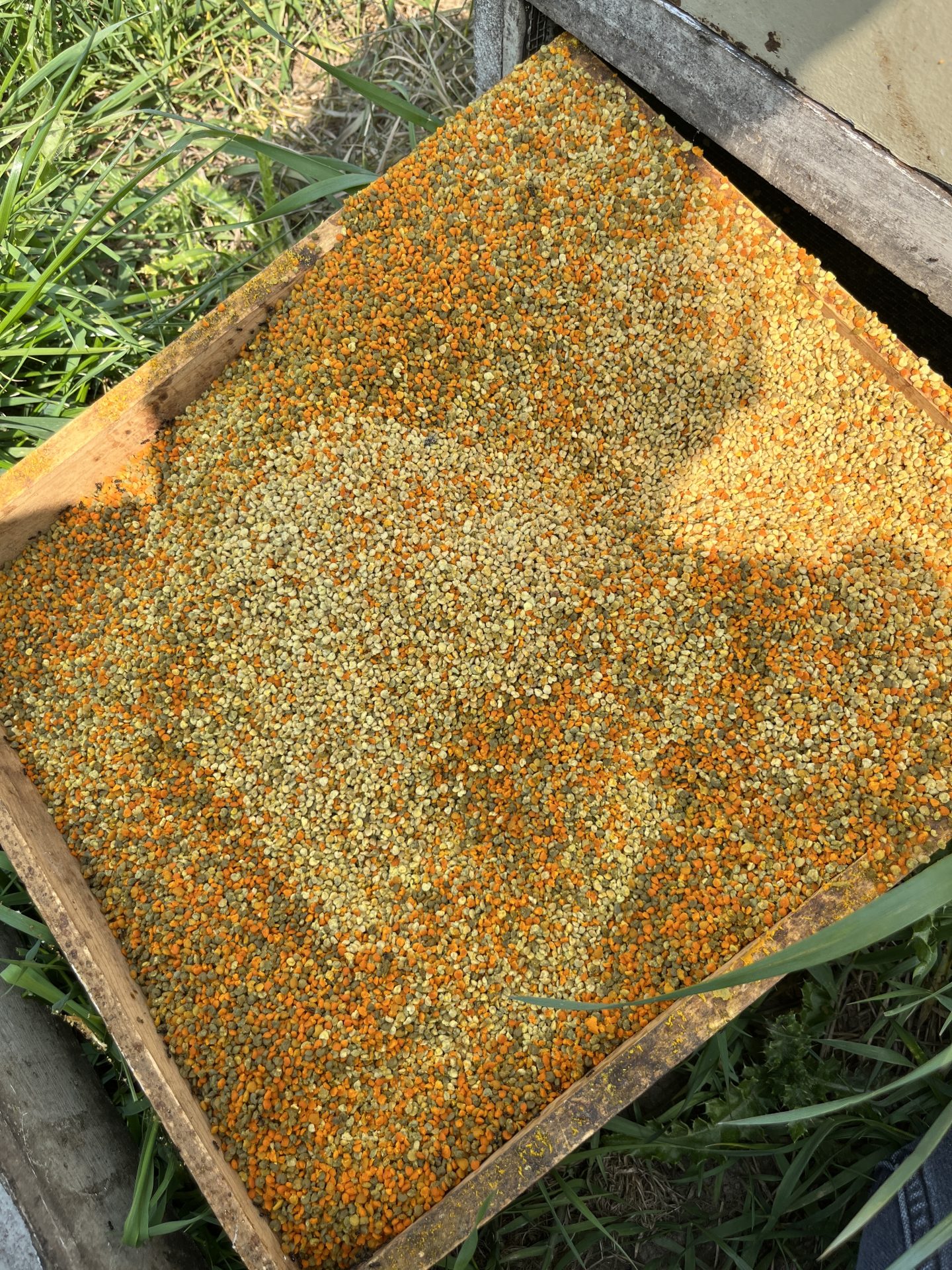
Dr. Samantha Alger, Research Assistant Professor at University of Vermont, and founder of the Vermont Bee Lab seems to have accidentally stumbled into the solution for the lack of hard evidence of neonic contamination of Vermont’s bee colonies. As Alger tells it, “We had been collecting pollen from pollen traps on hives throughout the state of Vermont to understand important forage resources but also began to test the incoming pollen for chemical residues. We started this work in 2021 and it was a really limited survey where we had four apiaries that were involved. It was an undergraduate research project and we sampled those four apiaries, at four different time points over the Summer. When we got the pesticide results back we were all sort of floored by how many different kinds of chemicals and how many hits we were getting for each of them. The Vermont Beekeepers Association (VBA) was also very interested in the results, so we started looking for funding to expand the project and we’ve been expanding it ever since.”
In 2023 the Vermont Bee Lab started calling their efforts a community science project, tapping into the VBA network of beekeepers throughout the state to collect as many samples from as many hives, in as many different geographic locations as possible. Dr. Alger’s intent was to focus the Bee Lab’s efforts on collecting the data that the state’s legislators would need to make an informed decision: “When we did this in 2023 we really tried to focus our sampling efforts to capture and find out when neonic exposure was happening. We designed our study to collect pollen samples from bee hives during the time when corn and soybean crops were getting planted with treated seeds…when the results came back overall we got 309 detections of 34 different pesticides that year in 62 pollen samples. We had 29 apiaries involved: 17 with and 12 without row crops (corn and soy) present. So, we had apiaries that were located in places without row crop presence that acted as control sites to see if we would still find neonics in those areas, or is it mostly linked to the presence of corn and soybeans. Furthermore, by collecting pollen both during and after the seed planting window, we learned whether neonicotinoid exposure is linked to the time when these seeds are getting planted.”
Alger continues, “What we found in terms of neonic detections was that 29.5% of all the bee collected pollen samples were positive for neonics. We also found neonics in 22.7% of flowering plant samples, so we didn’t just look at pollen from hives, we also collected plants that were blooming adjacent to corn and soy fields. When we looked at whether the presence of row crops made a difference, 41% of the samples that were from sites with corn and soy had neonic detections. So, most of the detections were found in sites where corn and soy were planted and nearly all of it was linked to the planting window.”
Changes on the playing field
Ensconced on the campus of New York’s Cornell University is the Cornell Chemical Ecology Core Facility (CCECF) that is affectionately known as the ‘pesticide lab’. This is the lab that the Vermont Bee Lab has been using to get their pollen samples tested. The Director of the facility is Associate Professor of Pollinator Health, Scott McArt. Dr. McArt and the CCECF are playing a pivotal role in helping beekeepers obtain accurate pesticide testing results down to the levels of detection that are most relevant to our industry.
Despite reams of research indicating that bees were being exposed and the health of colonies was being compromised from the use of treated seeds, State and Federal government testing has historically revealed few instances of neonicotinoid contamination in bee hives suggesting that there is no widespread problem despite the protests of beekeepers. Some of us, myself included, have long been suspicious of a cover up by officials designed to help prevent any actions that might reduce pesticide industry profits. However, now it looks like the cover up was not as much the result of actions by nefarious government bureaucrats and administrators’ (although this certainly has occurred) as a systemic failing built into the systems and protocols used by testing laboratories.
In some cases, labs used for pesticide testing simply do not have the latest state-of-the-art equipment designed to successfully detect residues of modern day pesticides down to the levels required to meaningfully evaluate their impact. However, old outdated equipment is only part of the equation. There are two other important factors that have allowed the tests run by the Cornell pesticide lab to provide much greater insight into pollinator specific impacts. It turns out that how deep and broad the screening panel a lab utilizes largely determines if the labs’ tests are sensitive enough to detect neonicotinoid contamination at low levels. As CCECF Director McArt explains, “…there are private labs and then the USDA also has a lab that will do these multi-residue pesticide analyses. Generally the private labs and the government labs screen for a lot of things, and there’s a cost. You can only push the machine so far. If you screen for a lot of things you can’t really get down to the really low levels (of detection), it’s looking at higher levels, where as if you screen for fewer things you can get down to really low levels of detection. So we do a little bit more targeted screening for things that are relevant to bees in particular and that allows us to get little bit lower levels of detection compared to private and government labs…the good thing, if you’re a beekeeper, is we’re screening for very specific things. Our current essay is 105 compounds, and even though we are screening for 105 things, we’re screening for the most relevant 105 things for bees. There are pesticides and there are certain fungicides that we know we should have our eyes on and herbicides as well, so those particular things are in our screening compared to for example, the USDA which just has this sort of random panel of around 200 compounds that they’re screening for. So they’re screening for a lot more stuff than us and also it’s just not very selective, there are a lot of things in there that honestly aren’t even relevant to bees.”
Dr. Alger, who relies on the Cornell pesticide lab’s services for all her testing, agreed with Dr. McArt, “They currently run a 105 pesticide multi-residue screen, with limits of detection less than 1 nanogram per gram for most pesticides. (1 ng/g is equal to 1 part per billion) So that’s less than 1 part per billion which is great. From what I’ve been looking at in labs, it’s the best bang for your buck. For $120 a sample, anyone can submit samples and they’re the most sensitive of the labs that I’ve seen which is really important in trying to understand if the residues that you’re finding are biologically relevant because if you use a lab with higher detection thresholds you could be getting false negatives.”
The answers don’t matter if you’re not asking the right questions
Alger opined further, “I don’t think it’s through negligence per se. The USDA APIS National Honey Bee Survey tests for hundreds of different residues and they’re doing it every single year across the majority of states in the U.S. So, the breadth of what they are looking for is a lot greater than ours but the depth, at this large scale, inevitably is not as deep. It’s great longitudinal data at the national scale. However, we can’t solely rely on those data. Low sensitivity labs will not detect residues that may be biologically relevant. This is particularly important for neonicotinoids, which are toxic at extremely low concentrations. Cornell’s neonicotinoid report summarizes the lowest concentrations found to cause impacts to bees: physiological impacts occur at neonic exposure levels as low as 0.1 pbb. At 0.9 ppb we see behavioral impacts with grooming behavior and increased viral levels, and then at 5 ppb we’re starting to see reproductive impacts where queens are less likely to survive, and they produce fewer eggs. So, if you’re utilizing a lab where the limits of detection are 10, 15 or 20 ppb you’re missing all of that. When complex toxicology results are being interpreted by a layperson or policy maker, I think this can potentially be a pretty big blind spot. The first question a beekeeper should ask when they get results back from pesticide testing (or even before they submit samples to a lab) should be: ‘What are the limits of detection/quantification?’ Then you can do a quick search to see that while these limits may not be enough to cause acute mortality where all the bees just die off, it may be enough to cause problems in the hive at a level that would then eventually lead to dwindling or a queen not laying right.”
Significant business potential
According to McArt, his pesticide lab is currently looking at an eight month turn-around time for new submissions and presently has about 3500 samples cued up. Clearly we need more pesticide testing labs to mimic the approach taken at Cornell to offer more bee relevant test panels that keeps the number of items being tested for low enough so that it doesn’t compromise the sensitivity of detection levels. For decades the pesticide industry has benefited from residue testing protocols that have in effect hidden the true extent of chemical contamination in our nations honey bee colonies. Improving those protocols is the only way that complete and accurate information can be made available to enlighten policy makers as they craft laws. The reality is that without the work of the Cornell pesticide lab, the treated seed bans in New York and Vermont would likely never have occurred. Let’s hope that there are other labs out there that will recognize this economic opportunity to help meet our nation’s bee hive residue testing needs.
