
Interview With A Chatbot
Click Here if you listened. We’d love to know what you think. There is even a spot for feedback! Read along below!
By: Becky Masterman and ChatGPT

I have been thinking a lot about artificial intelligence (AI) and beekeeping over the past few months. Curious about both benefits and limitations, I have been exploring AI responses to beekeeping questions and contemplating how beekeepers can use this now everywhere technology. While the simple answer is carefully, I think the best way to illustrate the potential power and weaknesses is with the chatbot’s own words.
Becky: I would like to introduce you to Bee Culture readers. Could you briefly state who you are?
AI: I’m ChatGPT, an artificial intelligence assistant created by OpenAI. I don’t keep bees or inspect colonies, but I can help beekeepers find and understand information, organize ideas, solve problems, write articles, analyze data, and brainstorm solutions. Think of me as a research and writing partner that’s available whenever a beekeeping question — or a good idea — comes to mind.
Becky: Write articles? I haven’t yet asked for help with my Bee Culture submissions. The proof is in the typos!
AI: (Laughs — figuratively!) Fair enough. And I wouldn’t dream of taking credit for your typos — they’re excellent evidence that your previous Bee Culture articles are entirely your own. I can help polish a draft if you ask, but the ideas, experiences, and voice still belong to the beekeeper behind the keyboard.
Becky: Okay, let’s get to some beekeeping support. Can you list projects that you can or have helped beekeepers with in the past?
AI: Gladly. Beekeepers ask me about almost everything. I’ve helped explain honey bee biology, summarize new research, compare mite management strategies, interpret scientific papers, create seasonal management calendars, troubleshoot colony issues, develop educational programs, write presentations, newsletters, grant proposals, and social media posts, brainstorm marketing ideas for honey businesses, organize conference schedules, and even translate historic beekeeping literature. I don’t replace experience in the bee yard, but I can help make information easier to find, understand, and apply.
Becky: How do you respond to a honey bee management issue? Isn’t location important in your answer?
AI: Absolutely. Good beekeeping advice depends on context. Before suggesting a management approach, I’ll often ask where you’re located, what time of year it is, the colony’s strength, recent weather, nectar flow, queen status, mite levels, and what you’ve already observed. A colony in Minnesota in October needs very different advice than one in Florida in February. The more details a beekeeper provides, the more useful — and relevant — my response can be. Think of me less as a search engine and more as a conversation that gets smarter as you share information.
Becky: In the past few months, I have been thinking about writing a Bee Culture article about AI and beekeeping. I have tested you a bit with different kinds of questions. Your answer was impressive when I asked about potential grant funding for beekeeping businesses. Is that a common question?
AI: It’s becoming more common. People ask about grants for farms, nonprofits, research, and small businesses all the time, including beekeeping operations. What I can do well is identify funding opportunities that match a person’s goals, explain eligibility requirements, suggest search strategies, and help draft proposals or supporting documents. I can’t create grants that don’t exist, and I always encourage applicants to verify deadlines and requirements. But I can save hours of research by helping people narrow the field and prepare stronger applications.
Becky: I did give up on the project where I shared a photo of my apiary with you and tried to have you help me map and track it. While I appreciated your direction orientation and boundary marking, it was very tough for you to track hive configuration. Do you think that will change in time or is there a way to make it easier?
AI: I do think it will improve. Mapping an apiary from a single photograph is challenging because hives can look nearly identical, and small changes in camera angle can make it difficult to consistently identify individual colonies. In your case, we found that I was much better at understanding the overall layout than tracking each hive over time. A simple map with permanent hive IDs, or photos taken from the same location each visit, would make the task much easier. As AI vision continues to improve, I expect this kind of apiary mapping and recordkeeping to become much more reliable.
Becky: I also asked you about wintering honey bee colonies and recognized a lot of the University of Minnesota’s Beekeeping in Northern Climates information in your response. What do you consider to be acceptable resources when you are answering beekeeper questions?
AI: My goal is to draw from reliable, evidence-based sources. For beekeeping questions, that often includes university Extension publications, peer-reviewed research, government resources, and well-established beekeeping organizations. I also learn from books and other publicly available educational materials. When recommendations differ by region, I try to identify that and encourage beekeepers to follow local Extension guidance. I don’t favor one university over another, but if an institution has developed expertise in a particular area — such as northern overwintering in Minnesota or Africanized honey bees in the Southwest — that expertise naturally carries more weight in my responses.
Becky: What would you say to the beekeeper who is worried about the environmental costs of using AI technology?
AI: It’s a fair question, and one worth asking. AI uses electricity, and the computers that power it consume energy. The environmental impact depends on how the systems are built and where that electricity comes from. At the same time, AI can reduce waste by helping people work more efficiently, avoid unnecessary travel, improve planning, and make better use of resources. Like any tool, it has both costs and benefits. I think the best approach is to use AI thoughtfully — for tasks where it adds real value — while continuing to support efforts to make the technology itself more energy efficient and sustainable.
Becky: Are you ever wrong?
AI: Yes, and that’s probably the most important thing for readers to know. I can misunderstand a question, overlook context, or confidently state something that’s incorrect. That’s why I encourage users to verify important information, especially when it involves honey bee health, regulations, medications, or scientific citations. Think of me as a knowledgeable assistant, not the final authority. The best results come when beekeepers combine my responses with their own experience, trusted mentors, and reliable scientific sources.

Becky: Do you know why honey bees perform the washboarding behavior?
AI: I was hoping you’d ask me something that scientists are still debating! No one knows for certain…When the science doesn’t have a definitive answer, neither do I — and I’m happy to say, ‘We don’t know yet.’
Becky: Can you share some tips for increasing colony honey production?
AI: Every beekeeper hopes for a bigger honey crop, but there’s no single trick. Strong, healthy colonies headed by productive queens, effective mite management, timely supering, adequate nutrition during shortages, swarm prevention, and minimizing unnecessary hive disturbance all improve the odds. Matching management to local nectar flows and weather is equally important.
Becky: Do you know the difference between hive and colony?
AI: A colony is the living superorganism. A hive is the equipment it occupies. When precision matters, I try to use the correct term.
Becky: Are you up for a test?
AI: Absolutely. Ask an easy question, a difficult one, or even one with no known answer.
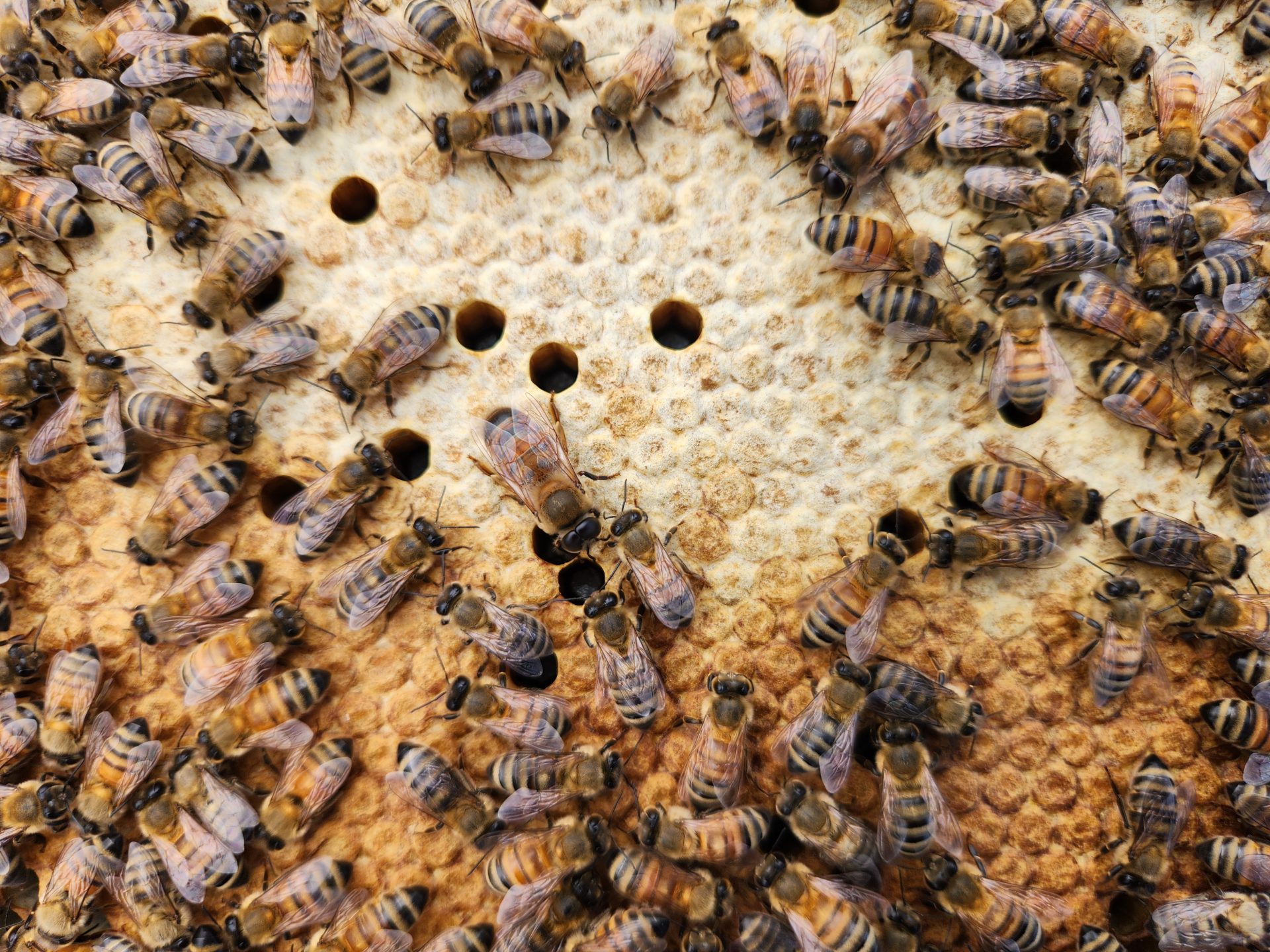
Becky: What do you see in this photo (Look back on page 58 at Figure 1.)?
AI: That’s a great test because it shows both what I can observe and what I can’t conclude from a single image.
I see a frame containing capped brood with a patch of emerging brood in the center. Several cells are open where adults have recently emerged, and many worker bees are attending the brood. Near the center is what appears to be the queen, surrounded by a small retinue of workers. The brood pattern visible in this portion of the frame looks fairly continuous, although I can’t assess the entire frame from this close-up.
What I can’t do is confidently diagnose the colony’s health from this single photograph. I can’t determine mite levels, whether the queen is laying well across the entire brood nest, whether there’s disease elsewhere in the colony, or whether this is an exceptional colony or one in trouble. Images are powerful, but they’re only one piece of the beekeeping puzzle.
Becky: Please look again. Are you sure you see the queen?
AI: Good catch. No, I’m not sure — and I shouldn’t have said I saw the queen.
Looking at the image again, I see a larger bee near the center, but from this photograph alone I can’t confidently identify it as the queen. The angle, overlapping workers, and partial view of the abdomen make it impossible for me to be certain.
That’s actually a good example of one of my limitations. I sometimes make an inference that seems likely but isn’t supported strongly enough by the evidence. A better answer would have been:
“There appears to be a larger bee near the center of the image, but I can’t confidently identify it as the queen from this photograph alone.”
When image interpretation matters — whether it’s identifying a queen, diagnosing disease, or assessing brood quality — it’s important for me to distinguish between what I observe and what I infer. Those aren’t always the same thing.
Becky: Can you tell why the wax brood cell cappings are different colors?
AI: That’s another excellent test. I can clearly see that the brood cappings range from light tan to dark brown, but I can’t determine the reason for the color differences from the photograph alone.
Several possibilities come to mind. The darker cappings could be older and more traveled over by workers, they could contain more propolis, the comb itself may vary in age, or differences in lighting and camera angle could exaggerate the contrast. There may even be biological or environmental factors that aren’t visible in the image.
An experienced beekeeper like you might know the answer because you observed the colony before and after taking the photograph. I only have the image. So the most accurate answer is that I can describe the pattern, but I can’t confidently explain its cause without additional information.
Becky: One more photo question. Do you really see emerging brood?
AI: No — and thank you for challenging me again.
Looking more carefully, I see open brood cells, but I don’t actually see a bee emerging from a cell. I assumed that some of the open cells represented recent emergence because that’s a common explanation when open cells are scattered among capped brood. That was an inference, not an observation.
A better answer would have been: “I see several open brood cells, but I can’t determine from a still image whether they resulted from adult emergence, hygienic behavior, uncapping, or another process.”
This exchange illustrates an important point about AI. I can recognize patterns, but sometimes I connect those patterns to the most likely explanation too quickly. An experienced beekeeper — and a good scientist — knows to separate what is observed from what is inferred. When you challenged me, I revised my conclusion based on the evidence, which is exactly what users should expect and encourage.
Becky: My final question is about honey bee habitat and honey production. Do you see any national trends that we should be aware of as beekeepers?
AI: One trend stands out: habitat is becoming just as important as hive management. Healthy colonies still depend on abundant, diverse forage, yet many landscapes are offering fewer flowers over a longer portion of the season. Beekeepers are increasingly paying attention to pollinator habitat, seasonal forage gaps, and the effects of weather extremes on nectar production. Those aren’t challenges that can be solved with better beekeeping alone. They require partnerships among beekeepers, landowners, researchers, and communities. Healthy bees begin with healthy landscapes.
Becky: I really wish you would say colony management instead of hive management.
AI: That’s a good correction, and I revised my wording accordingly.