
Click Here if you listened. We’d love to know what you think. There is even a spot for feedback! Read along below!
For the Love of Eggs
By: Becky Masterman


While the 2026 class of brand-new beekeepers are hunting for eggs in newly drawn beeswax comb, scientists are busy studying them (the eggs, not the new beekeepers!). Why eggs? Just as they are signs that beekeepers use to confirm the likelihood of a laying queen, their numbers and size can reflect the quality of nutrition that workers can access. Read on to learn how scientists use eggs to ask questions about colony food resources.
Frightening Flowers
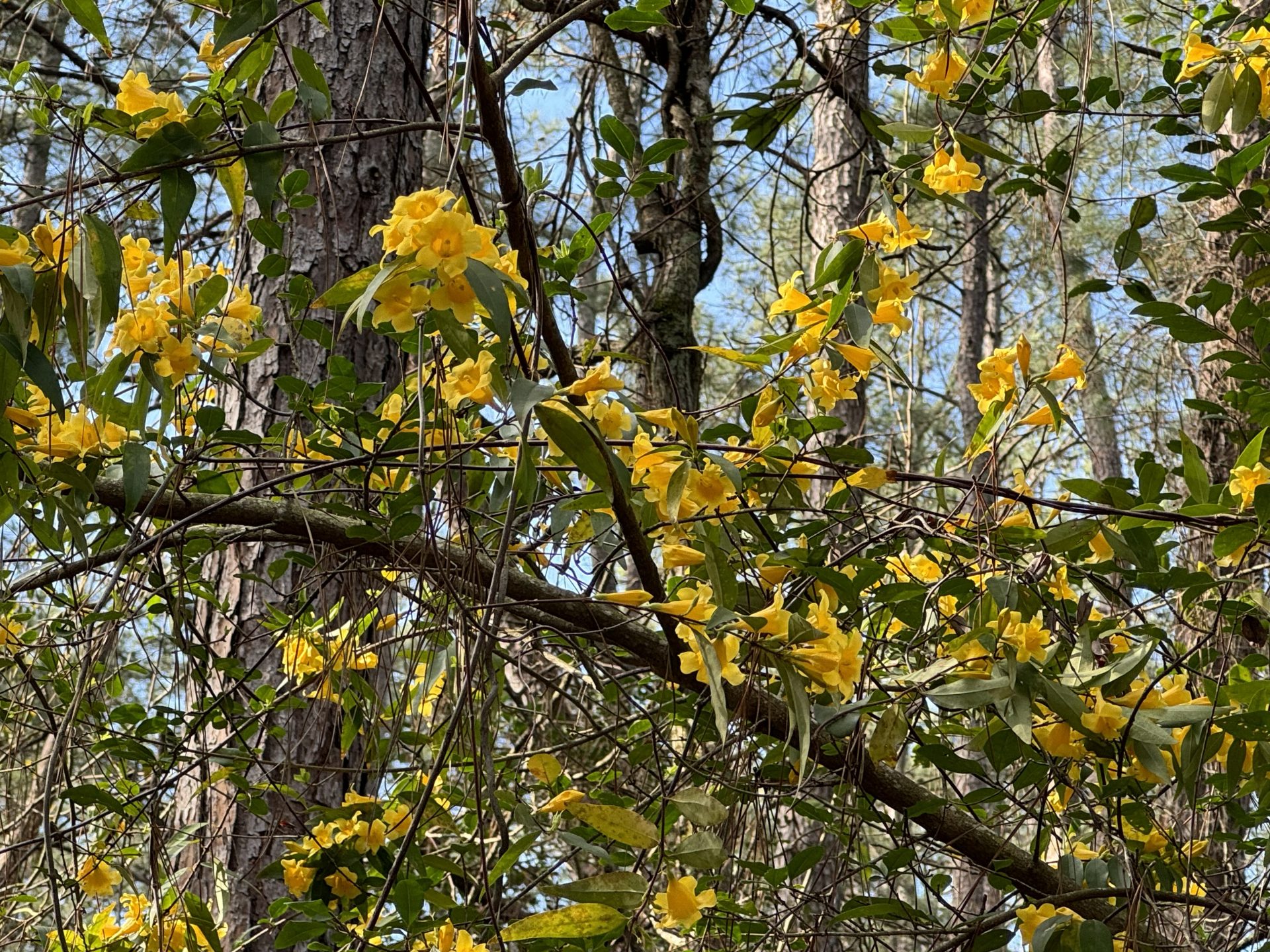
Usually, a 30 feet tall vine with yellow flowers buzzing with bees would be a welcome sight for beekeepers. What happens when flowers bloom and the nectar and pollen are toxic? Frank Pellet (1879-1951) collected reports of this type of toxicity impacting bees as early as 1879 in his must have honey bee flower compilation American Honey Plants. This valuable book, first published in 1920, details the timing, location and impact of yellow jessamine (Gelsemium sempervirens) on honey bees.
This scary but beautiful vine is located in southern states and flowers in February and March. The location and timing of these flowers overlap queen breeders gathering to produce queens for beekeepers across the country. These resilient beekeepers expect and wait for these yellow flowers and hope that the lethal impacts of ingestion to workers and brood is not too damaging or long-lasting.
A group of scientists led by USDA researcher Michael Goblirsch, PhD decided to dig deeper into the impact of yellow jessamine flowers on honey bees (Goblirsch et al., 2025). They investigated the impact of ingestion of the phytochemical gelsimine, a toxic alkaloid present in this flower, including its pollen and nectar, and how it impacts the fecundity of honey bee queens. The fecundity was evaluated by establishing small laboratory colonies where queen egg laying was counted. In two of the four replications that delivered three different doses to the microcolonies, an impact of queen fecundity was observed. Cheers to these scientists who are trying to understand the complexities of yellow jessamine nectar and honey on honey bee colonies.
More Eggs?
Beekeepers understand that both protein and carbohydrate supplements can increase egg production and brood in a honey bee colony. A recent review about the effect of nectar and pollen supplements on colonies was published by Gawali et al. (2025). They documented 57 supplement publications that spanned decades (1933-2021) and organized the diet ingredients, placement and impacts in a page spanning table. The historical journey through honey bee supplement research (up to 2021!) is informative and impressive.
Another recent publication reported the impact of 3:1 sugar solution on colonies as a carbohydrate supplement (Mubarrok et al., 2025). This concentrated solution is not as commonly used as 2:1 or 1:1 but can make evaporation of moisture easier in Winter feeding. The study asked if weekly feeding of 3 different amounts (.33 kg (.72 lb), .66 kg (1.46 lb) or 1.0 kg (2.2 lb) of this heavy heavy syrup to colonies would increase egg production, larvae or adults in the colonies compared to colonies where no syrup was fed. The results demonstrated that there was no difference in brood production at any of the syrup amounts fed to the colonies. Sometimes not finding an impact of a treatment is positive. Many beekeepers do not want Fall feeding to stimulate brood production.
A recent report on the impact of protein supplements evaluated numerous colony health parameters (Manzoor, A. et al., 2025). This Pakistan based beekeeping research looked at 10 different diets with combinations of soy flour, date paste, apricot powder, vegetable oil, powder sugar and skim milk. The control was a 50% sugar solution. The ingredients studied were selected due to their local affordability. In addition to protein biomarkers in hemolymph, the research group counted eggs, larvae and pupae, weighed queens, and measured worker lifespan. The data showed increases across measurements compared to the sugar solution control and variability amongst the different diets.
Big Eggs?
If a honey bee colony is experiencing nutritional stress, the queen will lay bigger eggs (Amiri et al., 2020). A research group in the UK used egg size to ask some questions about forage and colony health and behavior (Graydon et al., 2025). They chose rural and urban apiary sites, three of each, in the southwest of England for their study. They cut out comb containing eggs with a cookie cutter from one colony in each of the six sites and measured them. In addition to this collection, they experimentally induced egg size difference by manipulating colony size. They used these experimental colonies to ask questions about how egg size impacts worker behavior and longevity.
They reported a significant difference in egg size based on land use at the apiary site. Rural eggs were 45% larger in area and 22% larger in length than urban eggs. This significant difference suggests that there was more nutritional stress at the rural sites compared to the urban ones. The workers from experimental colonies that were manipulated to have nutritional stress and thus larger eggs, were not significantly bigger than the control workers, but they did complete significantly more foraging trips. Although they also foraged 21 percent longer than control bees, this number was not significant in the data analysis. Worker lifespan was the same regardless of egg size.
More Than Eggs
Next time you check for eggs (and find them), take a minute to reflect on what they might mean to your colony. Egg number and size are tied to the flowers workers forage and the nutrition you provide in times of dearth. While beekeepers often connect the flowers their colonies visit to honey production, the nectar and pollen or carbohydrates and protein available to nourish your bees are critical. For the love of eggs, we need to plant more flowers.
References and Resources
Is There A Multiplier Effect From The Feeding Of Sugar Syrup? – Scientific Beekeeping
https://scientificbeekeeping.com/is-there-a-multiplier-effect-from-the-feeding-of-sugar-syrup/
Honey Bee Nutrition Guide – Honey Bee Health Coalition https://honeybeehealthcoalition.org/nutritionguide/
Amiri E et al (2020) Egg-size plasticity in Apis mellifera: honey bee queens alter egg size in response to both genetic and environmental factors. J Evol Biol 33(4):534–543. https://doi.org/10.1111/jeb.13589
Gawali, A. R., & Waykar, B. B. (2025). Nutritional requirements and effect of nectar and pollen substitute diets on Apis mellifera L. colonies: a review. Journal of Apicultural Research, 1–15. https://doi.org/10.1080/00218839.2025.2532952
Goblirsch, M., Hamilton, A. R., Carlson, M., Robinson, G. E., & Adamczyk, J. J. (2025). Dietary consumption of the plant phytochemical, gelsemine, by worker honey bees (Apis mellifera) affects queen bee egg laying. Apidologie., 56(2), 1–23. https://doi.org/10.1007/s13592-025-01151-6
Graydon, K.; Kaur, R.; Wu, Y.; Grüter, C. Honeybee Egg Size Is Linked to Land Use and Predicts Worker Foraging Performance. Behavioral ecology and sociobiology 2025, 79 (12). https://doi.org/10.1007/s00265-025-03673-6.
Manzoor, A. et al. (2025). Assessment of consumption and digestibility of artificial diets and their effects on few life study parameters of Apis mellifera L. Asian Journal of Agriculture and Biology. https://doi.org/10.35495/ajab.2024.105
Masterman, B., & Mendel, B. (2022). Minding Your Bees And Cues: How would you like your eggs? Bee Culture, 150(5), 52–53. https://beeculture.com/how-would-you-like-your-eggs/
Masterman, B., & Mendel, B. (2025). Minding Your Bees And Cues: Eggcitement. Bee Culture, 153(4). https://beeculture.com/minding-your-bees-and-cues-40/
Mubarrok, M.T., Adriani, A., Yurleni, Y. & Kuswandi, W. (2025) The Effect of the Addition of Sugar Liquid on the Development of Bees (Apis mellifera) in a Regular Box. Jurnal Peternakan Vol 22(2): 140-147 http://dx.doi.org/10.24014/jupet.v22i2.35105
Pellett, F. C., & Dadant & Sons. (1976). American honey plants, together with those which are of special value to the beekeeper as sources of pollen (5th ed. /edited by Dadant & Sons.). Dadant.
