
Click Here if you listened. We’d love to know what you think. There is even a spot for feedback! Read along below!
Sting Theory
By: Jay Evans

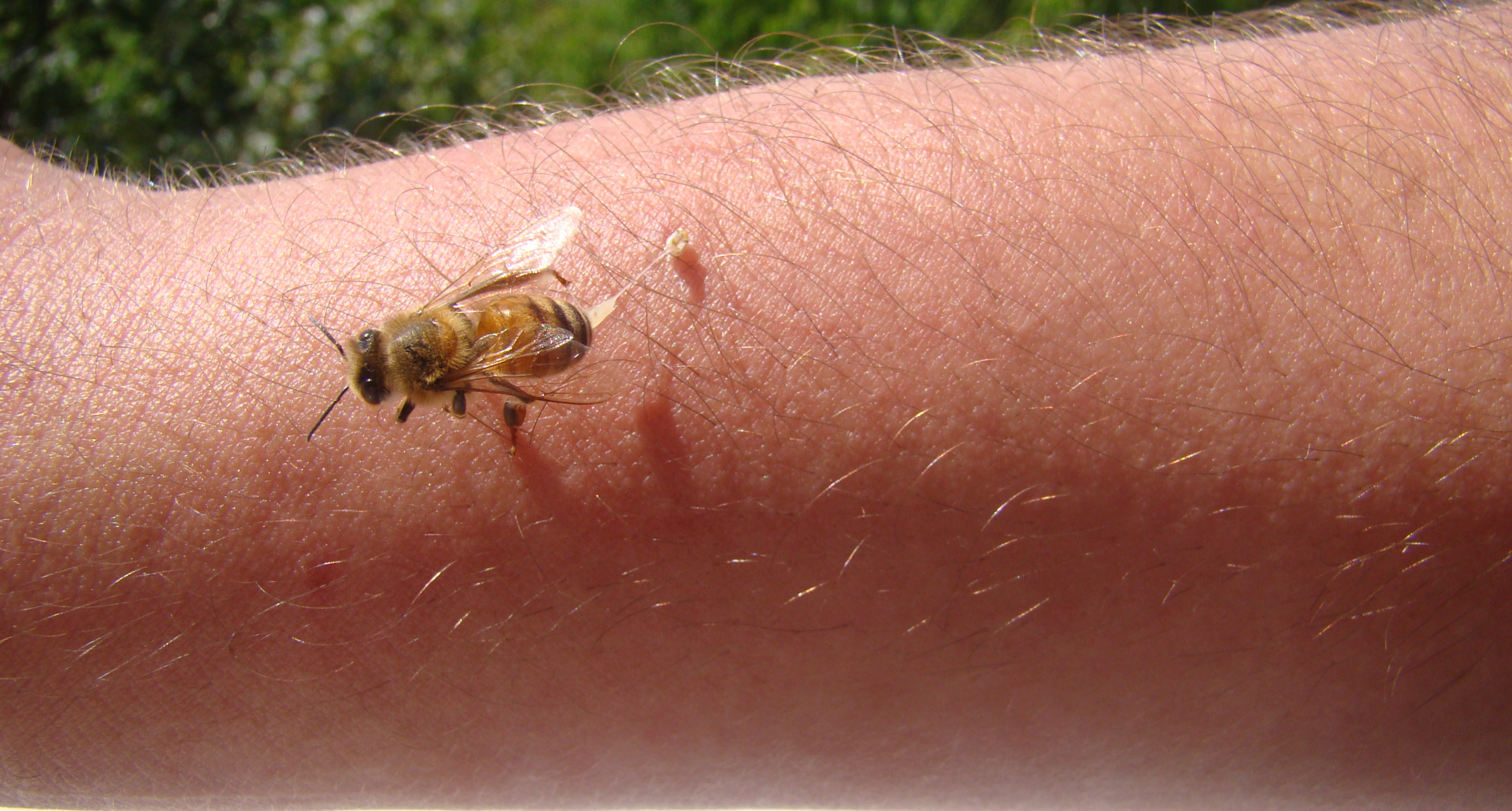
Stings are part of beekeeping. They can be inopportune, leading to temporary but noticeable swelling of faces and hands. They can also be dangerous when inflicted on a body that responds with an overactive allergic response. While human tolerance of stings is highly variable, few of us like to get stung. Nor do we want bees to sting non-playing characters who come close to our hives out of curiosity or convenience. So…what are the best ways to minimize stinging events? Personal protective equipment ranks highly for beekeepers and observers. As beekeeping mentors, you walk a fine line when encouraging new beekeepers to skip gloves. The clear gains in improved agility and learning a Seeleyesque gentle nature can be lost if that new beekeeper is continually nervous about incoming stings. I humbly wear thin lab gloves most of the time, and always protect my face (my money-maker, as almost no one says). Knowing your own bees and their alarmist ways is key as you go down a line of hives. Your particular stock of bees has much to say about their tendency to sting. The continuum of defensiveness in all races of honey bees is broad enough to be noticeable, and some bees are truly ‘hot’ much of the time. Seventy years of work show that new-world Africanized bees have a continuum that is longer on the ‘hardy and defensive’ end. The resilience of these bees in the southern U.S. means there is always a chance your colony will have one or both of these notable lineage traits. Smarter people can advise you about whether to requeen or shun a defensive hive, but a reboot is always an option when it makes things more comfortable for you and passersby.
What is more in your control, even day-to-day, is accounting for the mood of the bees under your care. Weather drives our mood and that of our bees. Gray days and rain can lower pep in some of us, and opening beehives on gray days often triggers a larger bee grump factor. This could reflect reduced foraging and a greater proportion of older ‘Braveheart’ bees inside the colony; those with a lower threshold to either release alarm pheromone or respond to it by getting defensive. It is also possible that a colony is more reactive in bad weather because bees can sense a greater risk of being opened, as cooler air or even water pours in. Surprisingly, there is almost nothing in the peer-reviewed literature confirming the sense that bees are more reactive when the weather is poor. In fact, the most-cited research paper, by Edward Southwick and Robin Moritz (Southwick, EE, Moritz, RFA. (1987) Effects of meteorological factors on defensive behaviour of honeybees Int. J. Biometeor., Vol. 31, No. 3, pp. 259-265), found that stinging rates actually increased with higher temperatures, sunlight, humidity, and wind across a German Summer. Someone needs to repeat this work. For now, many of us will follow the adage that it doesn’t take a scientist to know which way the stings go.
While the weather debate resolves itself, you might try soothing your bees via their stomachs. A recent study found that defensive colonies might just need a bee Snickers bar (as a government employee, I do not endorse Snickers over any other form of chocolate). Elizabeth Walsh from the USDA-ARS in Baton Rouge, Louisiana, led a group exploring whether depriving colonies of protein led to ‘hangry’ (hungry plus angry) behavior (Walsh EM, Avalos A, Ihle K, Lau P, Simone-Finstrom M, Acosta AA, Frake M, O’Brien S, Tundo G. (2026) Hangry bees: Pollen dearth impacts honey bee (Apis mellifera) behavior and physiology PLoS One. 21(1):e0338712, doi: 10.1371/journal.pone.0338712). Working with Pol-Line bees, the researchers used active pollen traps on eight colonies to reduce pollen returns, allowing eight control colonies to store pollen freely. Days after the experiment began, colonies with reduced pollen showed a trend towards higher levels of defensiveness based on a ‘meanness’ score based stinging, frame-hanging, running, and buzzing the observer. Five weeks later, bees from pollen-derived colonies were staging one battle after another, and were significantly more likely to respond to disturbances with defensive behaviors.
Given the five-week delay before bees became hangry, the authors suggested that the larval food environment might somehow ‘prime’ grumpy old bees. To better test this, they compared the physiological traits of hungry, defensive bees to their calmer associates, and also compared changes in physiology as bees aged and across the season. With respect to defensive brains, they supported an earlier discovery that levels of a mysterious protein, “GB53860”, are a good predictor of defensiveness. GB53860, perhaps unique to bees, was discovered by Clare Rittschof (now at the University of Kentucky) while working with Gene Robinson in the University of Illinois’ bee neurobiology lab. Levels of this protein also increased over the season in foragers from both bee cohorts. Bees from pollen-limited colonies also showed smaller hypopharyngeal glands. Other nutritional and behavioral genes changed with bee age or season, but not with pollen availability nor with the tendency to defend.
The authors conclude that hangry behavior is another important indicator of sublethal changes in bees facing environmental stress. Beekeepers might add sudden shifts in behavior to their notebooks and see how they relate to incoming food, perhaps guiding decisions for improving forage or supplements. The ultimate ‘why’ for hangry bees is interesting as well. Does this trait reflect changes in colony structure, or adaptive strategies to guard what little perceived foodstores are left? Is it more often a seasonal thing, tied to the dearths that inspire robbing? These scientists are digging deeper into a novel observation that could help you keep happy bees that tolerate disturbance. They might also make new discoveries related to how youthful traumas impact older bees, an important goal whether that trauma is caused by nutrition, pesticides, or disease. Overall, this neat study shows how genes and the environment combine to give bees and whole colonies a personality of sorts, and how this personality might affect your beekeeping.
