
“Disabeeity” – When the Doctor Becomes the Patient
Click Here if you listened. We’d love to know what you think. There is even a spot for feedback! Read along below!
By: Dr. Tracy Farone


A quick AI search of “the average age of the American beekeeper” presents results in the 50-60 years range. While there are no formal studies or census on beekeepers’ age in the United States, if one looks around your local beekeeping association meeting, one may find this average to be anecdotally true. Insurance companies are also quick to point out that our likelihood of becoming disabled in any given year is much more likely than death (that is, until the reaper ultimately catches up with us eventually). According to the WHO about 25% of all people will experience a disability at some point in their lives with that percentage increasing to 50% for folks over 65 years of age (1). Given the likely average age of beekeepers and the physicality of our work, it is also likely that many of us struggle from time to time with managing our bees during or with a disability. It is also likely that our bees’ health may suffer as a result. But we all live in “the dash”, you know that space between our birth date and death date on the tombstone, and we have to find a way to make the most of the time we have. While certainly not ideal, beekeeping can still be accomplished during a disability with some planning and some help. I learned this, this Summer, as a patient, not a doctor. I am hoping to pass along my knowledge to you, with practical encouragement, as I am sure many beekeepers may struggle in dealing with their disabilities and beekeeping.
This past Memorial Day, I was looking forward to a Summer spent with my family enjoying the outdoors with multiple hiking, biking and kayaking adventures planned. That evening my husband and I decided to go on a horse ride. I had been working with a horse that we had in training for about a year and a half. Since I was always the one dubbed able to ride the “crazy” horse, this was my mount. Long story short, for no reason whatsoever, he bolted with me and ran me threw a corpse of trees at a full gallop. In trying to do an emergency dismount, I hit a tree. I was life-flighted to an emergency hospital in Pittsburgh. My pelvis was fractured in two places, my left lung partially collapsed, I developed an eight-centimeter pelvic hematoma and was still bleeding into my pelvis and abdomen. I also acquired a wicked case of neck whiplash. They kept me in the ICU for two days to see if I would crash…I didn’t. But even now, months later, I am still learning to walk again.
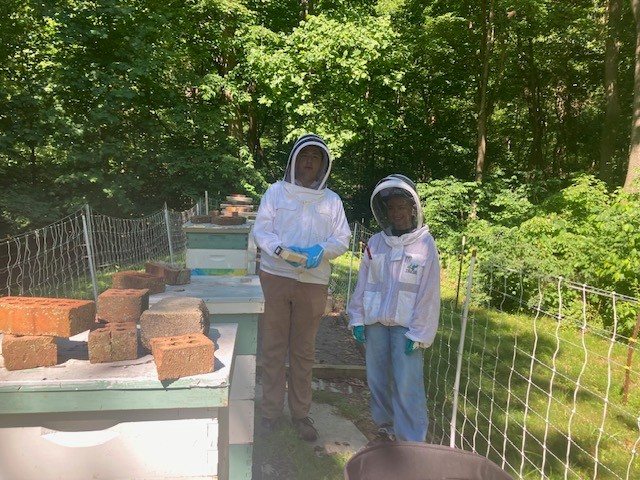
The previous week, my students and I had started our Summer honey bee research program, including an international research collaboration. We had 10 more weeks to go, and my two students had planned their Summer around this work. I was flat out in the hospital for a week but after a bit of consideration, we found a plan to continue our research project and take care of the bees. Here are some tips and practical examples, if you find yourself in a beekeeping situation while disabled.
- Listen to Your Health Care Providers.
It goes without saying that you should follow the medical advice of your health care team about what you should and should not do. I would encourage you to talk to your doctors, physical therapists and occupational therapists about things you would like to be able to do. For example, after my accident, I had in-home physical therapy for 4 weeks. During one of my last sessions, my physical therapist actually walked out to my bee yard on my property to evaluate and make suggestions on how I could get into the yard. We practiced getting me out my house door, onto our side-by-side to drive to the bee yard, then using a rollator, getting me into the yard to be able to have a seat (most of the time). Keep up with your PT. I know it can be hard, but don’t give up on the process. Sleep and eat as well as you can, they are truly restorative. - Get Help.
As all of you know, beekeeping is a very physical job. If you are unable to stand or lift, you may wonder how in the world you are going to do beekeeping. Simply speaking you must have physical help. This requires asking. Which, I know, is the hardest part. If you’ve been beekeeping successfully for more than 3 years, you are ahead of the curve. People actually need your help and there is still lot you can do as a mentor sitting down. Remember that neighbor, family member, or friend who is always asking about your bees? Suit them up. Ask around your local beekeeping club for help and mentees, find a local vet interested in working with bees, or a college student, or a school, community or church group, and let them do all the lifting for the season. My students were “new bees”, students I normally slowly introduce to hive inspections. However, given our particular situation, I warned them that they were going to have to” jump into the deep end of the pool and start swimming”. To my pleasant surprise, after a few days in the yard, these students excelled faster than any other group I had previously “babied”. - Make Use of Special Equipment and Technology.
You will likely need mobility aids to help you during a disability. I learned more about wheelchairs, walkers, rollators and canes from my physical therapist than I ever thought was possible. The equipment can be expensive. Ask your PT for contacts for used equipment, the VA and friends and neighbors may also be a good resource. My neighbors and my PT provided me with a wheelchair, walkers, canes and a rollator for free. Rollators are great for getting around terrain, including bee yard. It can help you walk through a yard and also serves as a seat. If you have a side-by-side or 4-wheeler and are able to drive, these vehicles can help you get into country apiary spaces. Technology can also be helpful. For the first two weeks of our bee yard research, I was unable to get in the yard at all, so I FaceTimed my students working in the yard. While not ideal, it still allowed me to give them guidance in the yard. Speaking of driving, if you are able to drive a car, be sure to get a temporary handicapped placard for your vehicle. Depending on your state this may not happen quickly. First, you will need a form signed by your doctor. Ask for it right away. Then you will have to send the request to your state. AAA can be helpful in this process. - Focus on Maintenance.
Do not expect too much from yourself. This is not the year to expand your apiary, and you may want to consider downsizing at least for a time. Leave a little extra honey on the bees. Focus on keeping the bees alive with good nutrition and varroa management. That is enough for now. - Expect Setbacks.
You may have to let some things go and be at peace. I must admit this year my bees didn’t do as well. I made less splits and had more swarms. However, with the help of my students, we still added and managed a collaborative research project within our yard. - Foster Mental and Emotional Health.
When you are down and out, it is easy to feel worthless and depressed. Flashbacks are a thing. Worries, loss and loneness occur. Acknowledge them. Do not dismiss the importance of taking care of your mental/psychological/emotional health. As physically exhausted as I was with this injury, once I journeyed into the bee yard and fresh air with the bees and kids, I felt better. I forgot my injury for a time. It was like therapy. Mostly for my mind.
Be thankful. Lean on your faith. Pray. Read books or that pile of Bee Culture Magazines you’ve had on the shelf for a while. Call that family member or old friend. Have honey tea on the porch. Give your mind something positive to do. Many beekeeping clubs would be happy to have volunteers help with projects, many of which could be done while sitting down. - Consider Duration
Catastrophic injuries can cause disabilities with a variety of recovery outcomes and expectations. Personally, I never had what would be classified as a “catastrophic” injury until now, and only those who have experienced these types of injuries know what it is like. It may take considerable time to know what you may or may not be able to do, and you and your bees may have to adapt to a new normal or goal timeframe. Decisions about how you move forward will likely be linked to your long-term prognosis. I’m hoping to be physically functional again in the bee yard by next Spring…we’ll see.
With all the contributing factors that can affect honey bee health and hive loss, I am not aware of anyone that has looked for a relationship between beekeeper health and their honey bees’ health in a study or survey. Food for thought. I hope this article is an encouragement to those of you who may be managing beekeeping while navigating a disability.
References
- https://www.who.int/news-room/fact-sheets/detail/disability-and-health Accessed 8/21/2026.
