
Click Here if you listened. We’d love to know what you think. There is even a spot for feedback! Read along below!
By: Stephen Bishop

Somewhere in the crevices of my brain, I have repressed the memories of my college public speaking class, which for extreme introverts like me is a class that ought to be outlawed by the Geneva convention. Once I overcame the initial hyperventilating and quaking, I was usually able to give a respectable five-to-seven-minute speech without breaking under the torture of people staring at me. However, once in a college English class, the professor had the bright idea of requiring us to act out a Shakespearean scene from A Midsummer Night’s Dream. I was assigned the role of Lysander, a young lovestruck lad, whom I creatively portrayed by mimicking a deer in headlights. No words would come out. It was as if my brain had short-circuited. The day before, when no one was watching, I could have recited the part backward, but stick me in front of a bunch of my peers and I couldn’t even utter the first word. Some people are born for the stage. I think it’s safe to say that I was born for the backstage.
But I’ve come a long way. My job requires a good deal of public speaking which I tolerate and occasionally actually enjoy, at least I did before the pandemic and the rise of Zoom. Yep, just when I had finally gotten used to people staring at me, now I have a gallery of little black screens staring at me. It’s terrifying. There are no visual cues of comprehension. No people nodding their heads, or smiling or even sleeping. Just the black screens of nothingness. During the pandemic, I also had to do a few talks in schools, when all the kids were wearing masks, and I experienced a similar phenomenon—not being able to see someone’s face, to gauge comprehension, takes some getting used to when speaking.
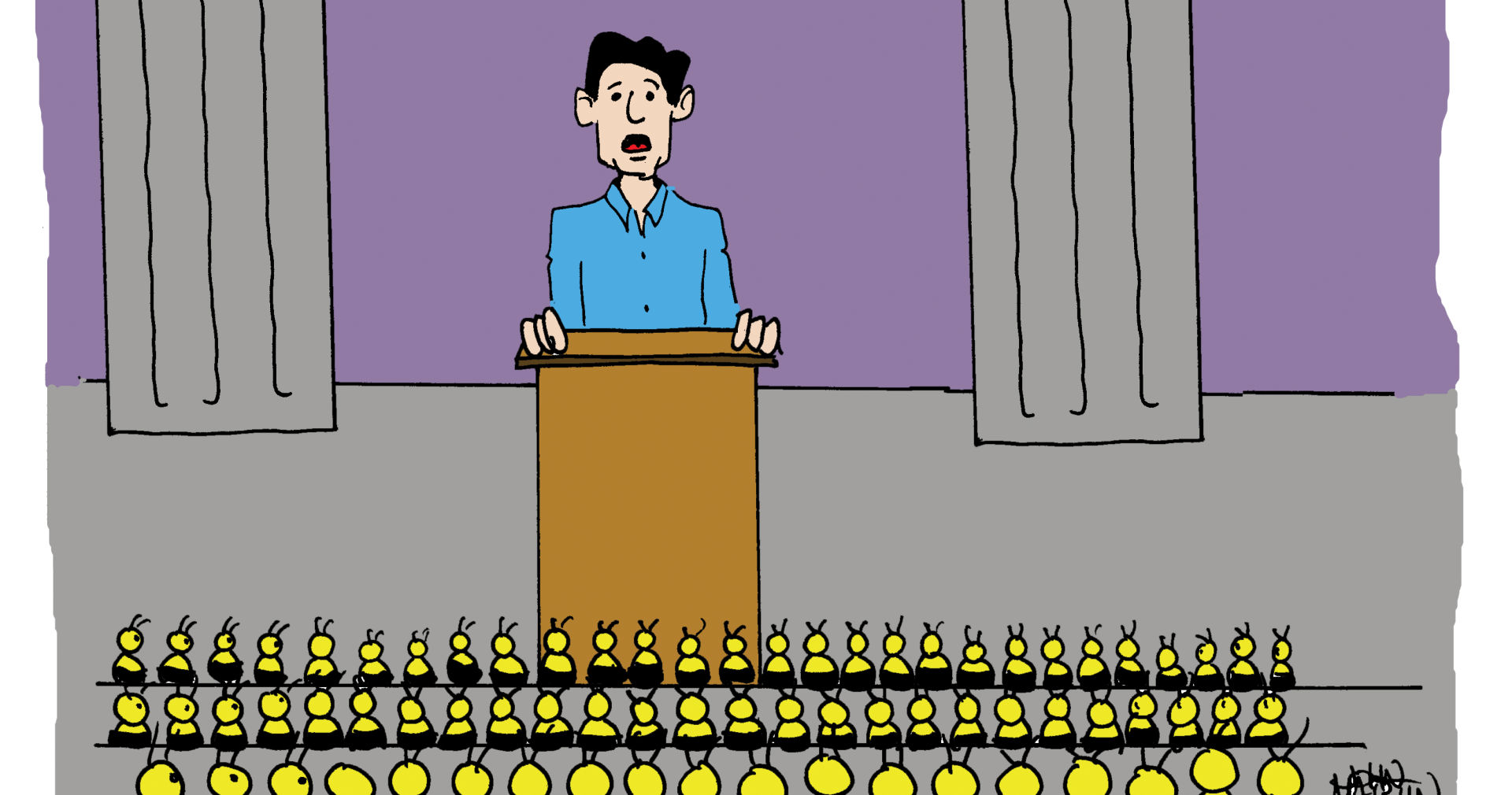
If I had to guess, I would say beekeeping is heavily skewed toward the introverted side of the scale, with the sort of people who feel more comfortable talking to stinging insects than a crowd of colleagues. All lined up on their top bars, watching your every move, bees are a good audience to practice speeches on.
In fact, sometimes I think of bees as a slightly less forgiving Toastmasters group. In Toastmaster meetings, they track the number of filler words you use, like “um” and “like,” in judging your performance. We beekeepers track the number of yelps and four-letter words. Bees provide more or less instant feedback—the millisecond it takes for one to zip from the top bar toward your hand and insert a stinger if your performance is really bad. And some crowds are tougher than others. Currently, I have one hive that is so mean it wouldn’t let you utter the first word before it pronounced judgment. Apparently, they are not big fans of human oratory, or humans for that matter.
For what it’s worth, cows are the best listeners in the barnyard kingdom. Chickens are too easily distracted to care about human problems, peafowl only care about themselves and pigs are so smart they don’t so much listen as psychoanalyze a farmer. But cows gaze at you empathetically and listen with curiosity to even the most banal of human complaints and even the most boring human speeches. They neither give advice nor interject, but merely chew their cud and gaze on non-judgmentally—somehow their big black eyes seem less threatening and intimidating than black screens of Zoom.
That said, I’ve never had a rogue black screen of Zoom grow tired of my drivel, charge toward me, and try to give me a helping horn, so maybe preferring public speaking to cows instead of computer screens isn’t all that rational. Neither is keeping thousands of stinging insects for fun, or talking to them, but I’ve never let that stop me.
