




Click Here if you listened. We’d love to know what you think. There is even a spot for feedback!
Read along below!

Humorous History:
The Life and Times of Triple LLL
By: Stephen Bishop
Lorenzo Lorraine Langstroth was the “Father of American Beekeeping.” He was born to his mother and father, “the Grandmother and Grandfather of American Beekeeping,” in 1810 in Philadelphia. He was the second of eight children, which just goes to show that being second inline isn’t always a bad spot to be in — his older brother quickly abdicated his responsibilities and duties to be the “Father of American Beekeeping,” so it fell on Lorenzo. Lorenzo was said to have had a “keen interest” in insects as a child. His parents took a tried-and-true method of trying to discourage his passion, to get him to play football or whatever sports they had back then, but strangely this only reinforced “his curious interest in the habit of ants.”
You never forget your first love, and for Lorenzo it was bugs. Sure, at the age of twenty-five, he married Miss A.M. Tucker of New Haven and eventually fathered three children, but as is usually the case, the wife and children are merely a sidenote to history, for the man had more important fathering to do, that of American Beekeeping. It should be noted, however, that his wife “helped” him in his experiments with hive designs, which says a lot for her — most wives (or at least mine) forbid their husbands from experimenting with hive designs in their presence. In that regard, Miss A.M. Tucker of New Haven certainly deserves to be called the “Mother of American Beekeeping,” but you rarely hear her credited as such.
Before getting married, Lorenzo attended Yale and majored in theological studies, which sounds pretty highfalutin, but you have to remember that back then Yale pretty much took anybody (at least any white protestant man) who could pay tuition. Lorenzo used his education in theology to become a minister. But it also came in handy in beekeeping, especially when he got stung in the hand, as he was a lot better at resisting the temptation to say bad words. Back then people got stung a lot more because to inspect a colony, you more or less had to destroy a colony and the bees didn’t like that. It was a catch-22 to be sure.
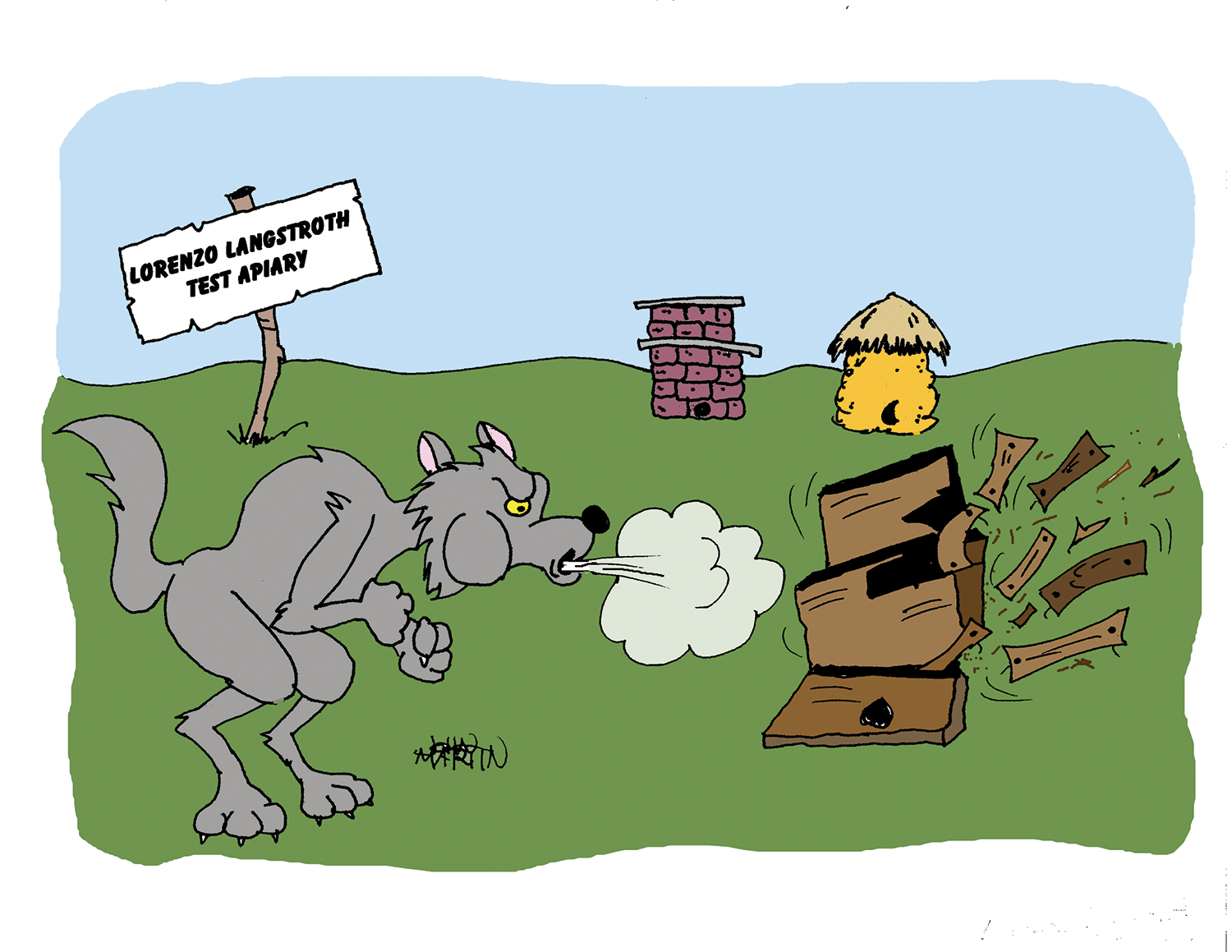
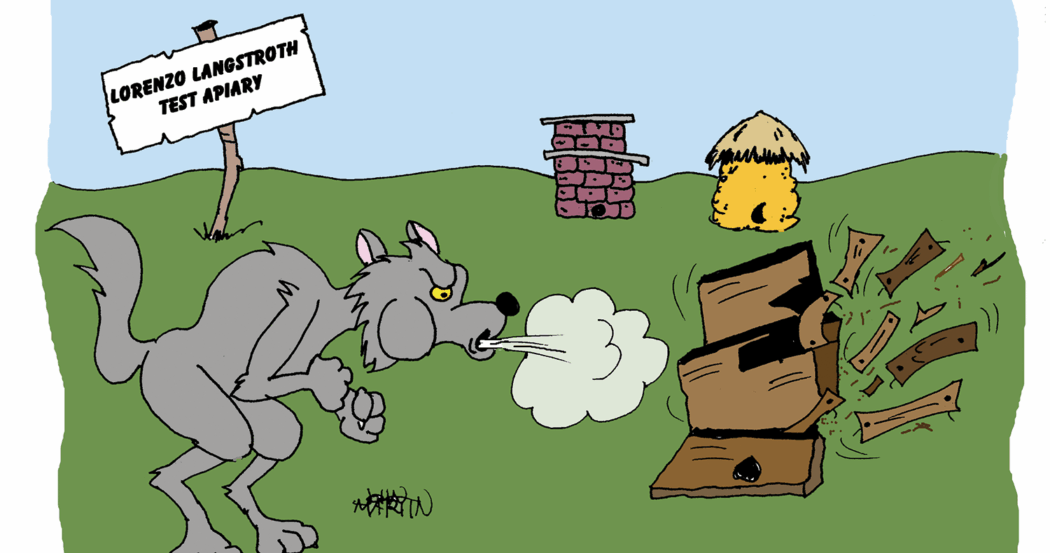
Lorenzo experimented with many different ways to solve the problem of destroying the hive and tinkered with many different hive designs. For instance, in his journal, Lorenzo theorized about brick hives, which never really caught on. Lorenzo eventually settled on a wooden design and received a patent for the L.L. Langstroth Bee Hive on October 5th, 1852. It was a little over-engineered, with a hinged top and little legs like a coffee table, but the hive innards, ten moveable frames, were a breakthrough — that part of his design remains the basis for most modern hives.
Throughout his life Lorenzo struggled with “head troubles,” or what many people now suspect were depressive bouts of bipolar disorder. At times, he could be superhumanly productive — in 1853, he wrote his 400-page tome, On the Hive and Honey-Bee, in six months. At other times, his head troubles were so crippling that he had to resign his ministerial duties. For much of his life, bees were not only his passion, but his refuge. He was a voracious reader of bee books, most of which, at the time, were written in a foreign language. Back then there was no such thing as Google Translate, so he had to figure out the language and translate it himself.
Like many brilliant minds, Lorenzo reaped very little in terms of monetary rewards from his ideas — he spent much time and money fighting off patent infringement. Thankfully, he was a minister and knew that storing up treasures on earth was a fool’s errand. He lived to 85 and died in the pulpit, which is only fitting for a man whose book was considered the bible of modern beekeeping. Such high praise is no small compliment (though maybe a little treasure stored in a sock drawer would have been nice).
If this made you smile (or groan), you’re a good fit for my free newsletter, with weekly musings from the funny side of farm life — subscribe at substack.com/@misfitfarmer.