






Click Here if you listened. We’d love to know what you think. There is even a spot for feedback!
Read along below!
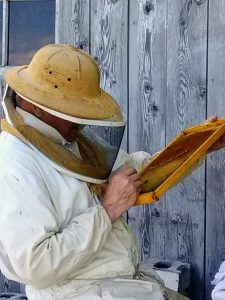
Richard Wahl began learning beekeeping the hard way starting in 2010 with no mentor or club association and a swarm catch. He is now a self-sustainable hobby beekeeper since 2018, writing articles, giving lectures and teaching beginning honey bee husbandry and hive management.
Off the Wahl Beekeeping
New(ish) Beekeeper Column
Robbing and DIY Robbing Screens
By: Richard Wahl
Robbing Season
Honey bee robbing occurs when foragers from one colony decide to invade another colony to steal honey or nectar. Robbing screens alter the main entrance and force the hive owner bees to find a new exit through the new offset opening. The resident bees only require a short time to figure the new exit/entrance route out while robber bees never seem to do so. Robbing activity usually starts during or shortly after a nectar dearth. In my area we had such a dearth this past July through early September as rain totals were far below the normal Summer average. The scent of honey in another hive or exposed spilled syrup can trigger a robbing frenzy. Once a robbing event begins it is hard to stop. I witnessed just such an event for the first time in my own hives this past October. Walking past my hives in mid-morning the first clue was more than a normal amount of dead bees just outside the hive entrance. This is easy to spot in my hives as they sit on a cement pad that extends a few feet in front of the hives. I could also see a lot of chaos and fighting going on just in front of the hive. Numerous bees were seeking an entrance along the junctions of the supers on the hive being attacked. Since it appeared that the attacking bees were gaining a foothold I knew I had to react quickly to save the hive. The weaker colony almost always loses out in this type of fight often getting its stores cleaned out. I did not want to lose this hive as it was one of my better honey producers during the past Summer.
There are another four or five beekeepers within a five mile or closer radius of my hives and since I had just put on internal feeders the day before my assumption was the robber bees were coming from one of the neighboring apiaries. My feeders are all internal frame, top or inverted bucket feeders and all my hives were given sugar syrup in one of these type feeders the day before. The hive being attacked had an inverted bucket feeder covered by an empty deep and the outer cover, so as to prevent just such a robbing event. I have used this hive self-contained feeding system many times before with no observed issues. My thought is that if all colonies are given sugar syrup at the same time they are kept busy retrieving their own syrup for a few days and less likely to go into a robbing event on other hives, but I may be wrong on this. The scent of syrup in other hives may have caused the initiation of a robbing event, but I did not see the robbing bees returning to one of my other hives.
Quick Action Stops the Robbing
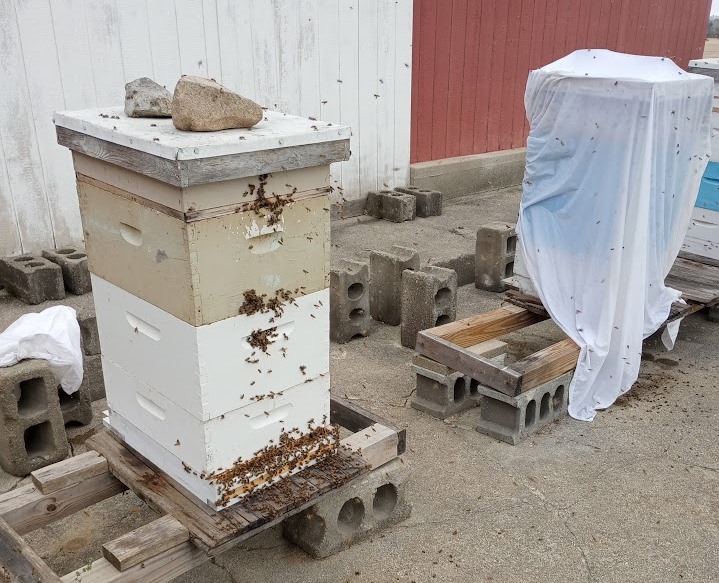
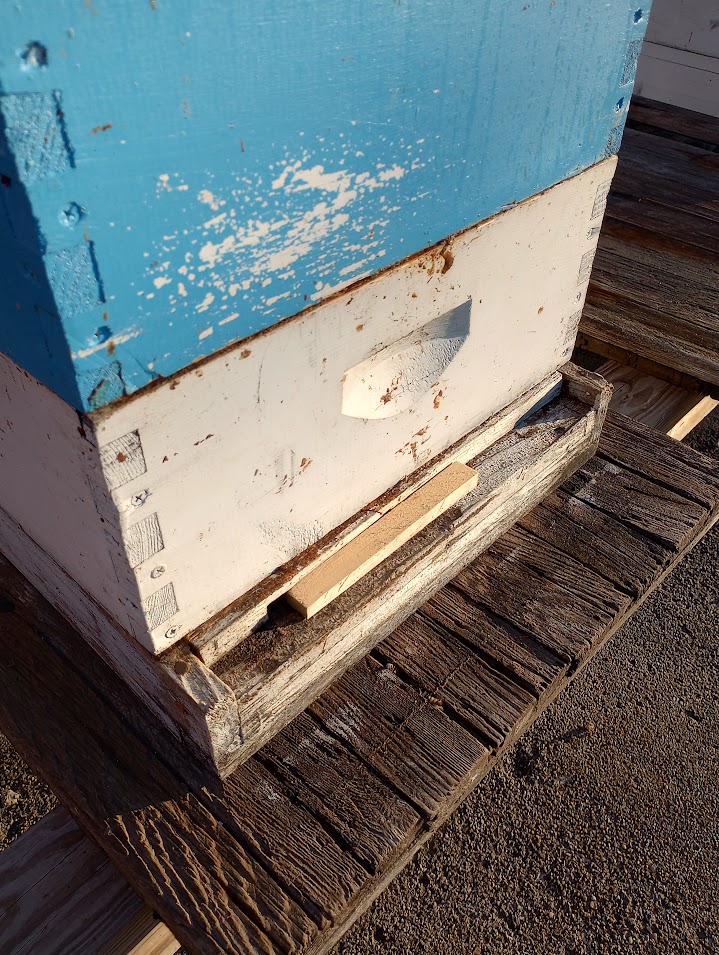
My initial reaction was to stop the robbing and so snapping a few pictures became a secondary concern. Since I had no bee suit on and my hive already had an entrance reducer, I immediately walked back to my garage and grabbed an old white sheet that I had previously used under swarm catches. I placed the sheet on my cement drive, soaked it with water and now with bee jacket and veil on took it to the beeyard. I swept away the bees seeking entrance along super junctions and threw the wet sheet over the hive being robbed leaving only the smallest opening to one side. I could then see that there were numerous attacking bees landing on the wet sheet looking for a hive entrance. This gave the defending bees the chance to fight off only those remaining under the sheet that did not belong to the attacked colony. Although this seemed to resolve the issue for the attacked hive the aggressive bees moved to the next hive a few feet west and began an attack on that hive. I once again got another sheet, wet it down and threw it over the neighboring hive. Realizing the bees might move on to another close hive I had a robbing screen ready for the hive to the east. I also brought out the garden hose and set the nozzle to fine mist aimed upward in front of the two hives with sheets over them. I let the water mist run for several hours. With these three hives now protected and fewer challenging bees continuing to land on the middle wet sheet, it appeared the robbing event had ceased. I left the sheets on for the rest of the day and the next day as things returned to normal activity. Just as a precaution I placed ¾ inch square sticks of wood in front of all my hive entrance reducers restricting the hive entrance to the smallest possible openings.
I continued to visually check on my hives for the remainder of the day. The rainy mist in front of the two hives with wet sheets seemed to discourage any further robbing incentive. Other than the many bees on the outside of the first wet sheet, I saw no other indications of robbing activity. After two days with wet sheets hanging over the middle two hives they were removed and the entrance activity returned to normal. Naturally, I kept a close watch on all the other hives to take action if any additional robbing activity were to take place.
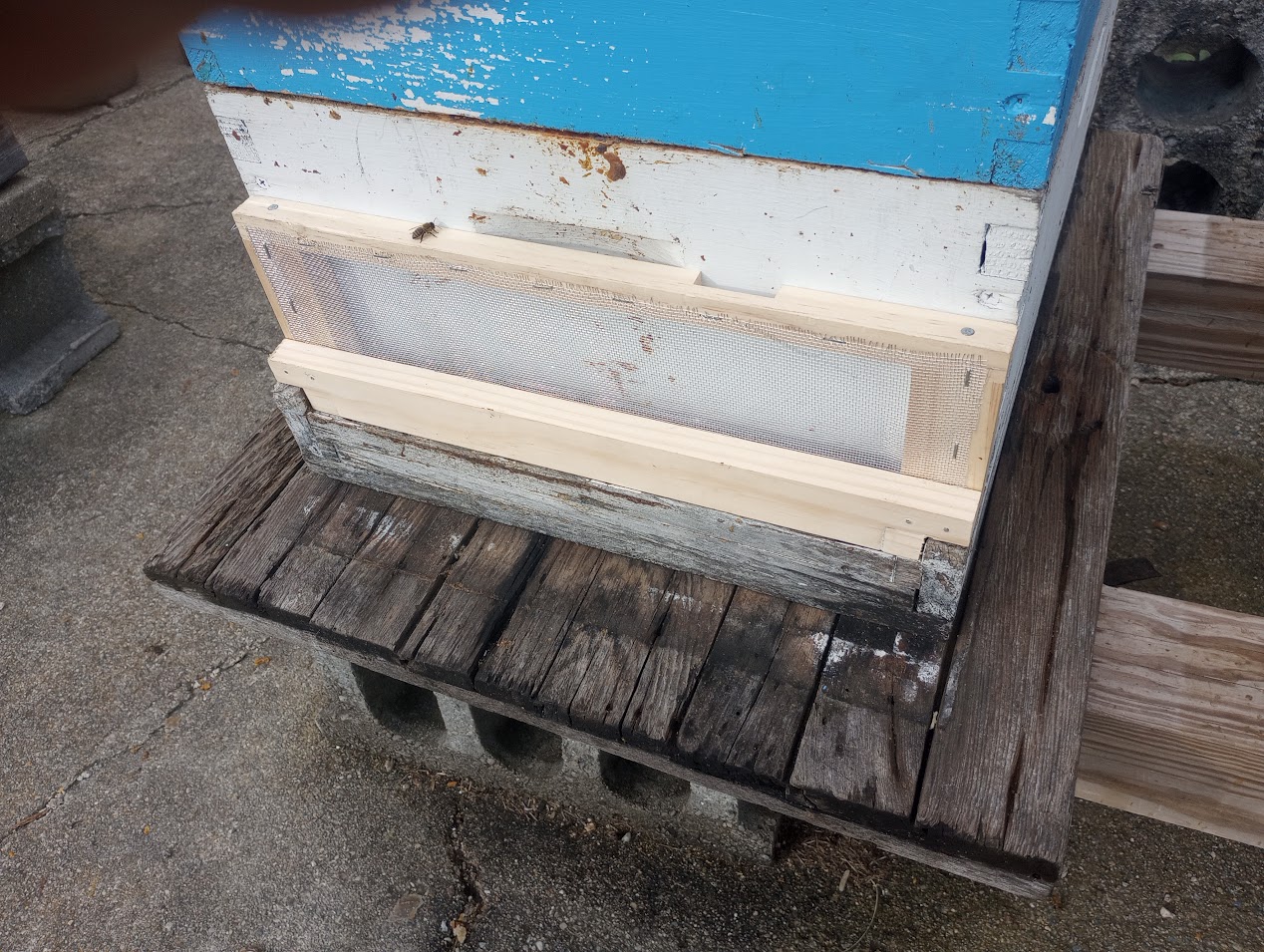
When using robbing screens it is best to place them on hives in the very early morning or late in the evening. At these times any foragers are in the hive and will find a new path out when departing the hive the next time. If robbing screens are placed on mid-day any foragers that are outside the colony will have some difficulty finding their way back in. After all, the purpose of robbing screens is to confuse bees in finding an entrance. If there is a need to place robbing screens on in mid-day it is best to block the entrance in its entirety for a half to an hour or so. Upon reopening the robbing screen entrance, the colony will quickly reorient while the robbers will still be at a loss to find the new entrance location.
DIY Entrance Reducers
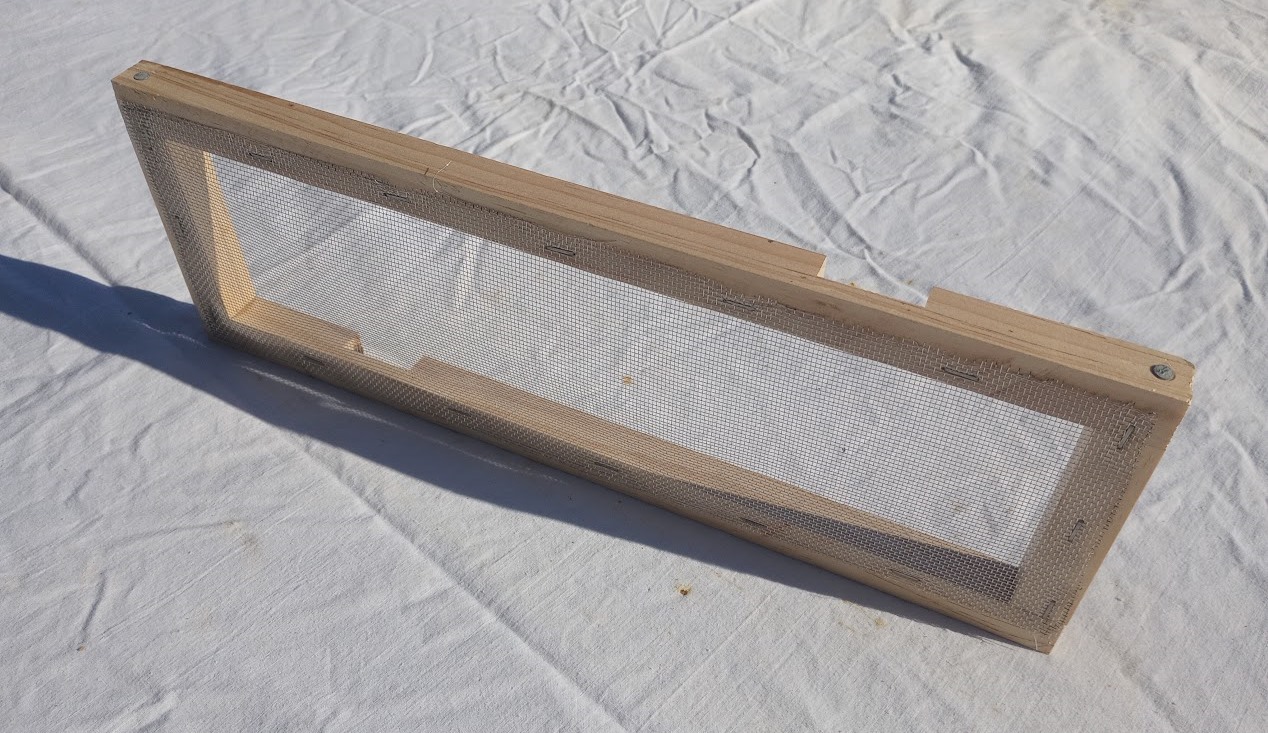
Making a simple entrance reducer is not a hard or time consuming project. All it takes is a few scraps of one inch boards ripped into ¾ inch strips. One inch boards sold at lumber outlets are actually only ¾ inch thick. So you end up with ¾ by ¾ inch pieces of lengths to your choosing. Since the space across the porch entrance is 14¾ inches long, I cut two strips to that length and cut two pieces to about 3½ inches for the vertical posts. Since the distance across the front varied somewhat on my bottom boards, I cut the longer pieces to 14⅝ to allow for slight variations. Cut a notch, called a dado or three sided rectangular channel, about 3 inches in from one end on each long piece that is 1 to 1½ inches long, much like the narrower dado in an entrance reducer. This can be done by setting the saw depth of cut to ⅜ inch and making repeated passes until the desired cut out length is obtained. Assemble, glue and nail the pieces in a rectangle with the dado cuts on the same side but on opposite ends. Cut a piece of window screen or ⅛ inch hardware cloth to the rectangular frame that is about ¼ inch smaller in length and width than the outer rectangle measurement. Staple the screen to the side that does not have the dado cuts.
The length and width of the rectangle and screens are not critical but need to match whatever bottom boards you are using. Since different manufacturers of bottom boards may vary slightly in dimension, measure before cutting the lengths to ensure a proper fit. If entrance reducers are to be left in place be sure the dado on the robbing screen is in a position that matches the entrance reducer opening in order to not completely block the bee’s entrance/exit location. If there is a concern about the robbing screen staying in place due to wind or curious critters a wood screw can be pre-located in the top center of the screen to fasten it to the hive super.
Alternate Designs
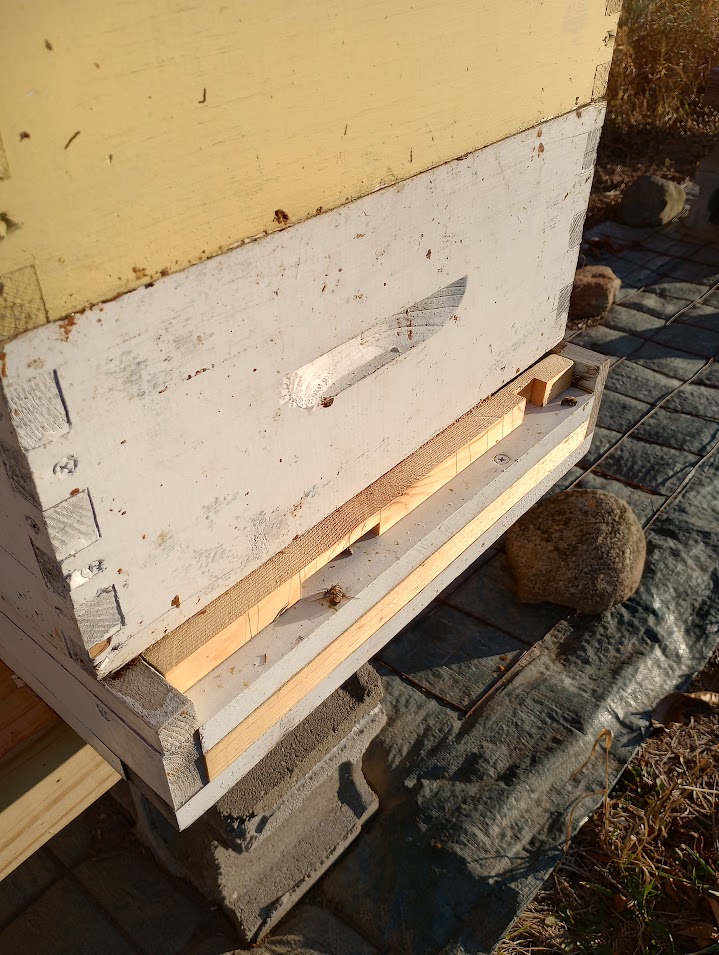
Robbing screens can easily be made to fit any style hive or cut to fit alongside Boardman jar feeders. Just eliminate the length a jar feeder would take and cut lengths accordingly. In my case I like to place entrance reducers so they are not flush with the front of the super above. Allowing the entrance reducer to only be partially pushed into the bottom board entrance makes them easier to remove once the bees have sealed them in with propolis.
This reducer removal will be required for those Winter dead bee bottom board cleanouts that may be necessary every other month or so during Winter, at which point robbing screens are no longer needed. My alternate design allows two inch wide vertical side pieces to rest on the extended bottom board rails that support the super and yet leaves enough space for bees to exit and enter. In this case the robbing screen is stapled to the front three sides of the top and vertical pieces and to the back of the bottom strip which has ¾ x ¾ inch cutouts to accommodate the bottom board rails. Again, care must be taken to ensure the entire entrance reducer/robbing screen combination does not completely close off the entrance opening. Any number of variations to the above designs can be made to fit your particular hive or nuc set up.
Wrap-up
Having robbing screens available and using them at the appropriate times, during a Summer dearth or preparation for those Fall months when nectar is often in short supply, may discourage the initiation of a robbing event. Robbing screens can also be beneficial when used in the Spring after colony splits when weaker nucs may be near strong colonies. Various alternate designs can be made to accommodate smaller nucleus colonies or bottom boards of any width. A simple bent piece of ⅛ inch hardware cloth the width of the open entrance with an offset top cut out can work equally as well. Entrance reducers could be attached to the bottom of any type robbing screen to be removed and replaced as a single piece. Be creative and design them to fit your needs. This would be a great Winter project requiring little time and a few basic materials.
Although a robbing event may not be witnessed, it can be recognized by no bees left in a hive and numerous wax bits remaining on the bottom board and perhaps many dead bees just out front of the hive. I had several entrance reducers on hand but I had not put them in place since I had never before, to my knowledge, had a robbing incident and only once in years past found a hive with no bees. The smaller opening using entrance reducers left on my hives all season had seemed enough to curtail any robbing. Each year we tell students in the beekeeping class I co-teach to place entrance reducers on in late September to early October just in case. This was one of those cases where do as I say, not as I do came into play indicating I should have followed my own advice.
Richard Wahl began learning beekeeping the hard way starting in 2010 with no mentor or club association and a swarm catch. He is now a self-sustainable hobby beekeeper since 2018, writing articles, giving lectures and teaching beginning honey bee husbandry and hive management.