






Click Here if you listened. We’d love to know what you think. There is even a spot for feedback!
Read along below!

Beeswax and Candles
A Hive Byproduct
By: James E. Tew
A cool season bee project
It is late mid-Winter, cold and snowy. My apiary is loudly quiet. No bees flying, no birds singing, no noisy insects – just cold and quiet. What to do? Reflect about last year or anticipate next year? As I recently stood in my bee yard, I decided to do some of both. In a friendly way, the Winter bee yard is lonely, reflective place. It always offers hope for the Spring season that is just a few months away.
My small honey crop has been processed and is history. I got an okay crop – not great. I have told you about all those swarming and supering adventures in previous ramblings. For the most part, my small wax crop has been rendered and is in storage as rough-rendered cakes. I’ve been accumulating small amounts of wax for several seasons. Now that things are so quiet with little bee yard work to do, it seems appropriate to turn my energies back to my small wax crop.
Beeswax Production
Beeswax is produced as a highly vaporous liquid by four pairs of glands on the bees’ bottom side. The liquid wax flows onto eight “mirrors” or shiny plates where it rapidly hardens into small, white flakes. Strangely, bees often drop these flakes where they can be seen accumulating on bottom board. Seemingly, they are not retrieved.
These discarded wax scales are an indicator that a nectar flow is underway. The wax-secreting bee uses a long spine on her middle leg to pass the crumbly flake to the front legs where it is chewed, hardened a bit, and then – using jaws that look like a couple of cement workers’ trowels, it is molded in the familiar new comb that beekeepers have seen in past Spring seasons.
Wax is produced only when storage comb is needed. That is usually during Spring and early Summer in most parts of the USA. Since it takes about 8 pounds of honey to produce one pound of wax, it is a building material that bees do not produce unless it is needed. When a hive becomes packed with honey and nectar, returning field bees, loaded with nectar have no place to unload. During these times, even the house bees’ internal storage structure (the crop) is filled with nectar. Bees that are of the right age, forced to hold surplus nectar, will involuntarily secrete wax. The beekeeper cannot make bees secrete wax – short of feeding heavy sugar syrup. Before the major flow starts, be sure to give colonies the space they need BEFORE they need it.
At this point in the crowded hive, the bees do one of three things:
- If the hive is not given extra space, they do nothing. So, part of the honey crop is lost.
- In early Spring, crowded bees will swarm and again, part of the honey crop is lost.
- The colony is given extra space, so it can build comb and continue to grow and store surplus honey.
Processing Beeswax
Melting down beeswax is a pleasant process. Beeswax has an agreeable aroma. However, beeswax is highly flammable and can result in a quick, hot fire. In many commercial beekeeping operations, the wax rendering facility is a separate building from the main facility. Beeswax melts at 147° F and molten wax floats on water.
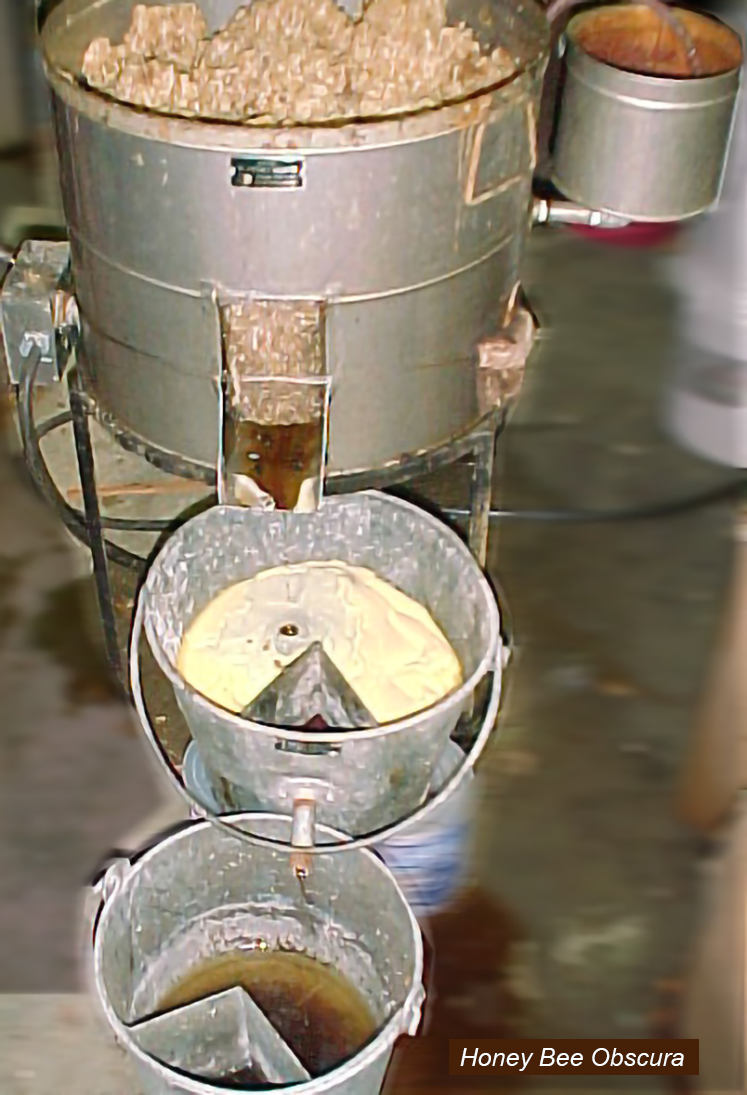
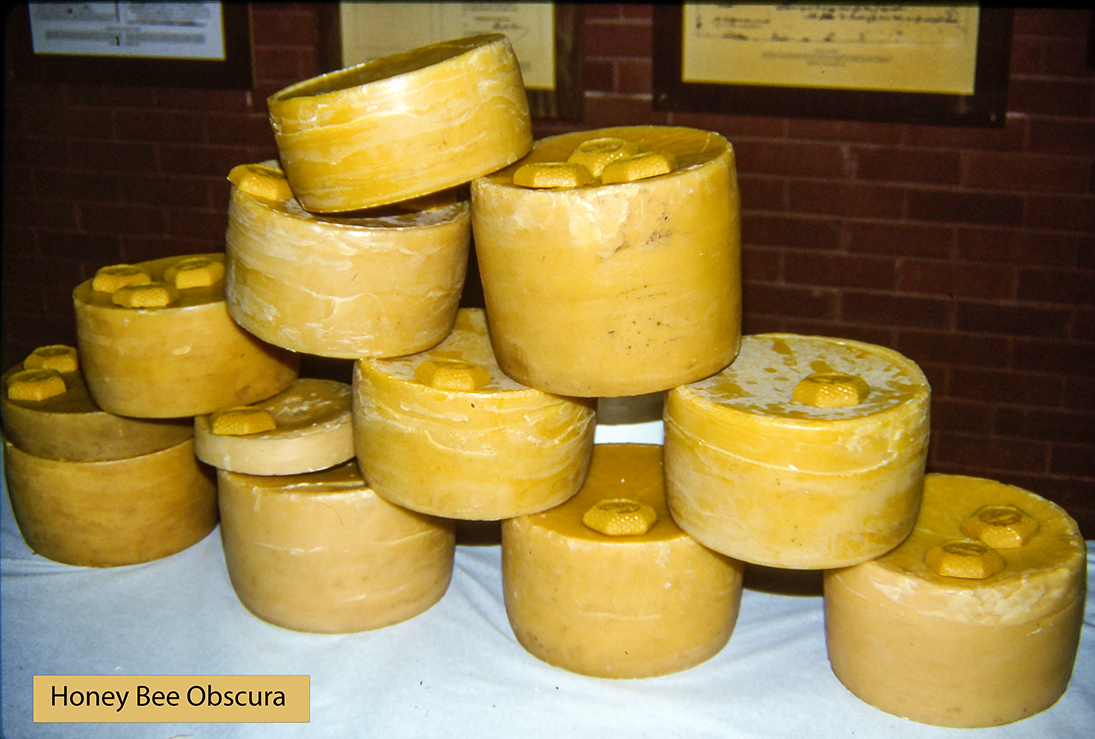
Beekeepers having only a few hives can render a small amount of wax in a double boiler where it can be ladled off and allowed to solidify into molded beeswax cakes. For larger operations, there are many models of melting devices that can be used to melt beeswax. Though most of these devices require hot water to accomplish wax rendering, some wax melters use hot air as the heat source. Wax is extremely durable and stable but will readily absorb residues from surrounding chemical sources.
A popular melting device for the hobby beekeeper is the solar wax melter. It is primarily a box, painted black on the outside and white on the inside with a glass covering. The box is normally tilted for melted wax to run out into a collection pan. Many times, discarded refrigerators with the door replaced with a double glass cover have been modified into solar wax melters. Other beekeepers have put their melters on pivot posts to have the melter always facing the sun.
Though solar wax melters are extremely cheap to use, they are inefficient. Probably only about 50% of the wax is recovered from a solar melter. Additionally, old hard combs are nearly impossible to melt in solar melters.
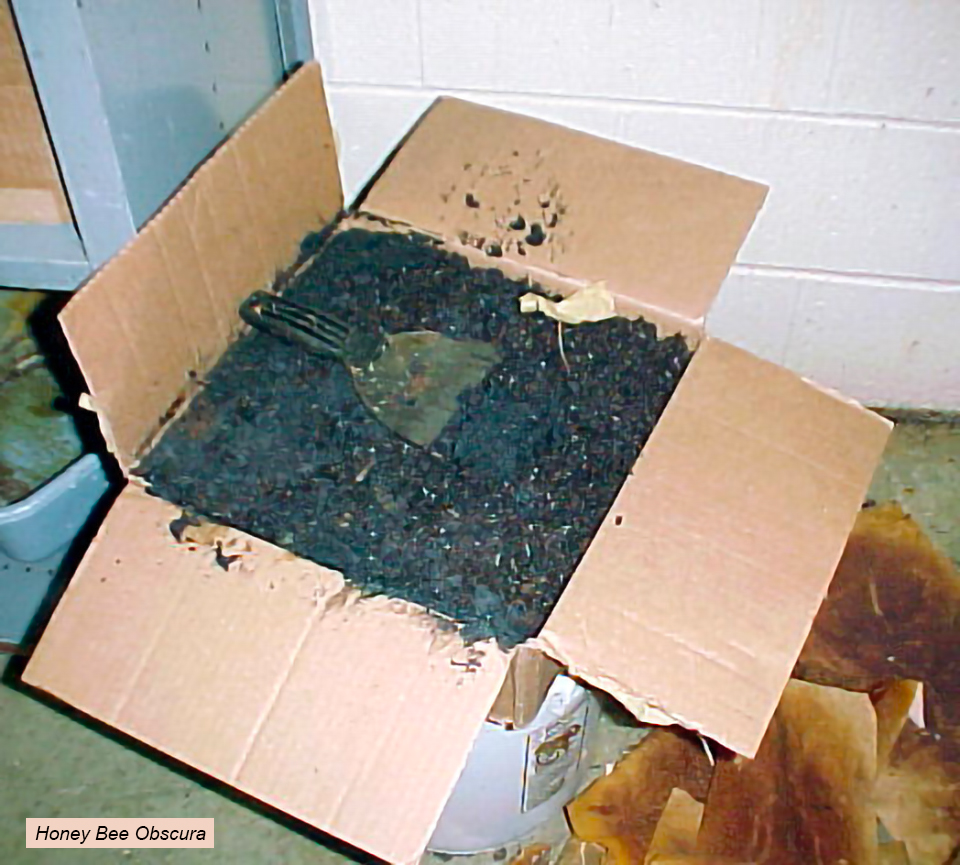
Slumgum
Slumgum is that ugly residue that clings to the bottom of a rough-rendered cake of beeswax. It is made up of everything that is not honey and wax – though it does include a significant amount of wax. As it builds up inside the melter, it begins to form an insulating layer between the heat and the wax to be rendered. Melters require frequent cleaning – a messy job. Having a large content of cocoons and hive litter, the dark slumgum can be pressed under pressure to yield more wax, but pressing devices are rarely available to hobby beekeepers. Other than being an excellent fire starter for Wintertime fires, slumgum has little use. Neither is it attractive to bees or wax moths.
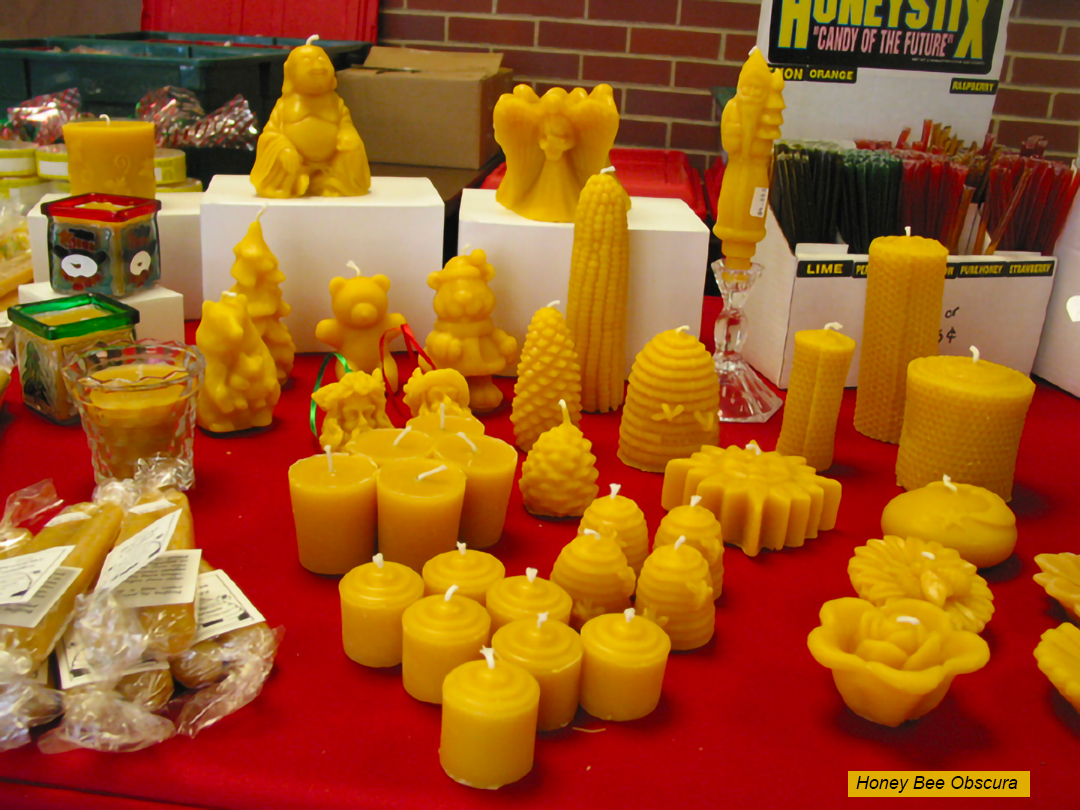
In years past, the production of beeswax candles was a prominent reason for keeping bees. Even today, beeswax candles are high quality candles that are nearly smokeless and dripless. Candles can be either poured or dipped. Poured candles are generally smoother but may not have the character that hand-dipped candles have. Though still available as new devices, antique candle-pouring molds are frequently seen in antique shops and are expensive. Candle making is an aspect of beekeeping that many people do without ever owning a hive.
The Candle Wick
Clearly, a wick is required for a candle to burn. The wick absorbs the wax in a liquid form and burns the molten beeswax absorbed by the wick. Too large a wick and the candle sides burn out from excessive heat, while too small a wick results in a hole burning down the center of the candle until the flame is extinguished. All wicking today is braided. When burned, braided wicking curls to one side and does not require frequent trimming (snuffing). Wicking can be purchased from candle supply stores or from craft shops. Specify the diameter candle to be made when you purchase wicking.
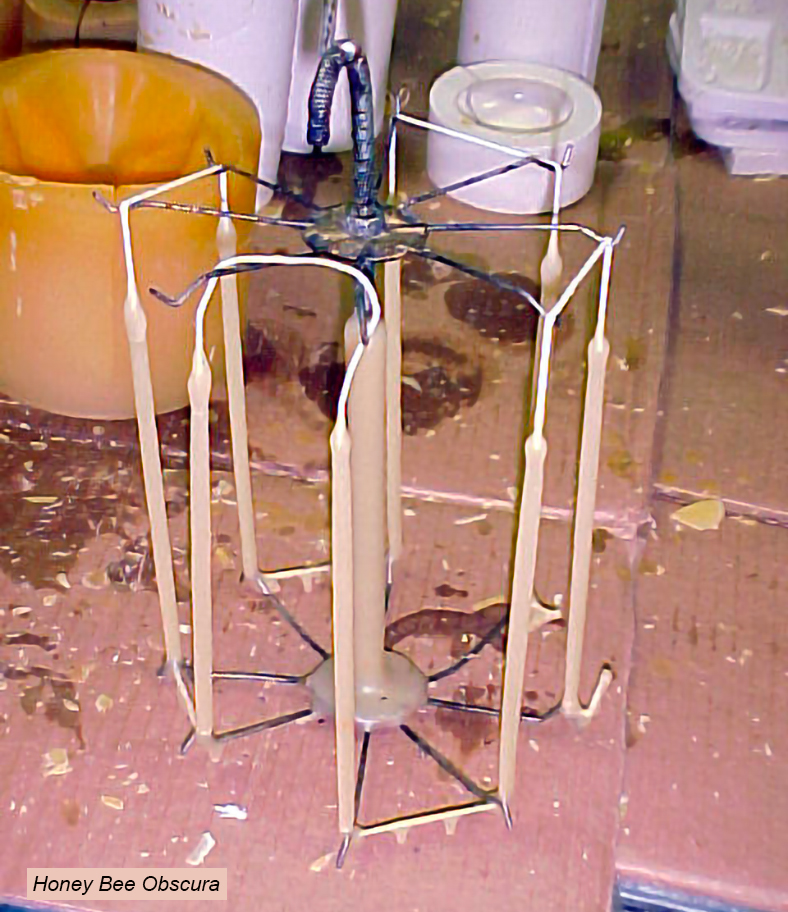
Hand-Dipped Beeswax Candles
Again, always remember that beeswax is highly flammable. When making simple hand-dipped candles, liquefy enough beeswax to yield the length of candle desired in a non-ferrous container. Attach a weight to the end of the wicking and dip the weighted wick into the molten wax to the depth desired. Pull the wick from the molten wax and wait a few seconds for the hot wax to solidify. Then dip and wait, dip and wait until the desired size candle is produced. This procedure does not guarantee a perfect candle, but a functional candle will be dipped.
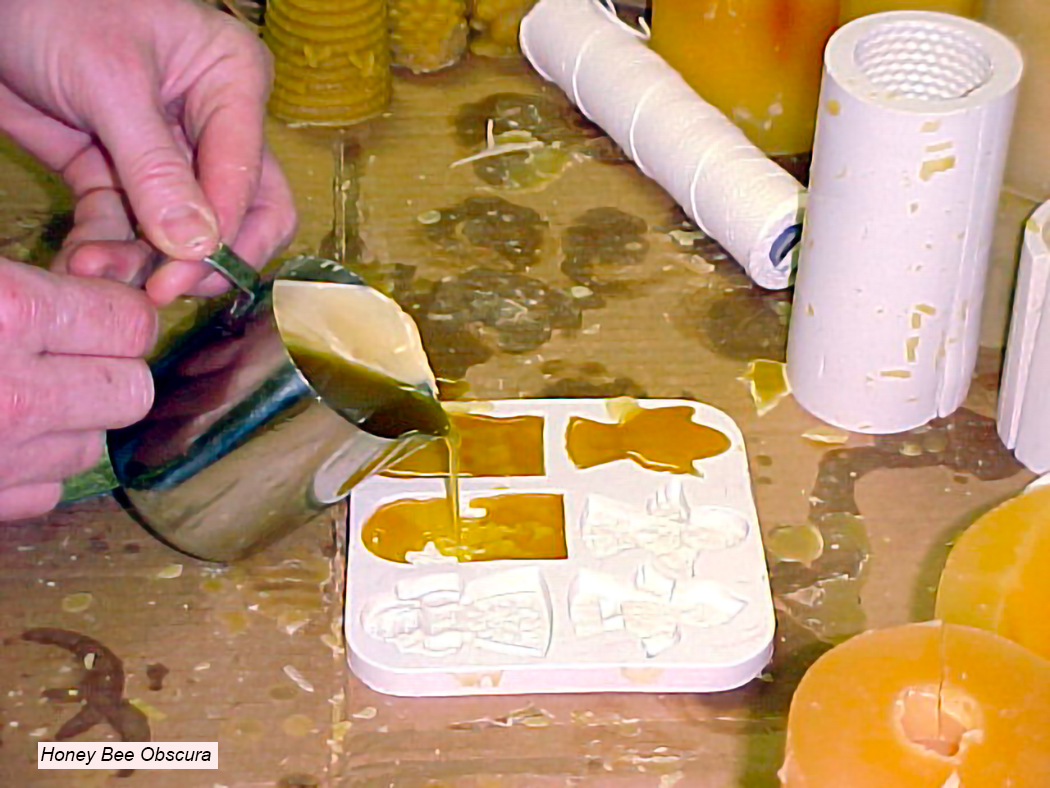
Poured Candles
Depending on the mold, either tin or rubber, thread the wicking through the mold and pour the molten wax into the mold. Craft stores sell a candle release compound so the wax will not stick to the mold. After thoroughly cooling, open the mold and remove the candles. In many cases, poured candles will be attached by the wicking and will require cutting the wick to get two separate candles.
Beeswax Foundation Candles
Beeswax foundation, as is used in frames, can be rolled around a wick to produce a beeswax candle. This candle will burn more quickly than either a hand-dipped or poured candle but does not require any heat or molten wax. Candle sheets come in a variety of colors and are easy to make.
The End of the Year
Finishing the wax crop and pouring a few candles really is the end of the past beekeeping year. Life in the hive goes on. Next year will be more of the same, but with continual improvements. Next year, healthier bees, more honey, fewer swarms, and more stories. I’m planning already.
Some rogue beeswax thoughts
Beeswax is always an ancillary hive product. I have never known of a beekeeper who kept bees strictly to produce wax. Think about it…a colony only produces new wax under the stimulus of incoming nectar. By default, the colony will only produce the wax it needs to store converted nectar. You can’t really get much beeswax without that stimulus. True, there is some wax in the brood comb, but it would be nonsensical to destroy brood combs simply for the wax.
What follows is a Jim Tew conversation about beeswax and mead. I have no science to confirm my speculation, but early bee people would wash wax to remove the residual honey before processing into wax cakes. I wonder if that washed wax water was part of the reason that a long-forgotten person noticed that the sugar/wax water fermented into a product that later became mead? I wonder, once that was noted, mead makers went straight to honey dilution for mead production. I’m only speculating.
Though wax has always had many uses, one of the early primary uses was for evening light – a candle. Ironic isn’t it that modern beekeepers are still desiring beeswax for candle production.
At all three of my daughters’ weddings, I produced beeswax candles for their ceremonies. They were high quality, dripless candles that were pricey for me to produce. All through the ensuing years, these wedding candles had a second life as emergency lighting when electrical power supplies failed.
Another short conversation, also without literature citations, is why beekeepers have never found practical uses for slumgum. I know that it makes a great fire starter but other than that, it seems to serve no purpose. This wax waste contains a significant amount of propolis along with spent cocoons, and maybe some pollen. Yet, we just burn it up. Come on beekeepers, there must be something that can be done with this waste product. Has it never found purpose simple because it so visually unappealing?
Though I have never done it, I wonder if could I gather the wax scales that were dropped to the bottom board along with all the other colony detritus and dump it into water? Would not the wax scales float to the top while the residue sank. What remains would be a very small of amount of high-quality virgin beeswax that would be brilliant yellow when processed. I just always dump it on the ground as I scrape the bottom board. I wonder…?
There are hundreds of uses for beeswax. I did not even try to list them but one of the interesting ones was that beeswax was used as a waterproofing product in both world wars and for lubricating bores of big guns. During both wars, beeswax became strategically valuable. Many countries ran collection drives or encouraged beekeeping to meet the demand. In the U.S. and U.K., civilians were urged to turn in surplus beeswax for the war effort, much like scrap metal and rubber.
All-natural beeswax will develop a crystalline “bloom.” That’s actually a good sign if one is needing pure beeswax. Briskly wipe the grayed wax with a cloth to polish the wax back to a bright shine. This wax characteristic is harmless.
Finally, I came up with a beeswax use that I have never heard before – I use small chips of beeswax to lubricate the hinges on my Case 3-bladed Stockman pocket knife. After laying a small chip on the hinge, using gloves, I use a heat gun to melt the wax into the knife’s hinge mechanism. The blades open smoothly for about a year and does not collect pocket lint the way a drop of lubricating oil does. Don’t burn your hand.
I’m done.
I like beeswax as a unique hive product. Nearly anything can be done with this limited hive product. It’s use makes a great Winter distraction. Thank you so much for reading to this point.
Dr. James E. Tew
Emeritus Faculty, Entomology
The Ohio State University
tewbee2@gmail.com
Host, Honey Bee
Obscura Podcast
www.honeybeeobscura.com