


Click Here if you listened. We’d love to know what you think. There is even a spot for feedback!
Read along below!
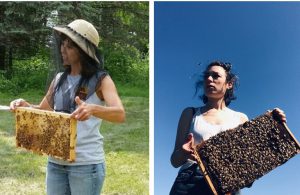
Becky Masterman earned a PhD in entomology at the University of Minnesota and is currently a host for the Beekeeping Today Podcast. Bridget Mendel joined the Bee Squad in 2013 and led the program from 2020 to 2023. Bridget holds a B.A. from Northwestern University and an M.F.A. from the University of Minnesota. Photos of Becky (left) and Bridget (right) looking for their respective hives. If you would like to contact the authors about virus stories, please send an email to mindingyourbeesandcues@gmail.com.
Minding Your Bees and Cues
Declan Schroeder, Virologist
By: Becky Masterman & Bridget Mendel
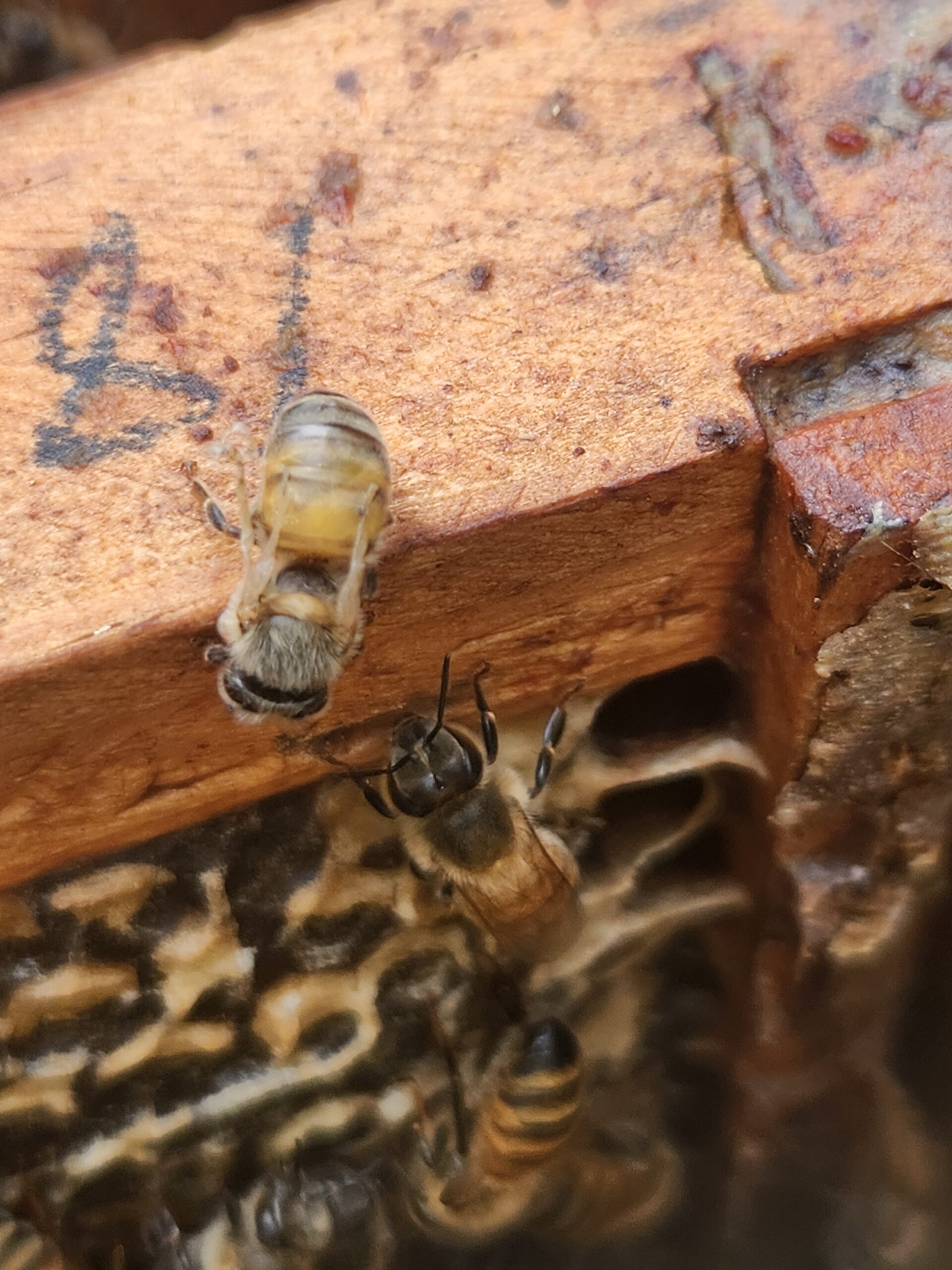
Schroeder and the UMN Bee Lab and Squad investigated the native bee researcher concern about disease spillover from honey bee colonies to bumble bees through spillover transmission on flowers. Their work looked for and did not observe evidence of virus transmission, like deformed wing virus, moving from honey bee colonies to bumble bees. Photo credit: Rebecca Masterman
This month, we spoke with Declan Schroeder, Associate Professor of Virology in the University of Minnesota’s College of Veterinary Medicine. For over 20 years, Schroeder has studied viruses. After talking with him, one begins to see the world as he does: viruses not as frightening diseases, but as the ancient, constant, and invisible companions of living systems. To Schroeder, viruses tell stories about migration, encounter, and climate; they help us understand the present moment, and anticipate how the future will unfold.
With over two decades of research experience in virology, biodiversity, pathology, and genomics, Schroeder has applied genomic tools to explore biological processes across an array of host-virus systems, from algae to honey bees. Lately, his work has focused on a newly identified virus resistance mechanism in honey bees
Q: How did you get into virology?
A: I’ve always been fascinated by how viruses interact beyond the level of the individual. My training was in molecular biology: genes, how they’re structured, how they function. But my ambition was always to look at the bigger picture: how viruses move and behave at population levels.
Viruses are invisible, so genomics is really the only way to “see” them and understand how they evolve with their hosts. I’ve always been drawn to systems we know little about, like algae. What can they tell us about human and plant diseases? As it turns out, quite a lot. Some of these systems are more connected than we think — algae, honey bees, humans. We’re closer to each other than we realize.
Now, at the University of Minnesota’s College for Veterinary Medicine, I am finally focusing on more applied systems like honey bees, swine, dairy cows and poultry. I’m interested in how viruses evolve and in doing so move within populations and how they interact with other parts of a system.
Q: How is your work with bees similar to or different from working with other animals?
A: Viruses are not an alien species; they might actually be one of the sources of life on Earth. They share a common ancestor, a common way of doing things, and then they specialize and adapt within different hosts.
The challenge is figuring out what’s specific to honey bees and what’s common across species. What’s unique about bees is how certain viruses cause disease within colonies. The social interdependent system of a colony makes everything more complex.
Q: The idea of “virus spillover” has become more familiar since COVID-19. How does that play out with bee viruses?
A: The concern is similar across systems. When a virus moves into a new species that hasn’t evolved to cope with it, that can disrupt the normal host-virus relationship. This happens for many reasons: exposure to new species, climate change altering species ranges, landscape disruption, overpopulation of a vector. Really, by any disturbance of a system’s balance.
A good example in bees is the Varroa mite. It’s an incredibly efficient vector. It removes a lot of the randomness in viral transmission and accelerates how quickly viruses move through a population. With that much being transmitted, even viruses that have been with honey bees for ages can decimate a colony.
Q: What led you to focus on bee viruses in particular?
A: Before Colony Collapse Disorder first emerged, the role of viruses was minimized. But a few years later, there was renewed interest as honey bees once again experienced dramatic die offs. And people were starting to consider the idea that honey bee viruses could be transmitted to native bumblebees, which are mostly wild therefore and even harder to study than honey bees.
At the same time, new sequencing technologies were becoming available, and suddenly we could identify new viruses and look more closely at how they behave. That opened a new chapter in understanding pollinator health.
Interestingly, once the possibility of virus spillover was raised, the bumblebee community took it up and ran with it. And the threat of honey bee virus spillover was linked with, and even overshadowed, other threats like habitat loss and climate change. The concern was that honey bee colonies placed near native bee habitat could essentially lead to bumblebees getting honey bee viruses via shared floral resources.
It interested me because intuitively it wouldn’t seem that the viruses that had evolved with honey bees would do well in bumblebees, or that flowers would be an efficient vector, but, there was also no good data either way.
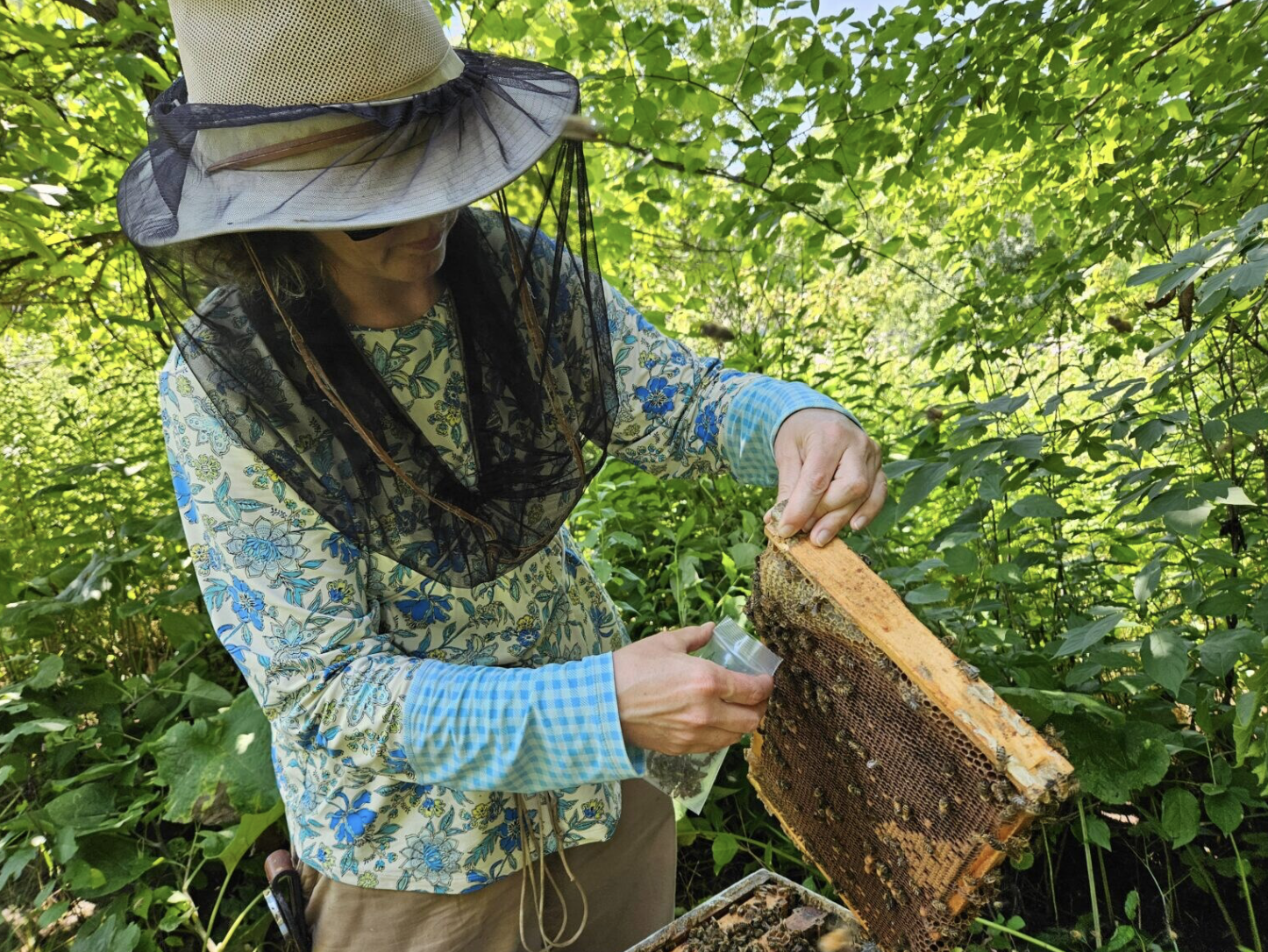
UMN Bee Squad Director, Jessica Helgen, collecting honey bees for virus screening during the pathogen spillover project. Photo credit: Clara Costello
Q: When you set up the pathogen spillover study, you tested and virus-profiled dozens of colonies monthly for multiple seasons. Your team simultaneously collected bumblebees on flowers at various distances from the apiaries each month, and tested those for viruses. You didn’t find any spillover between species. What does this mean?
A: When we looked at whether honey bee viruses were spilling over into bumblebees, we measured everything — number of colonies, distance to floral sources, and so on. None of it mattered. What mattered was that the viruses in honey bees and bumblebees were distinct.
That was an important realization. We’d been thinking of bumblebees as these victims, but they’re not. They have their own viral worlds, their own dynamics. Our eyes were off the ball. We need to study bumblebees as bumblebees and understand their specific challenges.
Q: Where are we with honey bee virus research?
A: I’d say we’re emerging from the dark ages of bee virology. New technology has completely changed what we can see. We’re now able to think at the colony or even apiary level, instead of just focusing on individual bees.
In other agricultural systems like swine, poultry, or cattle, biosecurity is highly developed. With honey bees, there’s still a lingering belief that they’ll “take care of themselves.” But in today’s world, that’s not realistic.
Q: For beekeepers, what are the practical reasons they should understand which viruses and viral strains are present in their bees?
A: A clear understanding of what’s happening in your colony brings you closer to the truth. It takes you beyond subjective interpretations of symptoms or signals.
Think about influenza: we have to know how the virus is changing in order to develop effective vaccines. The same applies here. Sequencing tells us how bee viruses are evolving and spreading.
For the first time, we have the tools to stay up to date with how disease is manifesting and changing in real time. We shouldn’t be trying to “fix” viruses from 40 years ago; we need to understand and respond to what’s happening now.
“We’re closer to each other than we think.”
Declan’s work underscores a shared truth: every living system is connected through the invisible world of viruses. Understanding those threads and how they move, adapt or evolve, and shape the world can help us navigate the ecological challenges ahead.
Reference/Resource
McKeown, D. A., Evans, E., Helgen, J., Warner, J., Zimmern, R., & Masterman, R. et al. (2025). Distinct virome compositions and lack of viral diversification indicate that viral spillover is a dead-end between the western honey bee and the common eastern bumblebee. Communications Biology, 8, 926. https://doi.org/10.1038/242003-025-08351
Check out the December 2025 Beekeeping Today Podcast episode featuring Becky and Bridget’s interview with Declan Schroeder at www.beekeepingtodaypodcast.com