



Click Here if you watched/listened. We’d love to know what you think. There is even a spot for feedback!
An Interview – Dr. Joerg Mayer
Current President of the HBVC
By: Tracy Farone
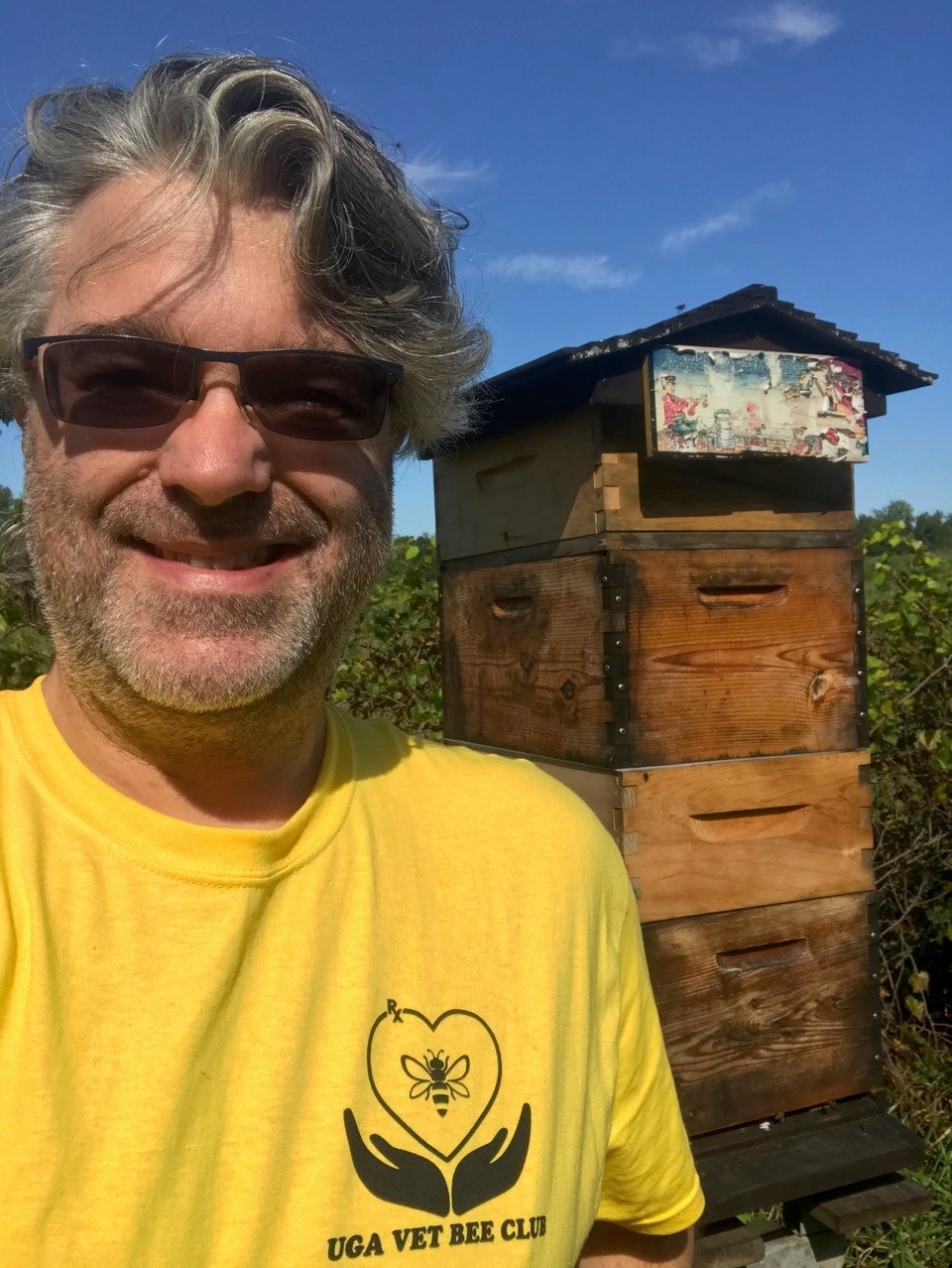
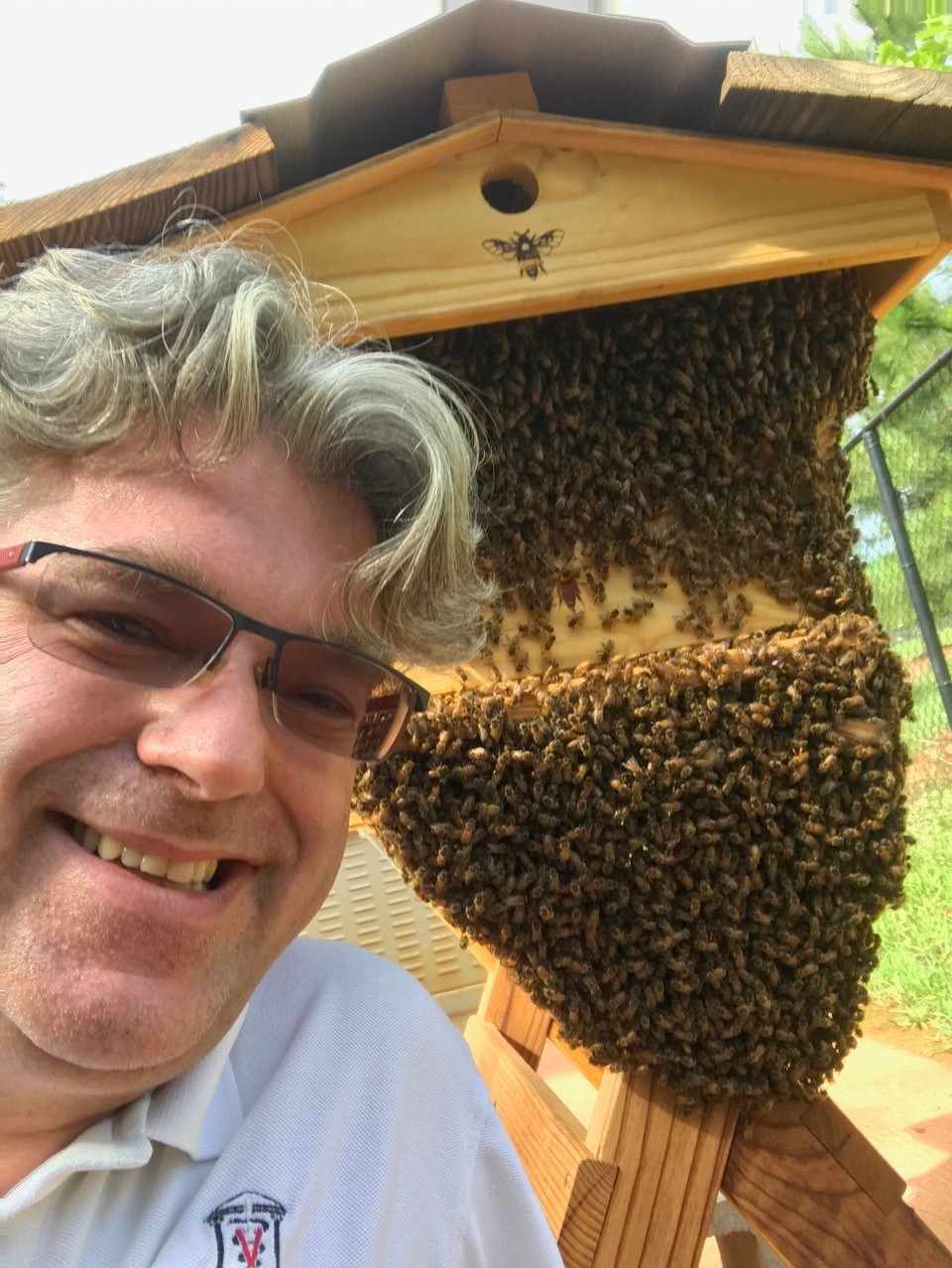
This month I had the opportunity to switch things up, play the role of reporter, and interview a colleague of mine, who has had a very interesting career and is now devoting much of his time to the service and study of the honey bee, Dr. Joerg Mayer. Here’s a brief background on Dr. Mayer and highlights of our conversation.
Dr. Mayer grew up in Germany where he received his primary education. He went to Budapest/Hungary to study veterinary medicine shortly after the “iron curtain” fell. During his studies, he was fortunate to be able to work with veterinarians in South Africa and Namibia for 6 months. He always had a strong interest in exotic animal medicine. After he received his doctoral degree from the University of Budapest/Hungary, he went to the USA for an internship in ‘Zoological Medicine and Surgery’ at the Roger Williams Park Zoo in Providence, RI. At the end of the internship, he was part of a research team to study wild tree kangaroos in the rain forest of Papua New Guinea for 3 months. After this exciting experience, he went to the Royal Veterinary College in London, England to study for his Master of Science degree in wild animal health. The masters project which focused on lead toxicity in the common loon, brought him to the Tufts Wildlife Clinic in the USA. There he was hired to serve as a clinical associate professor and as the head of the clinical service for exotic animals. After 10 years at Tufts University, he moved to Athens, Georgia in 2010. He currently is a Full Professor in Zoological Medicine at UGA.
He lectures regularly at large national and international conferences on all aspects of exotic animal medicine including Honey Bee Medicine. Dr. Mayer qualified with the first batch of specialists in Exotic Companion Mammals as a Diplomate of the American Board of Veterinary Practitioners, in addition he is also a Diplomate of the American and the European College of Zoological Medicine. He served as the president of the Association of Exotic Mammal Veterinarians from 2010-2012. Since 2012 he is also an International Fulbright Specialist in Zoological Medicine. In 2025 he received the status of being certified in honey bee medicine by the Honey Bee Veterinary Consortium.
Q1: Can you explain your current work/position and how it relates to both veterinary medicine and honey bee?
A: “In a nut shell, I generally tell people, our patients are animals that are like a pet but not the typical cat or dog. Sometimes it (our work) can be with some zoological species…like this week, we (worked on) a black bear…a deer…and an emu. So, it can range from a gold fish to a rhinoceros.”
a.) What’s the hardest part of your job?
A: A challenge is what draws us into this type of profession. A lot of times we have to “MacGyver” things. Like how do you ventilate a Toucan, can you make something out of a Coke bottle? We work with species that have a lack of standardization or reference values, so we have to think out of the box. But we are very comfortable in this murky water.”
b.) What’s the most fun part of your job?
A: “Yes, so it is similar. The challenge is logically thinking through a problem. What is called first principle thinking. To understand what is in the literature, yes, but also to consider what is unique in a species (with little reference values). That is how I got attracted to the honey bee.”
Q2: How can veterinarians be utilized to help honey bees?
A: “One-way (to help), whatever species you take on, you need to understand the natural history of the animal…and how it lives in the wild. Only then will you be a successful keeper (of animals). That’s my approach to bees.” Dr. Mayer went on to explain that understanding how the host interacts in its natural microclimate is a critical area that should be studied more.
Q3: How can vets best help beekeepers and the industry at large?
A: “Obviously, I’m biased towards vets!” he joked. “It reminds me of episodes I’d watch with my grandma of All Creatures Great and Small based on the books of James Herriot. He was a young veterinarian in England, going out to talk to old farmers that have been keeping cows or chickens for generations, who were thinking what is this vet going to tell me?! Today if U.S. animal farmers were talking about who they used for veterinary services and one said they did everything themselves, the other farmers would all be absolutely shocked but with beekeepers this is still the norm. So, I think we are still in the James Herriot times with bees.”
“Also keep in mind that in Europe antimicrobial use in honey bees is prohibited. So, I tell U.S. beekeepers you have a tremendous luxury of being able to use 3 legal antibiotics, if you abuse them, eventually the government will step in and take them away. So, it would be a benefit to learn about judicious use of these antimicrobials or to not even use them. I’m happy to talk myself out of a job for the benefit of the bees. We can avoid the use of antibiotics with management changes and sanitation inspections. The preventive aspect can be huge. Once we see signs of disease, it may be too late. It’s like IPM. Veterinarians can contribute by providing an epidemiological perspective.”
Q4: Do you think veterinarians should be involved more in honey bee health (i.e., more than 2 diseases, 3 drugs, and signing VFDs)?
A: “If you want to get an idea of the future look at history. In the 1850’s veterinary curriculum was four years, but it was like a farrier school to take care of the military horses and farm animals. Now it’s four years but morphed into a different world with dog oncology and giving CT scans to parrots. We are taking care of the “war horses” in beekeeping now. As I see it in the future, if you are a beekeeper with 10,000 colonies or queens maybe they’d want to look into prevention investigations and forensics veterinarians can provide. I don’t know how many years, but I hope we have a tighter relationship, so the industry doesn’t consider (vets) an unnecessary must, but as a benefit to have periodic vet checks. But right now, we are the farriers of beekeeping.”
Q5: Describe your position as president of the HBVC and what role/s do you think the HBVC serves?
A: “I believe a president should have a vision and how to lay the foundation for a future mission. The relationship between beekeepers and vets is very tender right now. Right now, we are trying to get the message out that there are veterinarians that are trying to help beekeepers and bees. Most of the vets in the HBVC are beekeepers themselves. We are looking to standardize some things for the industry. Which is why I’m so excited about our new certification program, CertHbV. We now have certified veterinary medicine for an invertebrate; that’s just another chapter in the history of veterinary medicine. I am extremely proud to be a part of it and trying to make the relationship between beekeepers and veterinarians as smooth as possible.”
Q6: What do you think are the top 3 true challenges in honey bee health today?
A: “Wow, only top three not the top fifteen?!”, he quipped. “Ok, obviously, it’s not a mystery, increased environmental pressures, emerging diseases, parasites/pathogens, poor nutrition…we need to understand the superorganism better. We need to raddle to cage a bit because the status quo is not working with all these large losses. It is insane. If any other industry lost 50% or more of its livestock, I don’t think the lights in the Senate and the House would go off. There would be people throwing money at the apicultural industry and yet with the bees we just call it a Wednesday…? In my opinion, if we can understand the superorganism and improve our husbandry, we can reduce the losses through preventative medicine. Learning to understand our patient better is what veterinarians do.”